


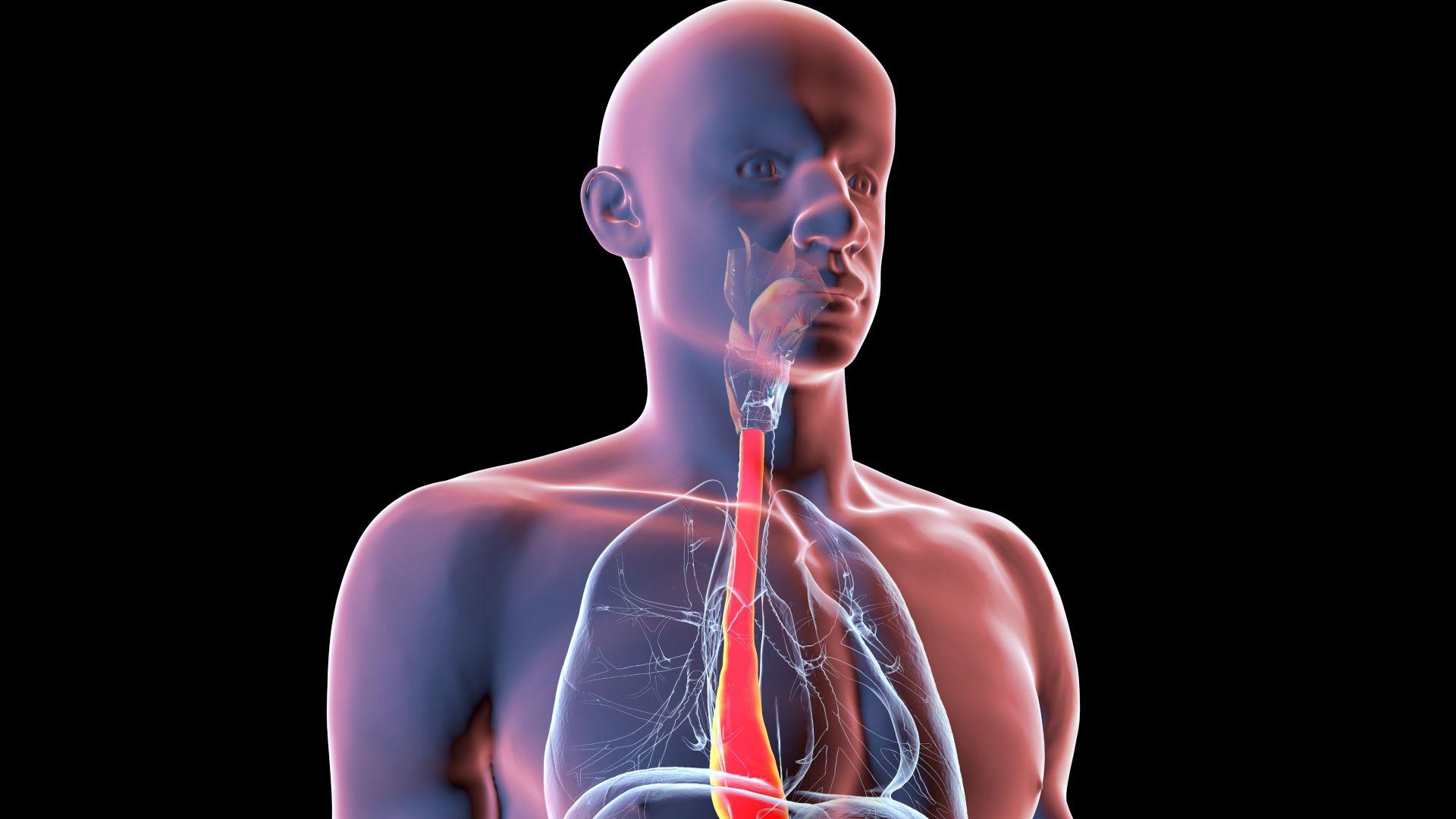
Dr. John Pandolfino jokes that he comes from a generational family of electricians and plumbers, and continues to follow the family business as a gastroenterologist.
That’s because the esophagus, the organ that transports food from the mouth to the stomach, is essentially a pipe with electrical wiring attached to it, he said.
you may like
Tia Ghose: You’re using a digital twin in a condition called achalasia. Could you please explain in detail what this condition is?
John Pandolfino: The main job of the esophagus is to push things that enter the esophagus into the stomach. And when something comes up backwards, the esophagus also has to push it down to prevent it from being aspirated and going into the lungs. In achalasia, the lower esophageal sphincter, which acts as a barrier between the esophagus and the stomach, fails to open. I can’t relax. Achalasia actually means not being able to relax. If that muscle doesn’t relax and open, food will just accumulate in your esophagus and you’ll literally start drowning in your own saliva and food, almost. Therefore, it can be a fatal disease.
What’s interesting is that after we treated the patient, we realized that the patient had developed this diverticulum. [a weakening and ballooning of the wall]we didn’t quite understand why this happened. So we asked a mathematical model, a virtual esophagus, and actually gave it a lot of options. I changed a lot of variables, including what type of surgery I had. How long did it take you to tear the muscle? Did it include a procedure called an anti-reflux procedure, in which a section of the stomach is removed and wrapped around the esophagus to prevent reflux? Does it matter what type of movement disorder they have? There are different subtypes of achalasia. So are some subtypes better than others? We went through this whole process. How deep do you cut the muscle? And we just ran the simulation.
So it took us months to train this and run millions of scenarios to show what happens. And ultimately, the model actually predicted what type of surgery would be best and which patients were at highest risk of developing complications.
So, with that information, we submitted an NIH grant focused on looking at two different types of surgery. Standard approach and surgery modified by virtual esophagus, i.e. virtual esophagus is what we chose. So we’ll test this standard approach, which works very well, against other approaches. And although we believe we have modeled the study to look comparable, we believe that the new study shows less reflux and diverticula.
What to read next
TG: What you’re describing seems like a far cry from what people describe as a standard digital twin. There, all the key chemicals and signal processing involved, all mechanical forces, and all real-time data from wearables and medical images are integrated. How far do you think we are from that type of digital twin?
JP: From a mechanical standpoint, I think it’s already much better.
In terms of learning more about the molecular structure and actin, [muscle filaments] I think that how muscles contract and how calcium flows is really far away. We learned how proteins fold. Developing a mathematical model of a cell will take quite a long time.
But mechanically I think this is possible. And what’s great is that this approach can be taken to all organ systems, including the bladder, aorta, and left ventricle. These processes are completely dependent on the transportation mechanism. This allows us to take advantage of this and apply it throughout these processes. [systems].
TG: So what you think is pretty close right now is primarily pump and tube type systems, primarily for surgical applications. Do you think it has prognostic or diagnostic value?
JP: It certainly has predictive value because it allows us to recognize scenarios where the drug is no longer effective, right? So once someone reaches a deformed wall, that wall goes away. No medicine you give them will make them better.
TG: People are starting to think that digital twins could be used for some of the animal research and clinical trial data.
JP: Yes.
What it does is we eliminate the need to use animals for surgery.
John Pandolfino, Chief of Gastroenterology and Hepatology and Director of Northwestern Medicine Digestive Health Institute
TG: Do you think that’s realistic?
JP: If you are considering surgery, there is no need to do this on the animal. You can run this in a simulation, as we did, to see what the effects are, and from there you can actually look at different changes in humans. That’s exactly what happened here. Our virtual esophagus proved what we thought was probably the right way to do this. So our hypothesis has been mathematically proven, and we are now starting human experiments.
TG: But I think most animal studies are focused on testing new compounds with therapeutic potential, right? So, do you think there’s a lot of potential there?
JP: In this study, mice were given about 50 times the amount that humans would ingest.Will the mice die from that? I don’t think so [digital twin technology will] influence it. What it does is we eliminate the need to use animals for surgery.
Additionally, I think this will get us to an area where we can create much better models for simulation. We will therefore understand much more about the material properties of organs and how they react to stress and tension, and will be able to develop simulations with tactile twins in the virtual world as well as in the real world. This means that it is actually made from a material that almost perfectly mimics the esophagus and internal organs, so it feels the same when you cut it.
TG: Can you also train it and pour some goop into it and see how it expands?
JP: That’s right. But as we all know, there is much we can learn from understanding parts of human anatomy and function. Because the body doesn’t come up with completely different ways to do things. If you repeat it, just make it bigger or smaller, or use slightly different lengths. [Organs like the bladder and heart] All work in much the same way. It comes with a tube that has some shrinkage. There is a sphincter muscle that opens and closes. If you look at the esophagogastric junction, which is a valve in the antireflux barrier, it looks very similar to the anorectal junction, where defecation occurs. And in fact, if you look at the physiology of how we defecate, how we swallow and protect ourselves from regurgitation, they’re literally reversed.
TG: Nature just copies itself.
JP: Yes.
TG: So do you think this could be applied more to the whole body?
JP: Yes, even in the esophagus. That means reflux heartburn affects one-fifth of the country. In fact, reflux is not caused by too much acid. Most people with reflux have normal stomach acid.
It’s more a question of anatomy and physiology. This means that our approach could hopefully modify many of the surgeries being performed for reflux disease, and could even help create effective minimally invasive approaches. So, just in G.I. [gastrointestinal tract] In general, there are many more possible uses in the esophagus. And even for people who may have bladder issues, who may have an overactive bladder, or perhaps an underactive bladder, how do you assess that in relation to bladder flow and emptying? [It’s] The same is true for aortic aneurysms. Aortic aneurysms are basically diverticula. This is a pressure-related change in anatomy, essentially causing a bulge. And when it swells, it swells and loses its function, and blood doesn’t get pumped properly.
This article is for informational purposes only and does not provide medical advice.