



Today’s security teams have no shortage of tools or data. They are overwhelmed by both.
But amid terabytes of alerts, breaches, and misconfigurations, security teams still struggle to understand context.
Q: What exposures, misconfigurations, and vulnerabilities chain together to create viable attack vectors for valuable attacks?
Even the most mature security team has no easy answer to this question.
The problem isn’t the tools. That is, the tools do not communicate with each other.
This is exactly the problem Gartner’s Cybersecurity Mesh Architecture (CSMA) framework was designed to solve, making mesh security operational on the world’s first purpose-built CSMA platform.
This article explains what CSMA is and how mesh CSMA works.
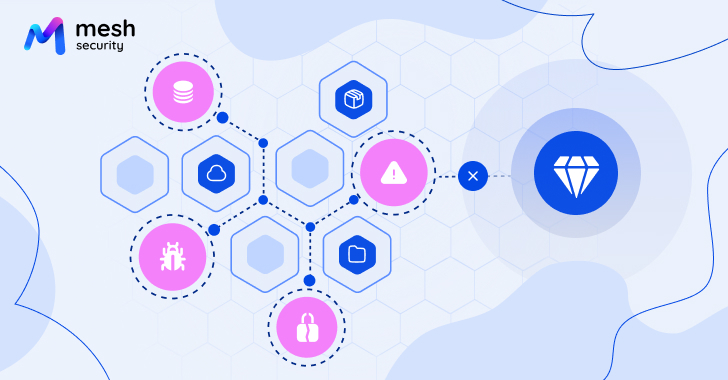
Discover attack paths to your masterpiece Prioritize based on active threats Systematically eliminate attack paths
What is CSMA and why is it important now?
Before we dive into the platform, let’s clarify what CSMA is.
Defined by Gartner, CSMA is a configurable, distributed security layer that connects your existing stack and integrates platform context on top of your best-of-breed tools. CSMA allows you to understand risk holistically, rather than in silos.

Problem: Orphaned tools miss attack stories
We’ve all seen the following findings displayed on separate dashboards:
A developer installed a legitimate-looking AI coding assistant from the VS Code marketplace The extension is flagged as potentially trojanized, but the alert is within one tool and not connected to the other The developer’s workstation has long session timeouts and no device isolation policy is enforced The developer’s credentials have extensive access to a production AWS account That AWS account is a production environment that stores customer PII Unlimited direct access to RDS databases
It looks like each signal can be managed separately, here a marketplace policy flag, here a session timeout misconfiguration. Security teams see them, record them, and de-prioritize them. None of them look like P1 on their own.
But when you put them together, they tell a completely different story. It’s a clear multi-hop attack path from the developer’s workstation directly to the most sensitive customer data. No breach has occurred, but the path is open, viable, and waiting.
Layering threat intelligence makes it even harder to ignore risks. Attackers are actively targeting development environments and supply chain entry points as their preferred foothold into production infrastructure. Did you flag the tool individually? It corresponds almost exactly to their playbook.
 Mesh Live Threat Exposure
This is an exposure of a real threat. It’s not a breach, it’s an exploitable path that currently exists in your environment, but it’s invisible because no single tool can see it all at once.
Mesh CSMA was created to solve just that. By unifying context across the stack, Mesh uncovers these cross-domain attack paths before they can be exploited. Therefore, the team can break the chain before the attacker can traverse it.
How mesh CSMA works
Mesh CSMA transforms fragmented signals into meaningful cross-domain threat stories. So your security team can focus on what’s important.
Here’s how the mesh works:
Step 1: Connect – agentless, no rip-and-replace
Mesh starts by integrating with your existing stack: all your tools, data lakes, and infrastructure. (What does Mesh integrate with? See over 150 integrations here.
 Mesh integration
Step 2: Reference – Mesh Context Graph™
Mesh then automatically discovers the crown jewels, such as production databases, customer data repositories, financial systems, and code signing infrastructure, and anchors the entire risk model around them.
This is the core principle that makes Mesh different. Risk is understood relative to what actually matters to the business, not the loudest alert.
From there, Mesh builds a Mesh Context Graph™. It is a continuously updated identity-centric graph of all the entities in your environment: users, machines, workloads, services, data stores, and the relationships between them.
Unlike an asset inventory that shows you what exists, a Mesh Context Graph™ shows you how everything is connected. Map access paths, trust relationships, entitlement chains, and network exposures into a single unified model. It all goes back to the Crown Jewels.
 mesh context graph
Step 3: Evaluate – Discover viable attack paths
This is where Mesh diverges from traditional exposure management tools.
CTEM platforms and vulnerability scanners uncover CVEs and misconfigurations. But a CVSS 9.8 vulnerability on an isolated internet-facing asset with no path to something sensitive is a completely different risk than a CVSS 5.5 misconfiguration on a service account with direct access to the production database. Mesh understands the difference.
The platform correlates findings across multiple domains, including cloud posture misconfigurations, exceeded identity privileges, detection blind spots, and unpatched vulnerabilities, and tracks them against a context graph to determine which combinations create a viable multihop attack chain to the crown jewel. Then prioritize based on live threat intelligence.
The result is a ranked, actionable list of complete cross-domain attack paths, each of which appears as follows:
Entry Point: How the attacker gains initial access Pivot Chain: Each intermediate hop in the environment Target: Which Crown Jewels are reachable Reasons for Execution: Specific misconfigurations, access paths, or detection gaps that allow it Threat Context: Are known active threat actors currently exploiting this?
 Exposed mesh crown jewel
With Mesh, you can click on each Live Threat Exposure to visualize the attack path and turn orphan signals into meaningful risk remediation roadmaps.
 Visualizing mesh attack paths
Step 4: Elimination – Breaking the Chain
Even if an attack vector is exposed, it’s only half the battle. The mesh closes them.
For each identified attack path, Mesh generates specific prioritized remediation actions that are mapped to existing tools in the stack. Rather than general guidance like “patch this CVE,” Mesh tells you to revoke this specific role binding, apply MFA to this service account, update this CSPM policy, and isolate this workload.
Importantly, Mesh coordinates repair across domains. A single attack path may require modifications to the CSPM tool, changes to the IGA platform, or policy updates for the ZTNA solution. Mesh coordinates these actions without forcing your team to manually switch context between consoles.
Step 5: Defense – Continuous Verification and Detection Gap Coverage
Mesh is more than just posture. It also continually validates the detection layer to identify blind spots where attack techniques are successful but do not generate alerts.
This closes the loop between prevention and detection. Security teams can see not only where attackers can go, but also where they might go undetected if they attack. Detection gaps surface alongside posture gaps within the same integrated risk model, allowing prioritization to reflect true business risk.
Mesh continually re-evaluates your environment as infrastructure changes, new tools are introduced, and threat intelligence updates. Attack path maps are live models, not point-in-time snapshots.
 Mesh automatic investigation timeline
How is this different from SIEM, XDR, or CTEM?
SIEM and XDR detect threats after the signal is generated. These rely on events that have already occurred and require significant tuning to reduce false positives. We do not actively model attack paths.
CTEM platforms prioritize vulnerabilities based on exploitability scores, but most operate within a single domain (cloud, endpoint, identity) and struggle to model how risks from different domains cascade.
Large platform vendors provide context integration, but at the cost of vendor lock-in and forced replacement of proprietary tools.
Mesh takes a different approach. Exactly what Gartner envisioned for CSMA, Mesh unifies context across all existing tools, data lakes, and infrastructure, enabling continuous exposure elimination without removing anything.
Who is Mesh made for?
Mesh CSMA is built for security teams who have already invested in the best tools and are dealing with the impact of fragmented security.
Dozens of dashboards, zero context Disparate security data, generating noise instead of insights Manual correlation, connecting the dots between tools
The platform recently completed a $12 million Series A led by Lobby Capital with participation from Bright Pixel Capital and S1 (SentinelOne) Ventures.
Next step: Learn more about mesh CSMA –
Security tools present isolated risks. The mesh shows attack paths to the Crown Jewel and eliminates them.
Want to see the threat exposure in your environment? Try Mesh for free for 7 days.
Or register for our live webinar: Who will reach your crown jewel? Attack path modeling with mesh CSMA allows the mesh to identify the actual attack path live.
