
Quark-gluon plasma can be formed by proton collisions
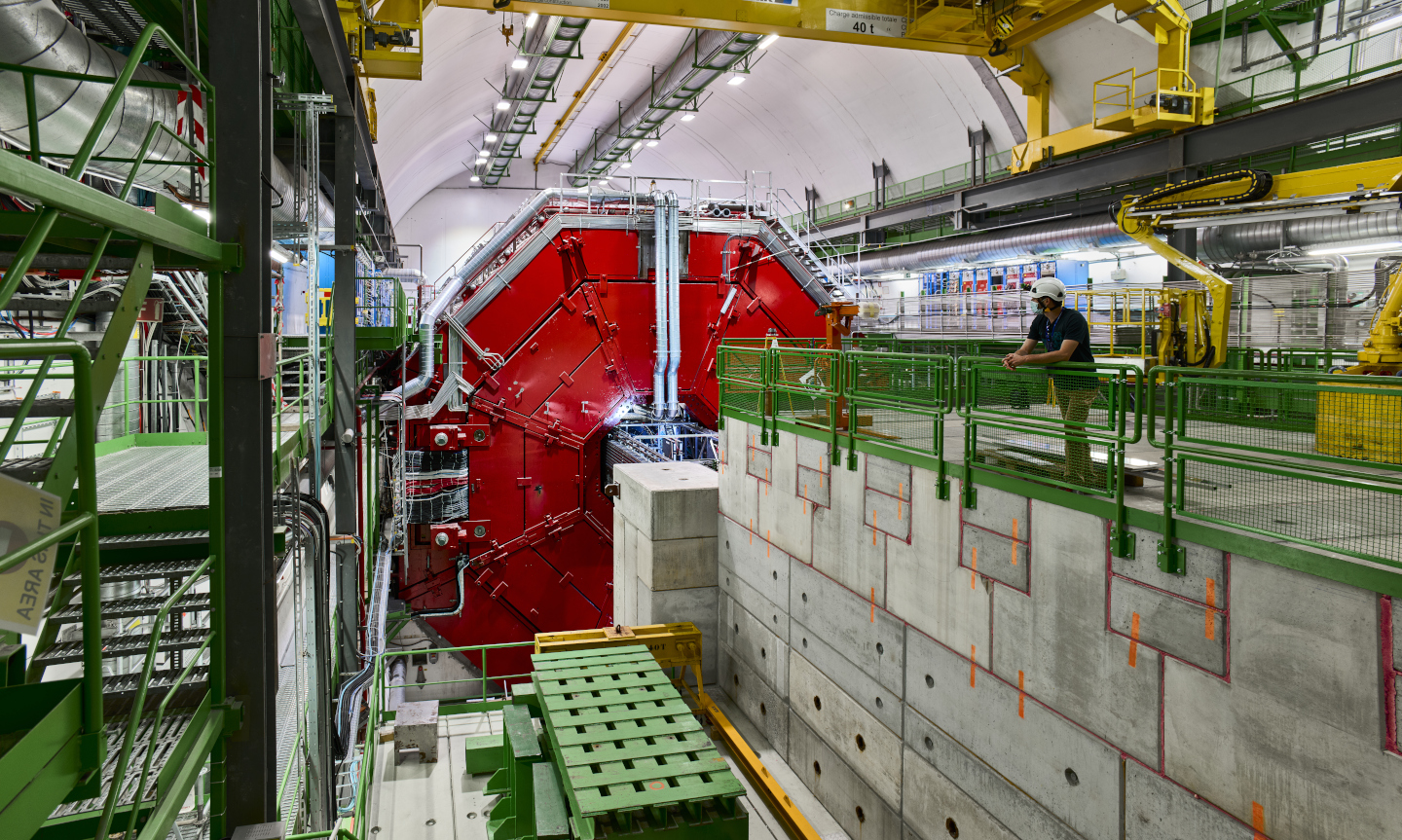
New results from the ALICE collaboration suggest that quark-gluon plasmas may be formed not only in heavy ion experiments but also in proton collisions.
New analysis from the ALICE collaboration is reshaping the way physicists understand the conditions necessary for the creation of quark-gluon plasma (QGP), a state of matter thought to have existed shortly after the Big Bang.
The findings, published in Nature Communications, show that even relatively small particle collisions can exhibit properties long associated only with large-scale heavy-particle experiments.
QGP has been studied for decades by crushing heavy ions, such as lead nuclei, at very high energies. These collisions reproduce the intense heat and density required to free the quarks and gluons normally trapped inside protons and neutrons.
Smaller systems, such as proton-proton collisions, were generally thought to be unable to reach such conditions.
This assumption is now under increasing pressure.
Evidence emerges from proton collisions
The ALICE collaboration analyzed data from proton-proton and proton-lead collisions at the Large Hadron Collider (LHC), focusing on how particles emerge from these events.
An important aspect that can be observed is “anisotropic flow”, a phenomenon in which particles are ejected not uniformly but preferentially in a certain direction.
In heavy ion collisions, this directional pattern is widely interpreted as evidence of collective behavior within the quark-gluon plasma. New research shows that similar patterns emerge in smaller systems if enough particles are produced.
More importantly, the researchers observed a clear separation between two classes of particles: baryons (composed of three quarks) and mesons (composed of two quarks).
In the intermediate momentum range, baryons consistently exhibited stronger anisotropic flow than mesons. This is a distinctive feature previously associated with QGP formation.
Quark-level dynamics provide clues
This difference between particle types is usually explained by a mechanism known as quark coalescence.
In this framework, quarks flowing in a plasma combine to form composite particles. Baryons contain an additional quark compared to mesons and therefore inherit stronger collective motion.
ALICE researchers extended this analysis across multiple particle species and a wide momentum range to isolate signals that reflect true collective behavior rather than background noise.
The consistency of the pattern across different systems strengthens the argument that quark-level interactions are causing the observed effects.
These findings suggest that quarks in smaller colliding systems may temporarily enter a state similar to a quark-gluon plasma before recombining into hadrons.
Model partially confirms the photo
To interpret the data, the collaborators compared the experimental results with theoretical simulations. A model incorporating both anisotropic flow at the quark level and subsequent hadronic mergers was able to reproduce the general trends observed in the data.
In contrast, simulations that excluded either of these processes were inconsistent with observations, reinforcing the idea that both mechanisms are essential to understanding the results.
However, this agreement is not accurate. Inconsistencies remain, particularly in how the models describe the internal structure of the protons and the initial shape of the collisions.
These uncertainties limit the precision with which researchers can interpret findings and point out areas where theoretical research is still needed.

Bridging the gap between small and large systems
The implications of this study extend beyond a single set of measurements. If quark-gluon plasmas can form in smaller systems, the traditional boundaries between small-scale and large-scale collision physics are challenged, and new questions arise about how QGPs emerge and evolve.
Future data may help clarify the situation. Experiments involving oxygen ion collisions recorded in 2025 are expected to provide an intermediate system between proton and lead collisions.
These results may help determine whether the observed behavior scales smoothly with system size or reflects different physical conditions.
Source link

