


NASA has announced a “nearly impossible” plan to ramp up its moon-landing efforts and launch a nuclear-powered spacecraft by 2028.
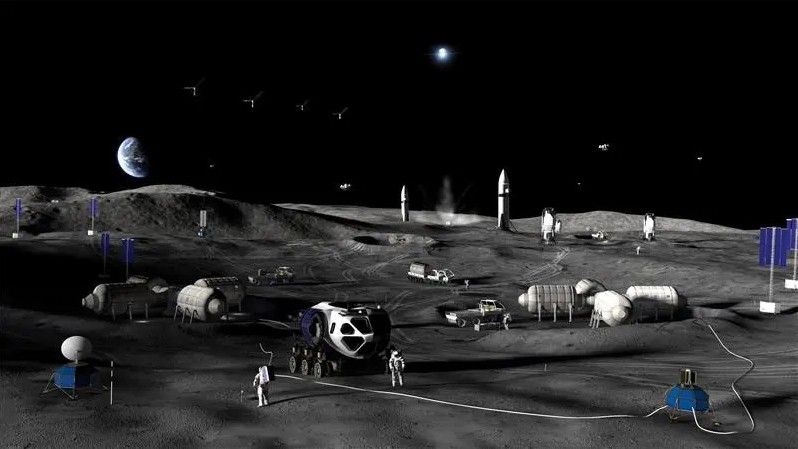
The change is yet another shake-up of the Artemis program that will see NASA pause development of the Lunar Gateway, humanity’s first lunar space station, and instead use its parts for a newly announced $20 billion lunar base.
“NASA is committed to achieving the near-impossible again: return to the Moon before the end of President Trump’s term, build a lunar base, establish a permanent presence, and do anything else necessary to ensure America’s leadership in space,” NASA Administrator Jared Isaacman said in a statement.
Article continues below
you may like
Isaacman outlined plans for a moon base on Tuesday, March 24, during a daylong press conference called “Ignition.” At the same event, Isaacman also announced plans to develop Space Reactor 1 Freedom, the world’s first nuclear-powered interplanetary spacecraft, which NASA claims will be launched to Mars as early as 2028.
This announcement means that NASA is now targeting two manned moon landing missions and the launch of its first-ever spacecraft in 2028 alone.
That’s an ambitious schedule, especially given the delays the space agency’s moon program has experienced in the past. For example, in 2019, NASA was aiming for Artemis III to land on the moon in 2024, but now the year is 2026, and NASA has not yet launched Artemis II, the first manned mission to the moon, but it could be as early as next Wednesday (April 1).
Why is NASA in such a hurry?
In his opening remarks, Isaacman cited the delays and soaring costs that have plagued the Artemis program in recent years, saying billions of dollars and years of losses have been wasted. He also reiterated that NASA wants to return humans to the moon by the end of President Donald Trump’s term, and that the agency faces competition from “true geopolitical rivals who challenge American leadership in the heights of space.”
It’s no secret that China is threatening to overtake the United States as the leader in space exploration, and the United States doesn’t want to fall behind. China plans to land its own astronauts on the moon by 2030, and both countries are eyeing the same lunar south pole landing site.
“The difference between success and failure will be measured in months, not years,” Isaacman said. “They may be early, but recent history suggests we may be late.”
watch on
Isaacman said NASA plans to strengthen its efforts on the moon by standardizing rocket structures, bringing NASA expertise to the industry and increasing the frequency of launches that support activities on the moon.
What to read next
The Ignition event comes one month after NASA announced a sweeping overhaul of Artemis’ return to the Moon. This includes changes to Artemis III, which will be refurbished in 2027 to test docking with the Orion crew capsule and lunar module in Earth orbit. Artemis IV and Artemis V aim to land astronauts on the moon in 2028, with Artemis V currently scheduled as the second human landing attempt and thought to lay the foundation for NASA’s permanent lunar base.
NASA has always wanted to establish a permanent presence on the moon’s surface with the Artemis mission, and details revealed in the Ignition event provided some clues as to how that might happen. The base will be established in three phases: the first phase will involve experimentation with design and functionality, the second phase will configure the initial semi-habitable infrastructure, and finally the construction of a permanent lunar base.
The Ignition event also included plans for Artemis V and beyond, with NASA saying it will aim for “frequent and affordable crewed missions to the lunar surface” every six months by incorporating more reusable hardware in commercial procurement.
A casualty of increased lunar activity is NASA’s long-planned Gateway, a small space station that will orbit the moon and host a rotating crew of international astronauts. It was once described by NASA as “Artemis, the centerpiece of the NASA-led moon return mission” and was scheduled to launch in 2027, but it will now remain on ice for the foreseeable future. Gateway’s future has been in doubt for some time, even though NASA has made significant progress in building the space station with support from partner space agencies in Europe, Canada, Japan, and the United Arab Emirates.
The moon is intended to serve as a stepping stone to Mars and deeper space exploration. NASA’s newly announced Space Reactor-1 Freedom could also help the agency ramp up its efforts on Mars. According to NASA, Space Reactor 1 Freedom will drop a small helicopter Skyfall payload to explore the Martian surface. It is unclear how much progress has already been made on nuclear-powered spacecraft and Mars helicopter squadrons.