


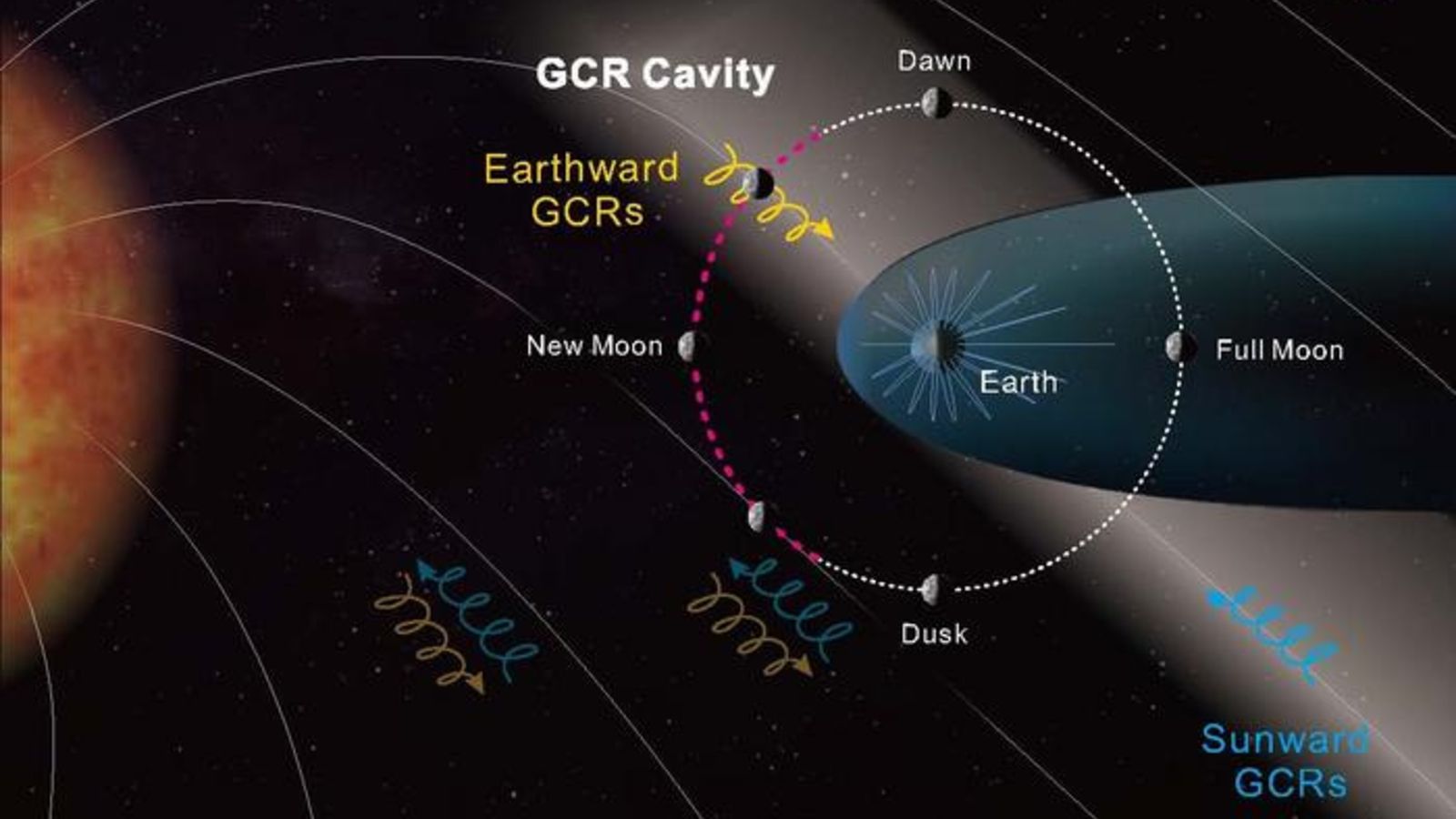
Could becoming a ‘morning person’ on the moon improve your health? Scientists have identified what they believe to be a ‘cavity’ near Earth’s moon with reduced cosmic radiation. The discovery could help reduce astronauts’ exposure to harmful radiation on future lunar missions by timing some ground activities to local morning hours.
The discovery, based on data from China’s Chang’e 4 lunar lander, suggests that Earth’s magnetic field may influence distances further into space than scientists previously expected. The discovery challenges the long-held assumption that galactic cosmic rays are nearly uniform throughout the space between Earth and the Moon, outside of Earth’s protective magnetic field, the researchers said.
Article continues below
you may like
Cosmic rays are one of the biggest radiation hazards for astronauts flying beyond low Earth orbit. These high-energy particles can penetrate spacecraft and human tissue, damaging DNA and increasing the risk of cancer. With more manned trips to the moon planned, starting with the April 1 launch of NASA’s Artemis II mission, researchers said a more accurate map of radiation intensity could help mission planners reduce radiation exposure for astronauts during surface exploration.
“The next landing will probably be in the polar regions,” Robert Wimmer Schweinruber, a professor at the Institute for Experimental and Applied Physics at the University of Kiel in Germany and corresponding author of the study, told Live Science in an email. He said lunar mornings appear to be the best time for excursions because the amount of radiation on astronauts’ skin is about 20 percent lower than the average radiation dose on the moon.
Cosmic ray calculations
I didn’t expect to see this “shadow” or cavity, but
Robert Wimmer Schweingruber, Professor at the Institute of Experimental and Applied Physics, Kiel University
To find this cosmic ray cavity, the researchers analyzed data collected over 31 lunar cycles from January 2019 to January 2022, focusing on quiet periods in the solar cycle when the measured cosmic radiation was primarily from galactic cosmic rays. They looked at repeated changes in the number of protons measured from Chang’e 4’s beam as the moon passed through different parts of its orbit around Earth.
The Lunar Lander’s neutron dosimeter recorded galactic cosmic-ray protons in two energy ranges, which the researchers grouped by lunar local time. The researchers found that low-energy protons, ranging from 9.18 to 34.14 megaelectron volts, were reduced by about 20% on local mornings on the Moon during the Gibbian period (the period between new moon and full moon) when the moon is waxing compared to later times.
Because this decrease appeared during certain recurring parts of the moon’s phases, rather than over the entire period, the researchers reasoned that the moon was passing through an actual region of reduced cosmic-ray radiation, which they attributed to Earth’s magnetic field blocking some high-energy protons. To investigate this idea, they ran a simulation of the movement of protons through the moon’s orbit and found the same cavity.
“I didn’t expect to see this ‘shadow’ or cavity,” Wimar Schweingruber said. “Looking back, it’s understandable, but when I first saw this result I was very skeptical,” and that’s why the team did so many tests, he added.
The expanding influence of the earth’s magnetism
The discovery provides a new picture of how cosmic radiation interacts between Earth and the moon. Scientists generally believed that once galactic cosmic rays passed through Earth’s magnetosphere, they were spread fairly evenly across Earth-Moon space, and the influence of Earth’s magnetic field was minimal.
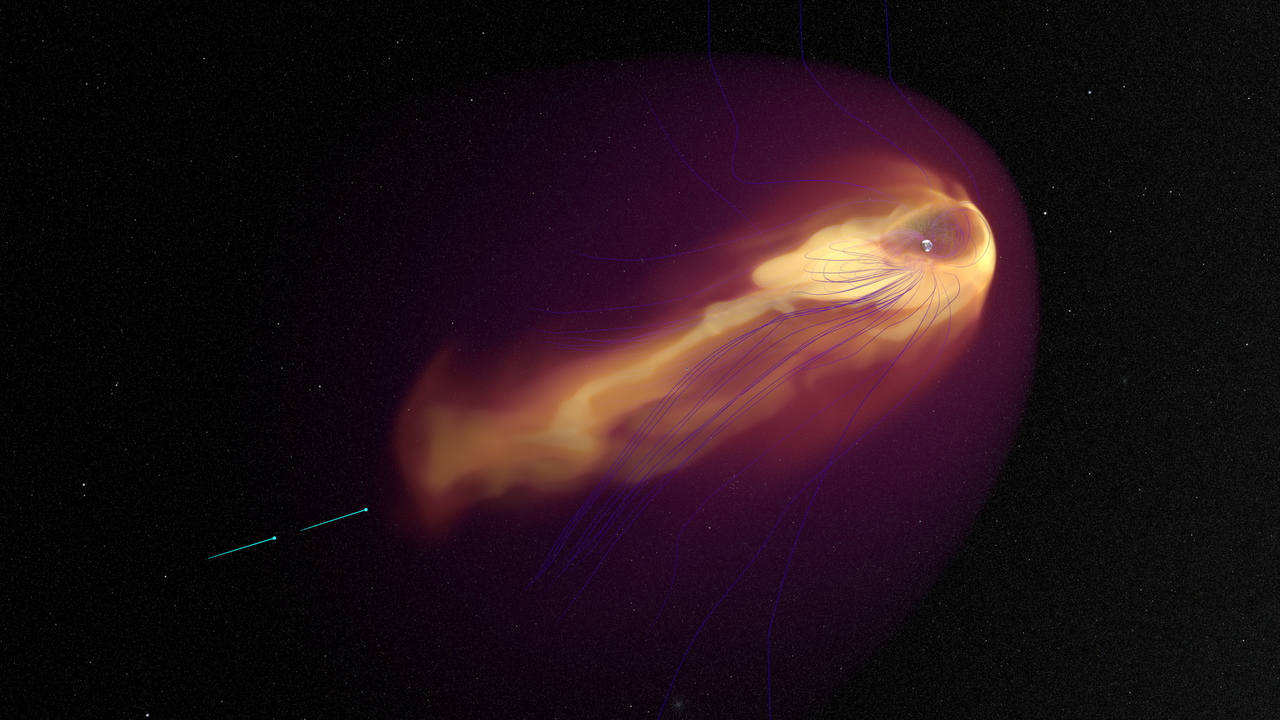
“Essentially, this result means that Earth’s magnetosphere is influencing the universe beyond its extent,” Wimmer-Schweingruber said. The researchers expected the Earth to affect the moon with its magnetotail, a long stream of magnetic fields that extends away from the sun on the night side of the Earth, but they did not expect a similar effect to occur prior to the magnetosphere on the sun’s side, he noted.
Wimmer Schweinrüber said future studies with larger datasets could better define the size and behavior of this cavity, which could help pave the way to an era of more practical lunar exploration. He suggested that a well-known rule of thumb could be applied to safer lunar missions. “It’s best for astronauts to fly to the lunar surface during local morning hours,” Wimmer Schweinruber said. “Just like humans on Earth!”
Shang, W., Liu, J., Xu, Z., Yue, C., Guo, R., Xiao, C., Shi, Q., Wimmer-Schweingruber, R., Guo, J., William, DA, Rankin, R., Tian, A., Zong, Q., Han, C., Park, J., Wang, H., Liu, W., Fu, S., Zhai, L.M.,. . Chen, T. (2026). Galactic cosmic ray cavity in space between the Earth and the Moon. Science progresses. 12(1), eadv1908. www.science.org/doi/10.1126/sciadv.adv1908