Close Menu
  • Home
  • Identity
  • Inventions
  • Future
  • Science
  • Startups
  • Spanish
What's Hot

These iPad apps will make you wish you had more free time

Iran-linked hacker compromises FBI director’s personal email and attacks Stryker with wiper attack

Anthropic’s Claude is soaring in popularity among paying consumers

Facebook X (Twitter) Instagram
  • Home
  • About Us
  • Advertise with Us
  • Contact Us
  • DMCA
  • Privacy Policy
  • Terms & Conditions
  • User-Submitted Posts
Facebook X (Twitter) Instagram
Fyself News
  • Home
  • Identity
  • Inventions
  • Future
  • Science
  • Startups
  • Spanish
Fyself News
Home » This week’s science news: NASA unveils nuclear rocket, reproduction in space proves difficult, why weed gives people munchies
Science

This week’s science news: NASA unveils nuclear rocket, reproduction in space proves difficult, why weed gives people munchies

By March 28, 2026No Comments7 Mins Read
Share Facebook Twitter Pinterest Telegram LinkedIn Tumblr Email Copy Link
Follow Us
Google News Flipboard
Share
Facebook Twitter LinkedIn Pinterest Email Copy Link

This week’s science news was packed with interesting new facts about how the human body works, including the discovery that weightlessness means zero game for humans trying to reproduce in space.

A new study shows that sperm migration, fertilization, and embryo development are significantly disrupted in simulated microgravity. This discovery could pose serious problems for future space colonization.

But as a Live Science interview with evolutionary anthropologist Herman Pontzer makes clear, that doesn’t mean we should bet on human adaptability. In fact, adapting quickly to new situations is one of our species’ strengths. Let’s take human nails as an example. Fingernails may have evolved tens of millions of years before touch screens, but that didn’t stop chemistry students from developing a clear polish to turn fingernails into styluses.

There were plenty of other weird and wonderful biological revelations this week, including the discovery that a virus in the gut may play a role in preventing blood sugar spikes. Researchers also found that the eyes of people with synesthesia physically react to the colors they see as if they were real.

NASA announces nuclear rocket

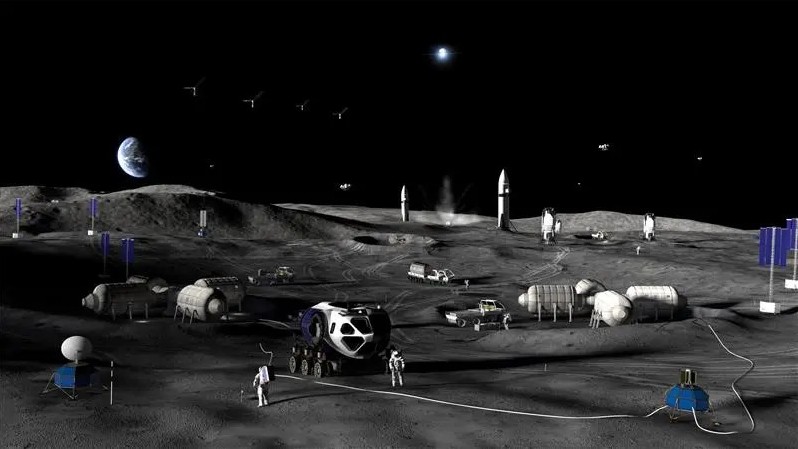
NASA hopes to accelerate lunar missions and establish a permanent lunar base.

The Artemis program will accelerate development of a $20 billion lunar base and nuclear-powered Freedom spacecraft. (Image credit: NASA)

This week, NASA announced some ambitious plans for a return to the moon. The space agency’s head, Jared Isaacman, announced that he would cancel plans for a space station in lunar orbit and use its components for a $20 billion permanent base on the moon, while also sending a nuclear-powered spacecraft to Mars.

Plans for a new moon base, which would use drones and a fleet of robotic landers to build a nuclear power plant on the moon by 2036, may be motivated in part by a desire to stay ahead of China in a new space race.

Whether the plan is realistic or just madness is likely to come into sharper focus next week, as the space agency’s Artemis II moon rocket makes its final efforts to launch by the April 30 deadline.

Get the world’s most fascinating discoveries delivered straight to your inbox.

More space news

— Chinese lander reveals giant radiation ‘cavity’ between Earth and moon — It could change the way lunar exploration is done

-Anomalies in Mars’ mantle could trigger volcanic eruptions, which could accelerate the entire Earth’s rotation.

—Cannonball-sized meteorite crashes through roof of Texas home as multiple ‘fireballs’ rain down on US

life’s little mysteries

A man with long wavy black hair wearing an orange shirt lights a joint with a lighter

Weeds can make people greedy. why? (Image credit: Alberto Case, Getty Images)

A common side effect of smoking cannabis is feeling incredibly voracious. So what explains this effect? ​​Live Science’s Kenna Hughes-Castleberry investigated why cannabis gives people a “munch.”

—If you enjoyed this, sign up for the Life’s Little Mysteries newsletter

Iran war is a climate catastrophe

Smoke rises from a building in Tehran, Iran, after an airstrike.

The US and Israel attacked more than 6,000 targets in Iran in the first two weeks of the war, releasing massive amounts of carbon. This photo was taken on March 13, after the Tehran airstrike. (Image credit: Fatemeh Bahrami/Anadolu via Getty Images)

As the Iran war enters its fifth week with little sign of a ceasefire, we report a surprising discovery. An alarming amount of carbon dioxide had already been released in the first two weeks of the war, with the largest source coming from the destruction of buildings that had to be demolished and rebuilt.

The war has depleted the world’s carbon dioxide emissions faster than the 84 least carbon-emitting countries combined. The aftershocks of the war are expected to have an even bigger impact on the climate than the fighting itself, as countries seek to cushion the fuel and fertilizer shock caused by Iran’s blockade of the Strait of Hormuz.

More Earth news

– Scientists race to save Australia’s ‘zombie trees’ from rapidly spreading fungal disease

– As climate change worsens, new research suggests drought could fuel the rise of antibiotic-resistant superbugs.

– Antarctica could warm 1.4 times faster than the rest of the Southern Hemisphere in the coming decades, study finds

Also featured in this week’s science news

—A mouse study suggests that brain aging is caused by a loss of control over how genes are regulated.

– Roman mosaic depicts a topless woman fighting a leopard in a stadium, study finds

-1,000-year-old altar and human sacrifice of the Toltec Empire discovered in Mexico

—AI compresses billions of years of evolution into seconds, creating a “Lego-like robot” that can recover after losing a limb

――What are the new developments in things? Bizarre ‘half-Möbius’ molecule has unusual properties chemists have never seen before

science reading material

Illustration of a circular DNA helix against a painted background

Over the past few decades, there have been significant advances in our ability to sequence DNA that has been released into the environment. Now, the challenge is to understand what that means. (Image credit: Collage by Marilyn Perkins, images from Qweek and I Like That One via Getty Images)

Genetic material is everywhere around us, in soil, water, and air, leaving invisible traces throughout ecosystems. By tracking this, scientists could potentially detect species, map food webs, and chart biodiversity without tracking a single organism.

But analyzing the components of this ambient DNA soup is a daunting task. In this long piece, Live Science explored scientific advances that could soon enable real-time monitoring of Earth’s biosphere.

something for the weekend

If you’re looking for something a little longer to read over the weekend, here are some of the best analysis, crossword and opinion pieces published this week.

— Is the Metaverse finally dead and buried? What’s really going on with the challenge of living in a virtual world? [Analysis]

— Live Science Crossword Puzzle #36: America’s National Bird — Horizontal 11 [Crossword]

-Our fossil fuel economy is a castle in the sand, and President Trump’s Iran war is about to destroy it. The need to transition to clean energy has never been clearer. [Opinion]

Science news in pictures

Beautiful light blue plumes swirling in the ocean off the coast of Key West

A beautiful pale blue plume of sediment appeared glowing off the southwest coast of Florida after cold Arctic winds were pushed into the eastern United States by the polar vortex. (Image credit: NASA/Terra/Landsat)

This photo taken by NASA’s Terra satellite in February shows a bright plume of swirling ocean mud that was kicked up off the coast of Florida after the arctic explosion that brought severe winter weather to much of the United States earlier this year.
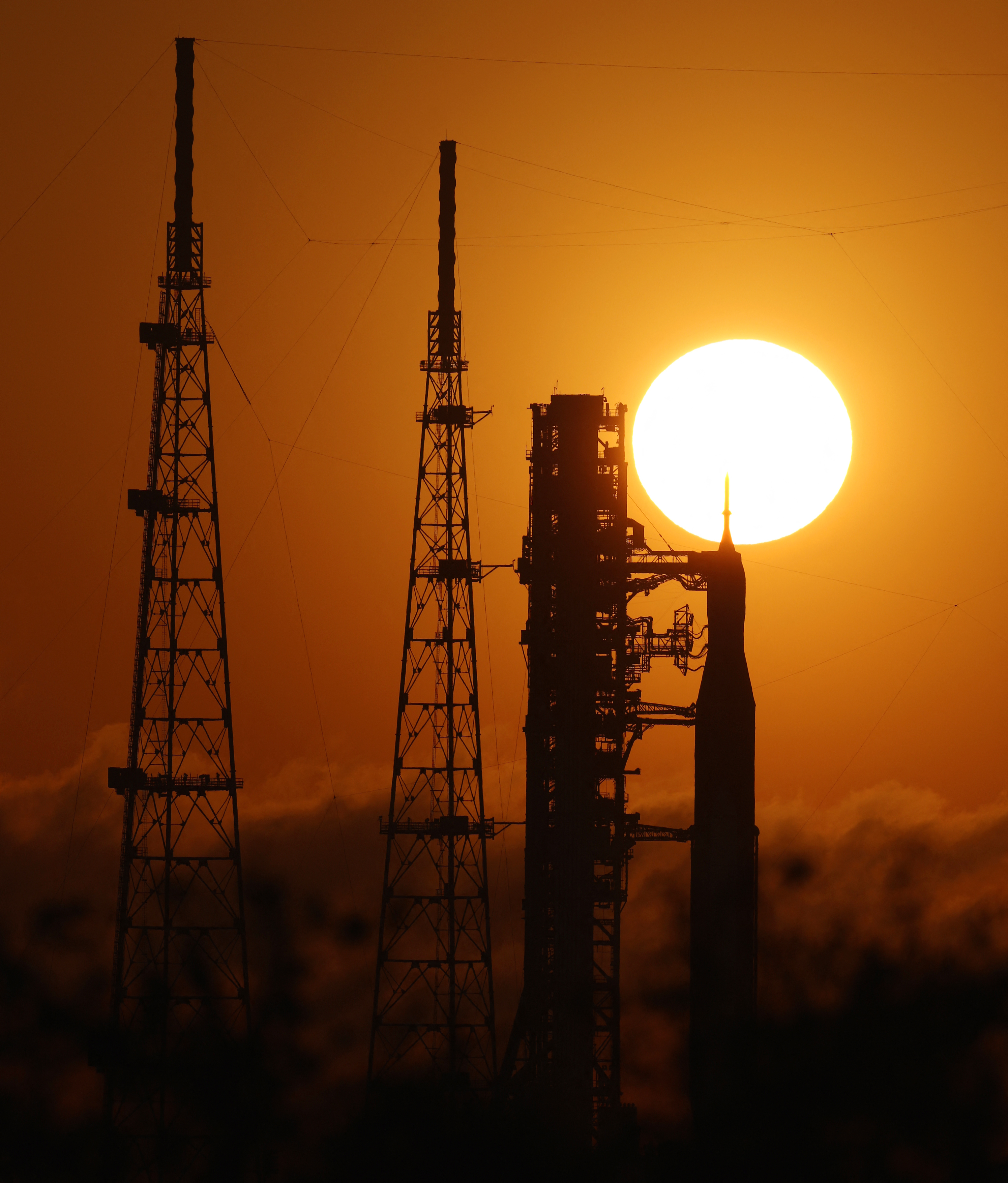
A rocket stands in silhouette in front of the setting sun.

NASA’s Artemis II Space Launch System (SLS) rocket and Orion spacecraft are seen at sunrise on Launch Pad 39B at Kennedy Space Center in Cape Canaveral, Florida, March 24, 2026. (Image credit: Gregg Newton/AFP, Getty Images)

NASA’s Artemis II rocket is poised on Launch Pad 39B at NASA Kennedy Space Center in Florida. The 322-foot-tall (98-meter) Space Launch System and Orion crew capsule stack is ready to launch the mission’s four-person astronaut crew for a 10-day flight around the moon and back as early as April 1.

science is in motion
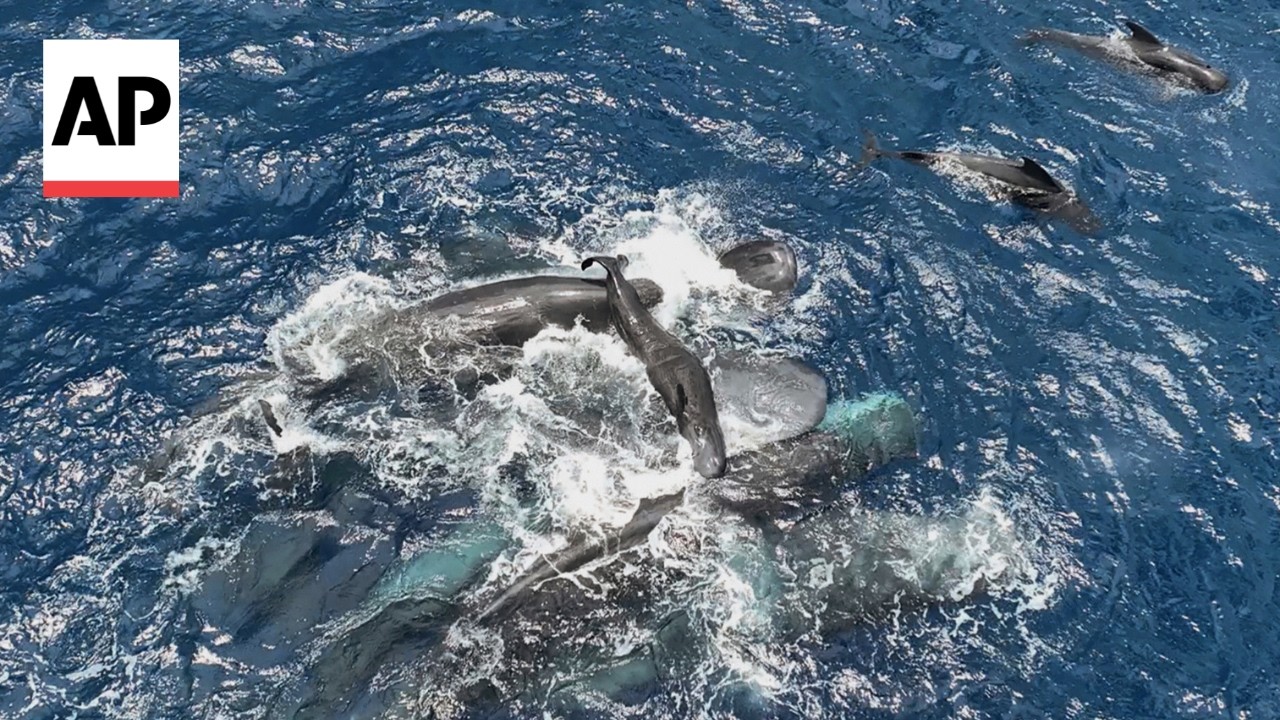
Rare video shows female sperm whale cooperating during childbirth – YouTube
Rare video shows female sperm whale cooperating during childbirth - YouTube

watch on

Researchers filmed a sperm whale giving birth while being assisted by 10 other females in its social unit. This is the first time this type of phenomenon has been confirmed in an animal other than primates.

The birth, filmed by an airborne drone in July 2023, took place over an hour, during which the female surrounded the mother and newborn in a protective circle and took turns lifting the calf to the surface, giving the fluke time to unfold and acquire its own natural buoyancy control.

Sperm whale social groups are matrilineal, with lifelong bonds formed between mothers, daughters, grandmothers, and unrelated females. Males, on the other hand, primarily roam the oceans alone, creating nature’s most extreme geographic separation between the sexes.

Follow Live Science on social media

Want more science news? Follow our Live Science WhatsApp channel to keep up with the latest discoveries. It’s the best way to get expert reports on the go, but even if you don’t use WhatsApp, you can use Facebook, X (formerly Twitter), Flipboard, Instagram, TikTok, Bluesky, and LinkedIn.


Source link

#Biotechnology #ClimateScience #Health #Science #ScientificAdvances #ScientificResearch
Follow on Google News Follow on Flipboard
Share. Facebook Twitter Pinterest LinkedIn Tumblr Email Copy Link
Previous ArticleCitrix NetScaler memory overread bug under active investigation for CVE-2026-3055 (CVSS 9.3)
Next Article Let’s take a look at the retro technology that’s making a comeback

Related Posts

Mysterious medical episode that left astronaut unable to speak points to one of NASA’s biggest risks as moon mission gets into full swing

March 27, 2026

Our fossil fuel economy is a house in the sand, and President Trump’s Iran war is about to bring it down. The need to transition to clean energy has never been clearer. |Michael Mann

March 27, 2026

Stargazing equipment needed for April 2026

March 27, 2026
Add A Comment
Leave A Reply Cancel Reply

Latest Posts

These iPad apps will make you wish you had more free time

Iran-linked hacker compromises FBI director’s personal email and attacks Stryker with wiper attack

Anthropic’s Claude is soaring in popularity among paying consumers

Let’s take a look at the retro technology that’s making a comeback

Trending Posts

Subscribe to News

Subscribe to our newsletter and never miss our latest news

Please enable JavaScript in your browser to complete this form.
Loading

Welcome to Fyself News, your go-to platform for the latest in tech, startups, inventions, sustainability, and fintech! We are a passionate team of enthusiasts committed to bringing you timely, insightful, and accurate information on the most pressing developments across these industries. Whether you’re an entrepreneur, investor, or just someone curious about the future of technology and innovation, Fyself News has something for you.

Castilla-La Mancha Ignites Innovation: fiveclmsummit Redefines Tech Future

Local Power, Health Innovation: Alcolea de Calatrava Boosts FiveCLM PoC with Community Engagement

The Future of Digital Twins in Healthcare: From Virtual Replicas to Personalized Medical Models

Human Digital Twins: The Next Tech Frontier Set to Transform Healthcare and Beyond

Facebook X (Twitter) Instagram Pinterest YouTube
  • Home
  • About Us
  • Advertise with Us
  • Contact Us
  • DMCA
  • Privacy Policy
  • Terms & Conditions
  • User-Submitted Posts
© 2026 news.fyself. Designed by by fyself.

Type above and press Enter to search. Press Esc to cancel.