
Close Menu
  • Home
  • Identity
  • Inventions
  • Future
  • Science
  • Startups
  • Spanish
What's Hot

Google attributes Axios npm supply chain attack to North Korean group UNC1069

PFAS crisis in Flanders (Belgium): butterfly effect

European Chip Law Design Enablement Team

Facebook X (Twitter) Instagram
  • Home
  • About Us
  • Advertise with Us
  • Contact Us
  • DMCA
  • Privacy Policy
  • Terms & Conditions
  • User-Submitted Posts
Facebook X (Twitter) Instagram
Fyself News
  • Home
  • Identity
  • Inventions
  • Future
  • Science
  • Startups
  • Spanish
Fyself News
Home » James Webb and Hubble telescopes reveal Saturn’s chaotic atmosphere in the most comprehensive view yet
Science

James Webb and Hubble telescopes reveal Saturn’s chaotic atmosphere in the most comprehensive view yet

By March 29, 2026No Comments3 Mins Read
Share Facebook Twitter Pinterest Telegram LinkedIn Tumblr Email Copy Link
Follow Us
Google News Flipboard
Share
Facebook Twitter LinkedIn Pinterest Email Copy Link

Saturn may be famous for its rings, but it has long fascinated scientists for other reasons. It’s a restless atmosphere formed by fierce winds, stubborn megastorms, and strange weather patterns that can last for years.

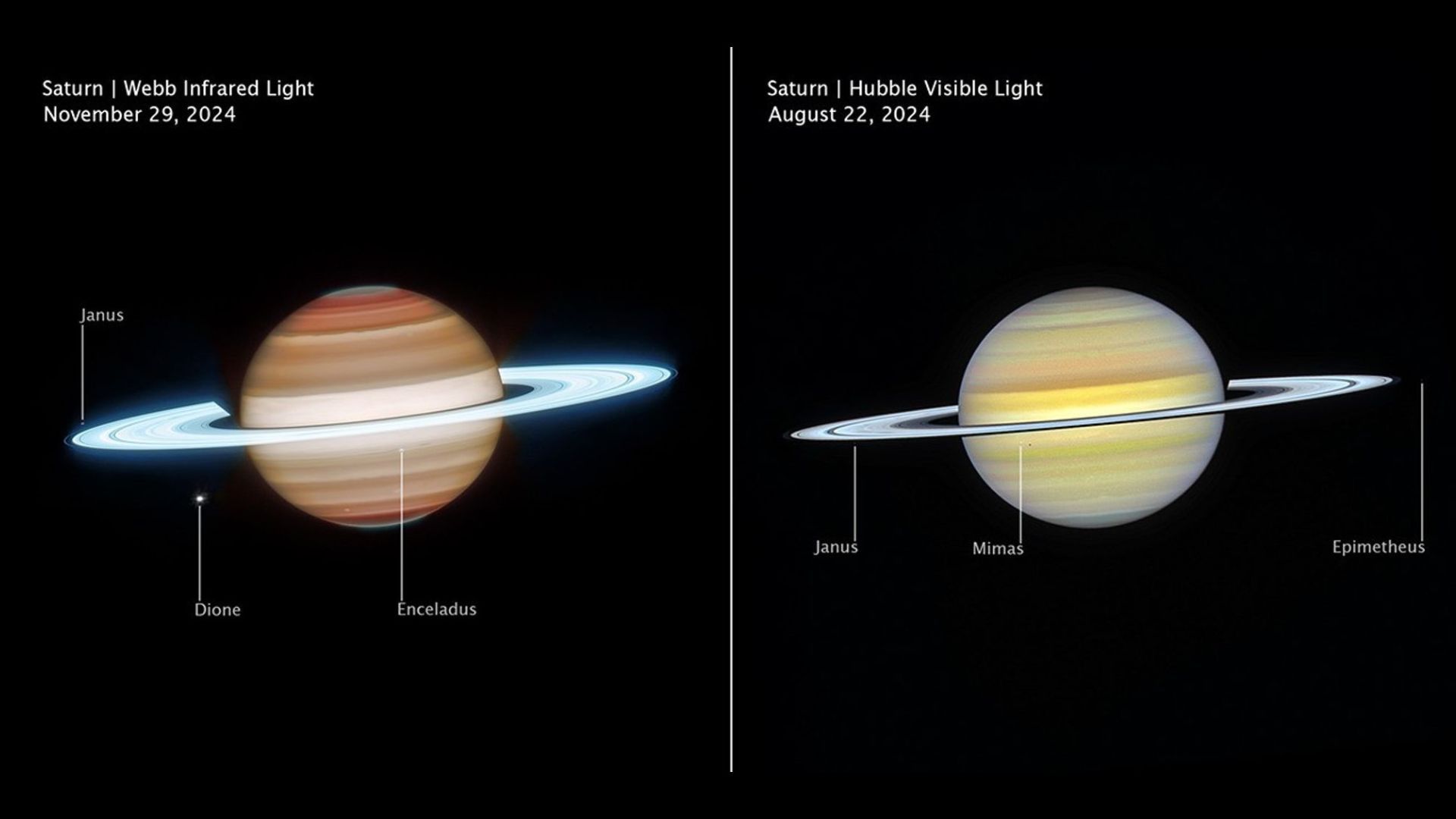
Now, two new views from the James Webb Space Telescope and the Hubble Space Telescope are cutting through the ringed planet’s clouds, giving researchers what NASA calls “the most comprehensive view of Saturn to date.” By combining these images, researchers can “slice” Saturn’s atmosphere at different heights.

This pair of observations captures one of Saturn’s strangest landmarks: the famous hexagon at its north pole. Both images show the faint edge of a six-sided jet stream, according to NASA. These photos may be some of the last high-resolution views of the hexagon until the 2040s, when Saturn’s north pole is about to tip into 15 years of winter darkness.

Article continues below

you may like

Studying Saturn’s atmosphere not only allows scientists to understand how planet-sized storms grow and thrive, but also provides further insight into how the planet formed and evolved over billions of years.

Planet seen from two directions

In August 2024, Hubble took visible-light images of Saturn as part of the Outer Planet Atmosphere Legacy Program, a 10-year project to track outer planets annually. The James Webb Space Telescope (JWST) took its infrared image several months later, in November 2024. These observations, taken 14 weeks apart, showed the ringed planet moving north from summer toward the spring equinox in 2025.

The two telescopes showed a completely different view of Saturn.

Hubble captured Saturn’s pale yellow bands and sparkling white rings, but JWST’s infrared images revealed even more surprising details. Saturn’s rings appear blue in infrared light “because they are made of highly reflective water ice,” NASA representatives said in a statement. Saturn’s poles also glowed a strange gray-green color, emitting light at a wavelength of about 4.3 microns. These emissions could be due to scattering of light from high-altitude aerosols or auroras, NASA suggested. (The telescope recently captured a giant aurora shining over Uranus.)

Get the world’s most fascinating discoveries delivered straight to your inbox.

As Saturn tilts into its southern spring, both space telescopes will continue to monitor Saturn’s atmosphere, possibly revealing more about Saturn’s weather dynamics. Until then, Saturn is hiding some of its most interesting secrets in the clouds.

Solar System Quiz: How much do you know about our cosmic neighborhood?

Take our quiz to find out how much you know about the planets of our solar system!


Source link

#Biotechnology #ClimateScience #Health #Science #ScientificAdvances #ScientificResearch
Follow on Google News Follow on Flipboard
Share. Facebook Twitter Pinterest LinkedIn Tumblr Email Copy Link
Previous ArticleAI systems are enabling mass surveillance in the US, but there are no national laws that “meaningfully limit” the use of this data.
Next Article Sora shutdown could be a reality check moment for AI video

Related Posts

Quantum computers need just 10,000 qubits to crack the most secure codes, scientists warn

March 31, 2026

Artemis II timeline: 12 key steps that will take NASA astronauts to the moon and back

March 31, 2026

Artemis II launch live: NASA prepares for historic space mission launch on Wednesday

March 31, 2026
Add A Comment
Leave A Reply Cancel Reply

Latest Posts

Google attributes Axios npm supply chain attack to North Korean group UNC1069

PFAS crisis in Flanders (Belgium): butterfly effect

European Chip Law Design Enablement Team

Fermilab’s electron beam technology tackles PFAS contamination

Trending Posts

Subscribe to News

Subscribe to our newsletter and never miss our latest news

Please enable JavaScript in your browser to complete this form.
Loading

Welcome to Fyself News, your go-to platform for the latest in tech, startups, inventions, sustainability, and fintech! We are a passionate team of enthusiasts committed to bringing you timely, insightful, and accurate information on the most pressing developments across these industries. Whether you’re an entrepreneur, investor, or just someone curious about the future of technology and innovation, Fyself News has something for you.

Castilla-La Mancha Ignites Innovation: fiveclmsummit Redefines Tech Future

Local Power, Health Innovation: Alcolea de Calatrava Boosts FiveCLM PoC with Community Engagement

The Future of Digital Twins in Healthcare: From Virtual Replicas to Personalized Medical Models

Human Digital Twins: The Next Tech Frontier Set to Transform Healthcare and Beyond

Facebook X (Twitter) Instagram Pinterest YouTube
  • Home
  • About Us
  • Advertise with Us
  • Contact Us
  • DMCA
  • Privacy Policy
  • Terms & Conditions
  • User-Submitted Posts
© 2026 news.fyself. Designed by by fyself.

Type above and press Enter to search. Press Esc to cancel.