


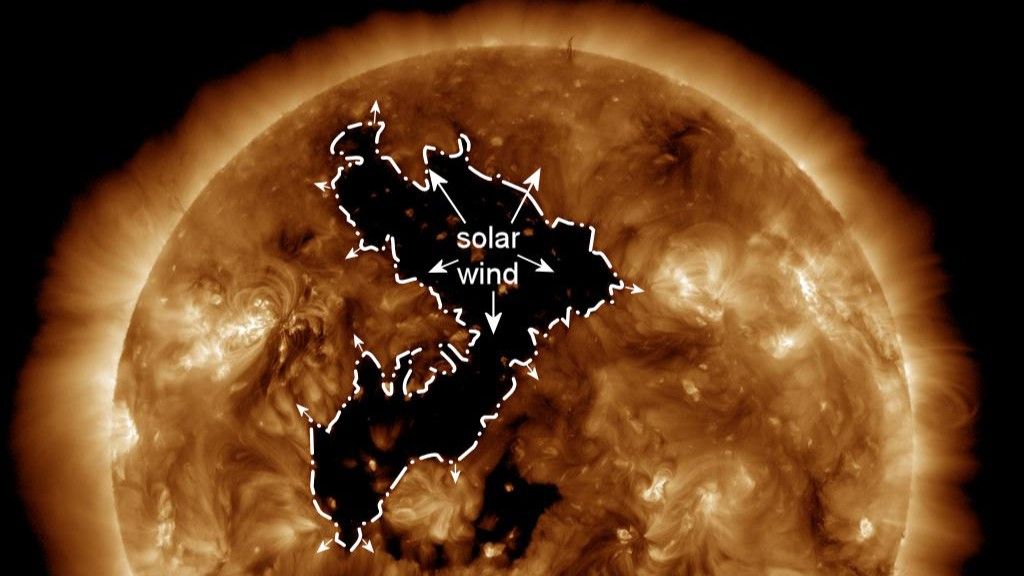
Skywatchers are in for a treat as the Northern Lights are predicted to grace the skies of several northern US states this week. It’s all thanks to a giant hole in the sun’s atmosphere.
The aurora borealis could be visible as far south as Idaho and New York state Friday night (April 17) and early Saturday morning (April 18), the National Oceanic and Atmospheric Administration’s (NOAA) Space Weather Prediction Center shared in a Facebook post.
you may like
Most of the particles are reflected by the geomagnetic shield that surrounds the Earth. However, some are swallowed up by Earth’s magnetic field before descending toward the north and south poles.
Once there, the particles collide with atoms and molecules in the atmosphere, heating them up and causing them to fluoresce, producing colorful displays of light known as auroras.
This week, a large hole appeared in the corona, the outermost part of the sun’s atmosphere. According to Spaceweather.com, these “coronal holes” are regions where the Sun’s magnetic field widens, allowing the fast-moving solar wind to escape into space.
The resulting high-speed winds can also interact with the slower solar wind ahead, causing clouds of these charged particles to build up. This creates a shock zone called a co-rotating interaction region (CIR), which can have a more dramatic impact on particles in Earth’s atmosphere.
According to NOAA’s three-day forecast released April 16, this week’s high-speed solar wind and associated CIR are expected to reach Earth on April 17 and 18, after which they are likely to cause temporary disturbances in the Earth’s magnetic field known as geomagnetic storms. Moderate (G2) storm conditions are expected from 5:00 PM EDT (9:00 PM GMT) on Friday until approximately 2:00 AM EDT (6:00 AM GMT) on Saturday, with the potential for mild to moderate severe storms. Radio interference and strong aurora.
NOAA says auroras caused by this class of geomagnetic storms are common in Alaska, Idaho, Maine, Michigan, Minnesota, Montana, North Dakota, South Dakota, Washington and Wisconsin. Skywatchers in Illinois, Indiana, Iowa, Nebraska, New Hampshire, New York, Ohio, Oregon, Vermont, and Wyoming will also have a chance to see nature’s greatest light show.
Friday’s new moon will allow for good viewing conditions even with dark skies.
Space weather forecasts are subject to change, so if you’re looking for northern lights, be sure to check NOAA’s n Aurora dashboard for the latest information.