
Ban on PFAS products expands in 2026 as US state law takes effect
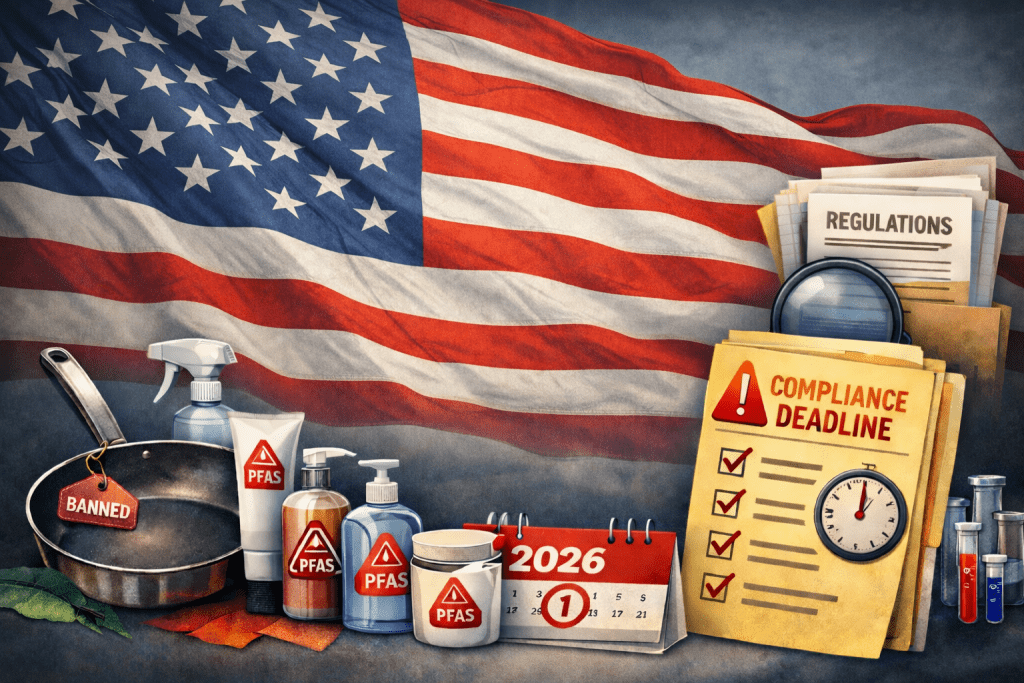
As of 2026, PFAS laws in several U.S. states have moved from gradual to aggressive enforcement, introducing new PFAS product bans and disclosure requirements for manufacturers and retailers.
Colorado, Maine, and Vermont implemented restrictions on certain PFAS-containing products, such as cleaning products and cookware, on January 1, 2026. Connecticut’s broader prohibitions and notification requirements will continue on July 1, 2026.
Minnesota’s Amara law introduces detailed reporting requirements for manufacturers by July 1, 2026, increasing documentation and supplier verification risks. Additional state proposals remain in effect.
Which PFAS product restrictions begin in 2026?
Starting January 1, 2026, applicable PFAS product limits began to vary by state, but several statutes now prohibit the sale, distribution, and manufacture of consumer products containing intentionally added PFAS, creating immediate compliance pressures.
Colorado’s rule went into effect on January 1, 2026, and covered cleaning products, cooking utensils, and dental floss. Vermont implemented similar limits on the same day, with a 100 ppm standard that will be strengthened in 2027.
Maine’s 2026 measure also went into effect on January 1, banning the use of PFAS in cleaning products, cookware, cosmetics, and youth products, alongside existing restrictions on food packaging where safer alternatives exist.
Connecticut’s broader framework begins July 1, 2026, including advance notification requirements to the Department of Energy and Environmental Protection. Minnesota will add reporting requirements for manufacturers on the same day.
Companies must prioritize PFAS alternatives, supply chain validation, and consumer compliance measures.

What are “intentionally added PFAS”?
Most state laws focus on “intentionally added PFAS,” or substances intentionally incorporated into a product or component during formulation or manufacturing, rather than trace amounts of PFAS contamination.
Compliance therefore requires mapping all inputs (ingredients, coatings, adhesives, inks, subassemblies) to determine whether PFAS play a functional or process role.
Definitions vary by jurisdiction. Some rely on the manufacturer’s intent, while others use surrogates such as total organofluorine thresholds. Without clear internal specifications and supplier certification, these differences can create regulatory uncertainty.
Where reporting is required, such as Minnesota’s July 2026 deadline, records must include the identity of the PFAS, its function, and the components affected. Exemptions for “technically unavoidable” uses may apply, but require documented technical justification and periodic review.
Which states will implement PFAS regulations in 2026?
Compliance risk in 2026 is highest in jurisdictions that combine broad product coverage with enforceable deadlines: Colorado, Connecticut, Maine, Minnesota, Vermont, and Washington.
Colorado, Vermont, and Washington have introduced new bans effective January 1, 2026, targeting consumer categories such as cosmetics, textiles, cooking utensils, and cleaning products. Connecticut has introduced disclosure requirements for certain clothing and equipment and plans to expand the ban on July 1.
Maine currently restricts multiple product categories and continues to restrict PFAS in food packaging where alternatives are available. Starting July 1, Minnesota will focus on detailed reporting.
Across these states, documentation, audit preparation, and substantiation of “PFAS-free” claims are likely to be central to enforcement.
Colorado, Maine, and Minnesota: 2026 PFAS Timeline
These states require special attention because of their time limits and combination of product and reporting requirements.
Effective January 1, 2026, Colorado will ban the sale and distribution of cleaning products, cookware, dental floss, menstrual products, and ski wax containing intentionally added PFAS, with additional categories phased in through 2028. Companies must verify formulations and ensure supplier certification.
Maine’s enforcement began on January 1, 2026, and targeted cleaning supplies, cooking utensils, cosmetics, and products for youth. Businesses must update their product range, labeling and communications with retailers to prevent non-compliant stock movements.
Minnesota will value transparency. Manufacturers will be required to report products containing intentionally added PFAS by July 1, 2026, including detailed product and company information, increasing both regulatory and reputational risks.
Kansas, Missouri, Ohio: PFAS bills to watch
Legislation is still in progress in several states.
Kansas HB 2674 proposes to ban PFAS-containing cookware and dental floss by 2027 and requires early SKU mapping and supplier verification.
Missouri’s HB 1925 targets PFAS-based firefighting foams and proposes to ban their manufacture and sale in 2028, requiring procurement controls and a phase-out plan.
Ohio’s proposal would introduce broader consumer product regulations and strengthen multiple states’ transition to chemical-based regulations.
These developments support a risk-based compliance approach focused on testing, managed claims, and supply chain governance.
Product-specific PFAS rules: Cookware, textiles, floss
Compliance increasingly depends on product category.
As of January 1, 2026, several states, including Colorado and Maine, have banned cookware containing intentionally added PFAS, as well as certain cleaning and textile products.
These restrictions apply across retail and e-commerce channels and require SKU-level validation and supplier certification.
The rules for textiles are particularly complex. Connecticut plans to expand a broader ban starting July 1, 2026, implementing disclosure requirements for outdoor clothing and firefighting equipment containing PFAS.
Vermont applies a concentration-based approach, regulating products above 100 ppm until July 1, 2027, after which the threshold drops to 50 ppm.
PFAS testing, labeling, and reporting requirements
With effective dates focused on 2026, enforcement is shifting to verification: testing, labeling, and reporting.
Colorado and Connecticut combine bans on PFAS products with disclosure requirements, placing an evidentiary emphasis on supply chain documentation and defensible testing when asserting “no intentionally added PFAS.”
Label requirements are also evolving. New Mexico has proposed warnings for products containing intentionally added PFAS that include QR codes linking to health information, signaling a move toward standardized consumer information disclosure.
Minnesota’s July 1 reporting deadline requires detailed product and manufacturer data. At the federal level, the U.S. EPA is expected to complete the revised TSCA PFAS reporting rules by June 2026, which may overlap with state requirements.
How to prepare for PFAS enforcement in 2026
Enforcement in 2026 is already focused on verification and documentation. Manufacturers and distributors must prepare for audits of substantiation and records.
States including Colorado, Connecticut, Maine, Minnesota, Vermont, and Washington have implemented bans and reporting requirements for PFAS products across categories such as cosmetics, textiles, cooking utensils, and cleaning products.
A defensible compliance program must include supplier certification, bill of materials screening, and targeted testing for intentionally added PFAS.
If disclosure is required, the system must capture product identifier, PFAS functionality, concentration range, and manufacturer details.
Companies must also track ongoing rulemakings, such as New Mexico’s proposed labeling requirements, and maintain jurisdiction-specific compliance frameworks with escalation and recall protocols.
Source link

