


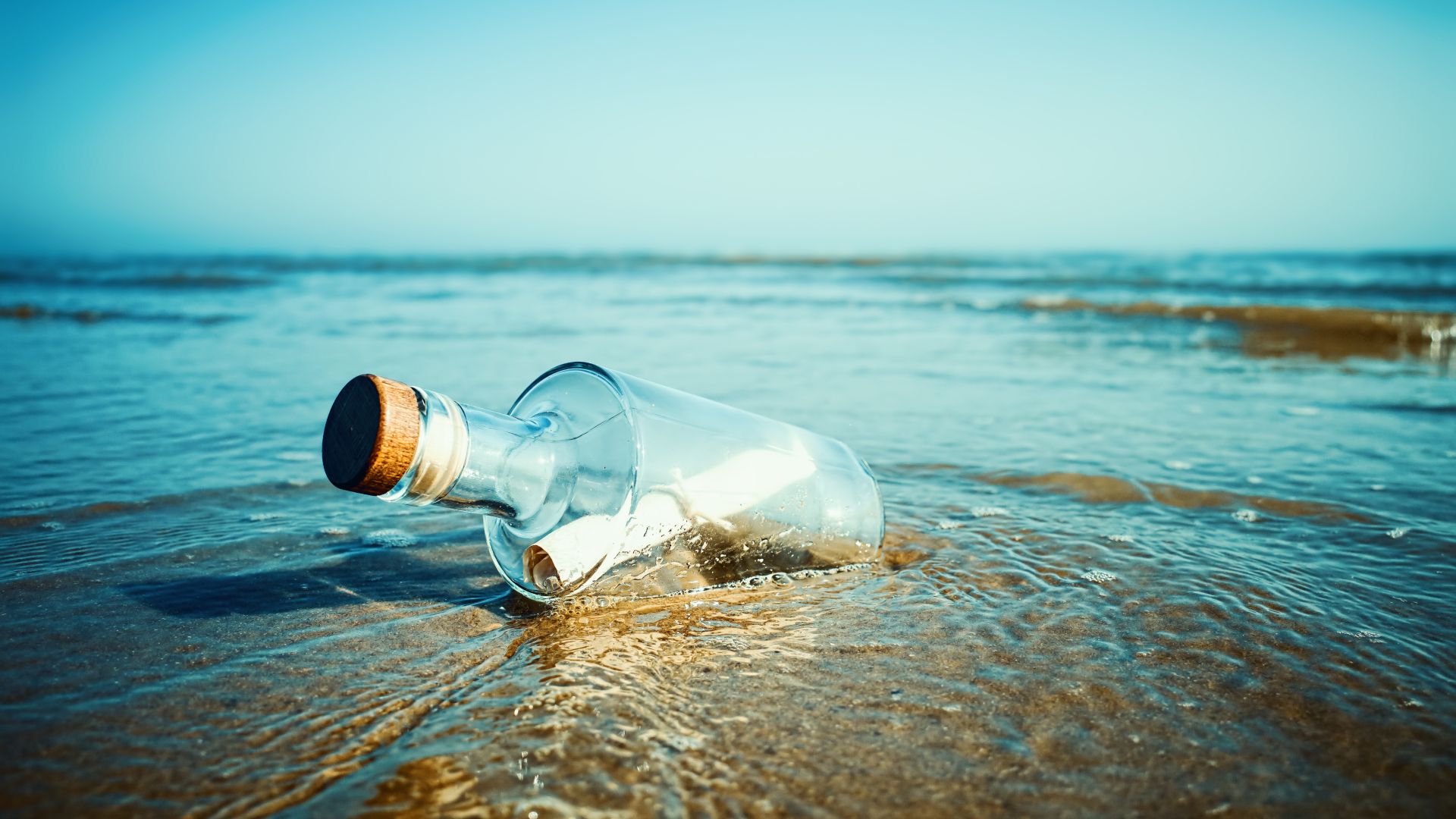
A 100-year-old upbeat message in a bottle was recently discovered on Australia’s south-west coast. In it, a World War I soldier declared he was “as happy as Larry.”
If you’re a bettor, you probably wouldn’t expect odds this big to happen. A bottle thrown into the ocean can end up anywhere.
you may like
So what are the chances that more than 100 messages in the bottle will be found? And what are the chances of finding this bottle?
There are many possibilities during the life of the bottle, but the probability we are looking for is a simple calculation. Count the number of 100-year-old bottles with messages found and divide by the number of messages sent this way (assuming you know the number of messages sent).

The image below shows a hypothetical situation where a total of 20 bottles are sent, 6 of them are found (indicated by the gold color), and one of them is more than 100 years old (indicated by the “100” stamp). This means that one in every 20 bottles will be found to be over 100 years old. (Note: This is just a hypothetical calculation and not actual data.)
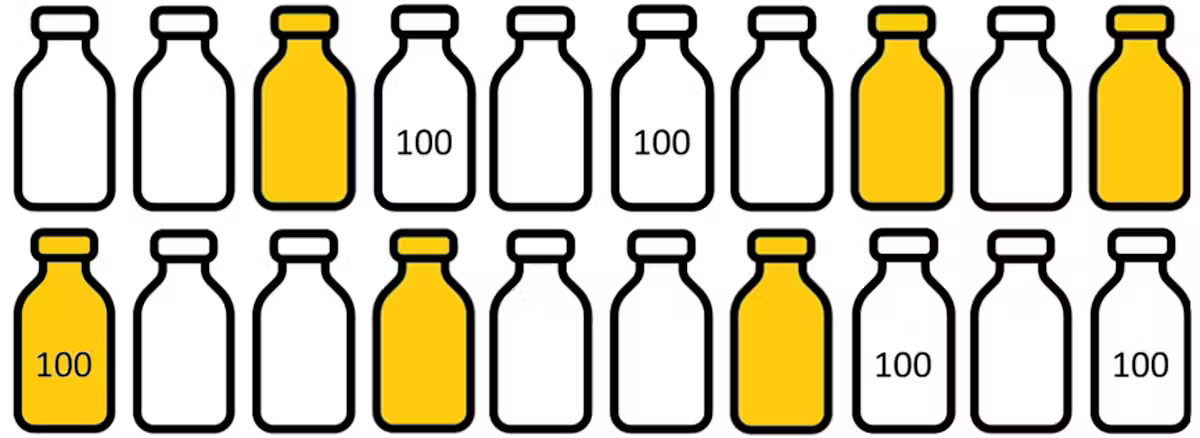
An alternative to calculating probabilities directly is to split the problem into two parts. (A) A bottle with a message was found, (B) More than 100 bottles were found. You can calculate these two probabilities separately and multiply them together to get the result you want.

This is known as the “power law” of probability, and as before, the assumed numbers confirm that (6/20) × (1/6) = 1/20.
Both approaches to calculating this probability are simple. However, a direct calculation requires knowing the total number of bottles shipped, which is very difficult to know in the real world.
The multiplication rule has the advantage of splitting the calculation into two parts. You can consider each separately and then combine the two results to get the probability you want. This is useful in real-world situations where information can be drawn from a variety of sources.
What to read next
First, we deal with the probability of finding a bottle with a message, regardless of age.
Experts from Germany’s Federal Maritime and Hydrographic Office suggest that the chances of finding a message in a bottle are one in ten. This is roughly consistent with various historical “drift bottle” experiments in which oceanographers released large numbers of bottles to understand ocean currents.
For example, studies in the 1960s and 70s in the North Atlantic found recovery rates of 14% from the Gulf of Mexico, 8% from the Caribbean, and 7% from the northern coast of Brazil. A more recent study further north (between Canada and Greenland) in the 2000s had a recovery rate of 5%.
If you conduct different experiments in different parts of the world, you would naturally expect the results to be different. However, to keep things simple, we’ll stick with 1/10 as the probability of finding a bottle with a message.
Now for the second part of the calculation. What percentage of bottles discovered are more than 100 years old?
The table below summarizes data from news articles collected on Wikipedia about very old bottles with messages that were discovered. However, data is only collected on bottles older than 25 years, perhaps because older bottles are more newsworthy.

So we had to estimate for ourselves the number of bottles with messages that were between 0 and 25 years old. Here’s how:
This table shows that as the bottles get older, there are fewer bottles with messages. The message in the bottle degrades over time. This means that the bottle is more likely to crack, sink, or become covered with a layer of sediment. By plotting this data on the graph below, we were able to see the trends in the age of the bottles found more clearly.
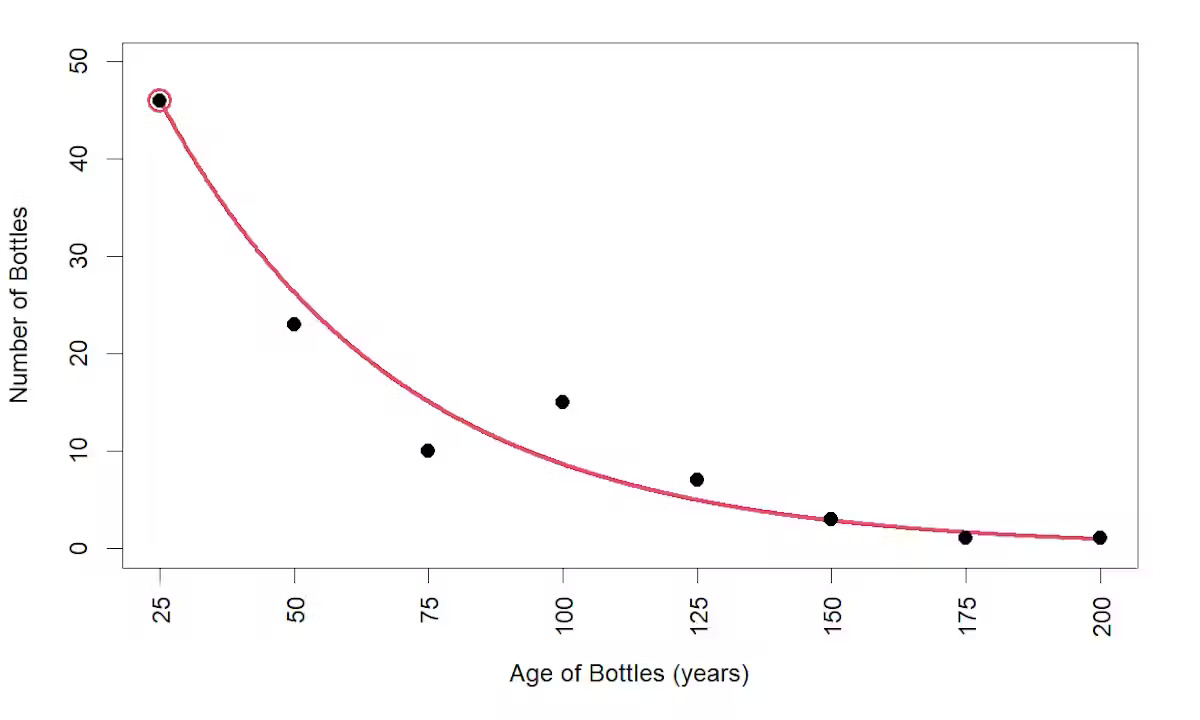
We drew a line consistent with this trend observed in the age of the bottles found. This red line in the graph corresponds to the following equation:

This formula provides an estimate of the number of bottles found in a particular age range (25 = 0 to 25 years old, 50 = 25 to 50 years old, etc.). Since we are interested in bottles that are between 0 and 25 years old, the equation shows that 46 bottles were found in this range.
Adding this up with all the numbers in the table, we get a total of 106 bottles found, 12 of which are over 100 years old, so 12/106 is about 1 in 10.
To summarize the above: (A) 1 in 10 bottles with messages are found, and (B) 1 in 10 is more than 100 years old. Putting these results together using the multiplication rule, we estimate that the chance that the message in the bottle is found and is more than 100 years old is (1/10)×(1/10) = 1/100.
So if there are 100,000 bottles with messages floating around in the ocean waiting to be discovered, we would expect 1,000 of them to be discovered and to be over 100 years old. Assuming that everyone in the world is equally likely to find one of these, there are currently 8 billion people out there, and your chances of finding one of these are about 1 in 8 million, which could be quite low.
However, some people are more persistent in their quest for Message in a Bottle than others. Following the paths of ocean currents (known as circulations) can provide clues about where to look.
Specifically, peninsulas and islands that intersect with these gyres could be good locations. This suggests that Caribbean islands are ideal places to find bottles, as they are in the path of the North Atlantic circulation. That sounds like a great reason to travel to the Caribbean.
But let’s also think about the poor people stranded on desert islands. They probably don’t understand that their SOS is unlikely to be found.
This edited article is republished from The Conversation under a Creative Commons license. Read the original article.