
Microgripper developed for precise assembly of fragile cell spheroids in tissue engineering
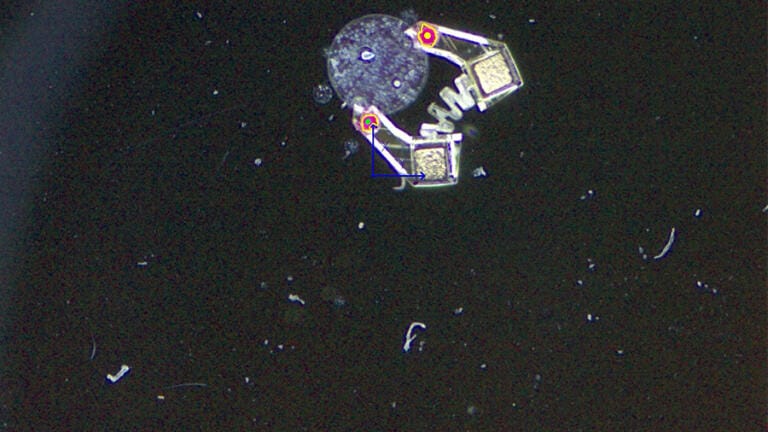
A team at Purdue University has designed a mobile microgripper (MMG) that can handle fragile cell spheroids with controlled force and high spatial precision.
Spheroids have become essential for tissue engineering because they can mimic the biological interactions between cells and the surrounding matrix, but they are very fragile and can be problematic to handle.
“Other techniques for bioassembly of cell spheroids may affect tissue architecture or apply limited manipulation forces,” said Dr. David Cappellelli, professor of mechanical engineering and biomedical engineering at Purdue University.
“Force-sensing MMGs address these current issues by allowing the safe bioassembly of various spheroids into a single structure,” he said.
But in new research, a team at Purdue University in West Lafayette, Indiana, has developed a small robotic gripper that can manipulate spheroids without damaging tissue.
The robot uses a magnetic microscope claw mechanism
The wireless mobile microrobotic gripper consists of two articulated arms connected by a hinge and operates under magnetic actuation, allowing controlled closure to grasp spheroid cells with minimal force. An external magnetic field allowed both the movement of the device and precise control of the gripping jaws. This design maintains compatibility with the biological environment while overcoming the need for direct mechanical contact and bulky instrumentation.
“That was a big part of the design: finding a way to use the magnetic field to both move and control the opening and closing of the gripper jaws,” Cappellelli added.
The force sensitivity of the MMG continuously monitors the spheroids and adjusts the grip accordingly. This means that operators can work with a variety of spheroid shapes and structures, reducing the risk of damaging cells during handling.
Computational modeling and in vitro experiments confirmed that MMG can safely treat cells.
The research team evaluated the performance of the microgripper and confirmed that the amount of force applied during manipulation of the spheroid was within the limits of survival after implantation. Future research will address extending the ability of microgripper to address three-dimensional tissue fabrication, with the long-term goal of constructing fully functional engineered tissues.
So far, MMG has been successful in assembling spheroids into planar cell sheets, which serve as the basic structure for future constructs. These more elaborate constructs resemble structures that house heterogeneous cell populations within in vivo tissues.
The team also plans to move from manual work to automated control of microrobots, which could increase productivity in terms of both volume and efficiency.
In the supplementary video below, you can see representative experimental validation tests specifically for MMG spheroid placement and micromanipulation of PDMS spheres.
Source link

