
Bridging the gap in urban and wildland defense
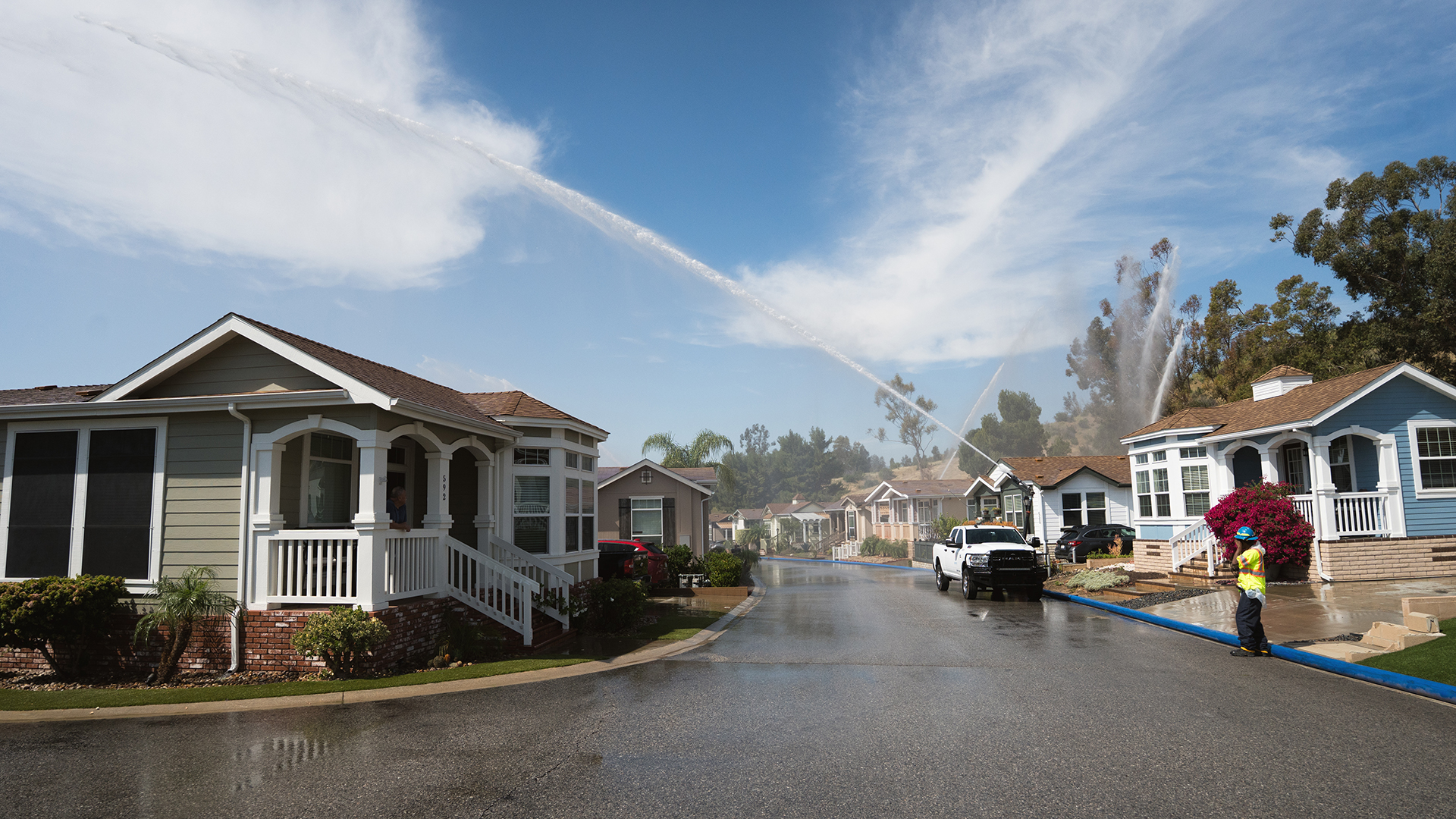
Wildfire Water Solutions will discuss the evolving challenges of wildfire management and highlight the importance of deployable infrastructure solutions to enhance access to water and improve preparedness at the urban-wildland interface.
In many parts of the world, wildfire behavior is evolving. Longer fire seasons, increased fuel loads, and more frequent extreme weather events are creating conditions that exceed the original design assumptions of many response systems.
In rapidly changing wildland-urban interface (WUI) environments, fire suppression effectiveness often depends not only on expertise and effort, but also on the logistics of getting critical resources to where they need to be, quickly and reliably.
Under these circumstances, water access, pressure, and delivery routes can be limited, especially if friction is created by topography, infrastructure design tolerances, or simultaneous demand. This is not a failure of existing systems, but rather reflects the scale and intensity of modern wildfires.
This gap has led to the emergence of a new category: deployable infrastructure.
Wildfire Water Solutions (WWS) operates within this category, offering systems that can be quickly deployed to expand and enhance existing capabilities. The focus is not just on moving water, but on ensuring that water can be accessed, located and used even under the most demanding conditions without relying on fixed system constraints.
“Our role is to support communities and government agencies by improving access to water when and where it is needed most,” said Mike Echols, CEO of Wildfire Water Solutions. “This means working in parallel with existing systems and increasing their range during peak demand.”

From suppression to preparedness
A global shift from reactive suppression to proactive preparedness is underway.
In this context, water is more than just a coping tool. When properly planned and deployed, they become part of a broader resilience system.
Deployable infrastructure enables this transition by allowing water systems to:
Pre-positioned ahead of risk Sourcing from a variety of available sources, including reservoirs, rivers, lakes and coastal sources Operates independently from fixed networks when required
These systems are designed to complement existing firefighting resources and be integrated into established incident management structures.

Availability over quantity
The effectiveness of wildfire prevention measures is not determined by quantity alone.
In many environments, water can be limited, regulated, or difficult to access. And even if it’s available, it may not be easily delivered to where you need it. The operational challenge is to close that gap.
WWS systems are designed to operate in both situations where water is scarce and where water is available but inaccessible, and focuses on:
Placement (providing water in the right places) Timing (making water available before and during critical periods) Purpose (using it in a targeted and coordinated manner)
This approach positions water not as an isolated input but as a strategic resource within the system.
A practical definition of defense in depth
Resilience from wildfires is not achieved through a single measure. It comes from multiple coordinated actions that work together to reduce risk.
The layered approach can be understood through four main components:
Fuel Management Reduce fire intensity and influence fire behavior before it reaches the asset Operational Readiness – Ensure trained personnel and systems are activated quickly and operationally aligned with the incident management structure Community and Asset Preparedness – Improve ignition resistance through design, maintenance, and planning.
Deployable infrastructure
WWS provides an adaptable water supply system that can support suppression operations, improve firefighting conditions, and expand operational capability during peak demand periods.
These layers are modular and scalable. These can be implemented in stages and adapted to local risk, governance, and resource availability.
Reference models, not requirements
In some cases, the community has implemented a more comprehensive version of this approach.
California’s Oak Ridge Mobile Home Park is one example, where fuel management, community preparedness, and deployable water infrastructure are integrated into an integrated system.
It is important to note the following points:
This level of integration is not necessary in all settings Individual components can be applied independently The underlying principles are transferable across regions
The goal is adaptation, not replication.
Operational integration
Effective implementation requires more than equipment. Coordination is required with how wildfire responses are managed.
WWS personnel are trained to operate within an established incident management framework and liaise with local fire services. The system is designed to support, rather than complicate, existing operations, and the deployable infrastructure ensures increased overall response efficiency.
Utility partnership and system integration
WWS has a single-source, multi-year partnership with one of the largest local governments in Los Angeles, California. This collaboration is focused on strengthening infrastructure resilience and supporting both wildfire response and broader water system continuity.
This partnership reflects the growing recognition that deployable infrastructure can play a role not only in fighting fires but also in maintaining critical services under stress conditions.
Beyond wildfires: Water resistance to multiple disasters
Although initially deployed in support of wildfire response, deployable water infrastructure has a wide range of applications that are increasingly relevant to national and regional resilience planning.
In many environments, the same conditions that make wildfire response difficult, such as remote location, topography, infrastructure design limitations, and system stress, also impact the ability to maintain reliable access to water during other types of fire events.
As a result, these systems can be applied to multiple scenarios such as:
Emergency potable water transfer and distribution Continuation of service during infrastructure disruptions (power outages, earthquakes, system damage) Support to remote areas or rapidly growing populations Augmentation of existing systems during periods of peak demand
This dual-use capability is particularly important for sovereign parties whose infrastructure investments need to serve multiple purposes over long periods of time.
Deployable infrastructure supports broader recovery strategies beyond just wildfires by enabling both emergency response and continuity of critical services.
Range of operational capabilities
Deployable infrastructure must be evaluated based on real-world conditions. Performance is not defined by a single specification, but by how the system behaves across terrain, distance, and resource availability.
WWS systems are configurable based on environmental and mission requirements. Common operating ranges include:
Water delivery distance: Up to approximately 80 km (50 miles), depending on terrain and configuration Elevation gain: Achieved through staged pump configurations, adaptable to various terrains Flow rate: Scalable from targeted applications to bulk transfer, depending on operational objectives Sustained operation: Designed for long-term continuous operation with adequate fuel and maintenance support Deployment Installation speed: Approximately 1 to 3 km (0.5 to 2 km) per hour, depending on conditions (miles per hour) Terrain, Access, and Configuration Time to Initial Operation: Depending on deployment strategy, the system can begin delivering water before it is fully built Mobility: Can be moved without permanent infrastructure. Designed for rapid installation and removal Water sources – Can be taken from reservoirs, lakes, rivers Shallow or unconventional water sources with proper screening and configuration Coastal water sources where environmental and engineering conditions permit Storage and buffering – Tactical (thousands of liters/gallon) Strategic (millions of liters/gallon) modular storage Designed to stabilize supplies, mitigate fluctuations, and reduce continued upstream dependence Power and fuel Primarily diesel-powered pump system designed to operate independently Fuel consumption and logistics can be tailored to system configuration and deployment duration Capable of operating in environments with limited or no grid access Personnel and Operations Deployment and operations are supported by trained personnel operating within an established incident management framework Personnel footprint scales with system size, duration, and mission complexity Designed to integrate with local agencies and enhance existing capabilities Water quality and system compatibility The system is compatible with treatment, storage, and water distribution infrastructure Where treatment and regulatory frameworks are in place to support the transfer of potable water in emergencies Designed to operate with a variety of water qualities (including saline water), depending on the application Adaptability – configurations can be optimized for: Wildfire suppression support Targeted water distribution and exposure protection Emergency potable water transfer Infrastructure continuity and system augmentation
All specifications vary depending on site conditions, system configuration, and operational objectives.

end point of view
Wildfires are an increasingly serious system challenge defined by the interaction of environment, infrastructure, and response capacity.
As the situation continues to evolve, resilience depends on the ability to scale and adapt existing systems in real time. Deployable infrastructure represents one approach to doing that, bridging the gap between what systems were designed to handle and what they are now being asked to endure.
Please note: This is a commercial profile
This article will be published in an upcoming Wildfires Special Focus Publication.
Source link

