
CERN supports future circular collider in new European particle physics strategy
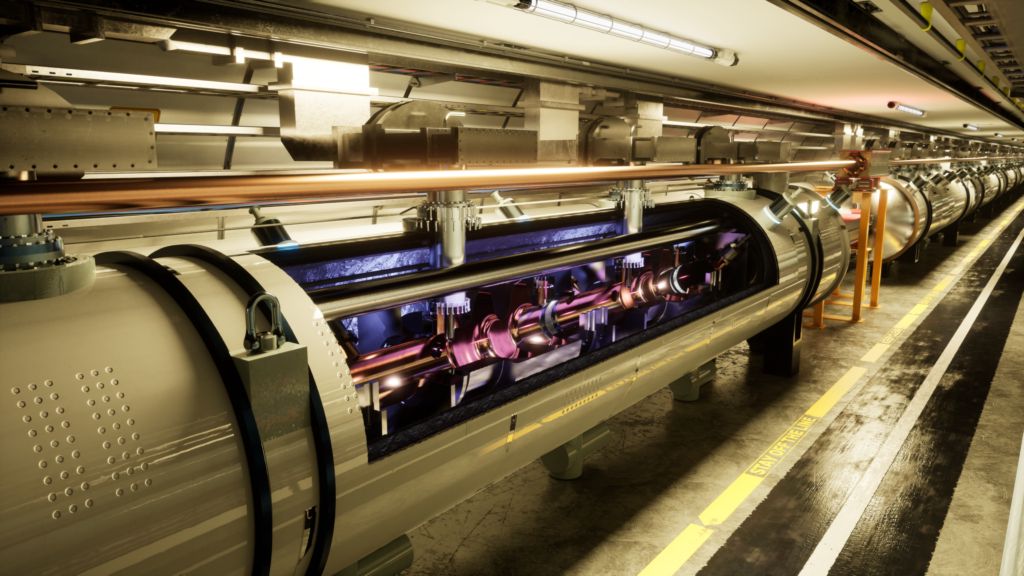
Europe’s particle physics community has agreed on a new long-term roadmap that puts CERN’s proposed future circular collider at the heart of the continent’s scientific ambitions.
The latest European Strategy for Particle Physics, adopted by the CERN Board after more than two years of consultation and consideration, outlines how Europe plans to maintain its leadership in high-energy physics beyond the lifetime of the Large Hadron Collider.
This strategy update is based on input from hundreds of researchers, institutions and international partners. More than 260 written submissions were reviewed before recommendations were submitted to the CERN Board in late 2025.
The final framework prioritizes continued operation and upgrades of the Large Hadron Collider, while approving the Electron-Positron Future Circular Collider, known as FCC-ee, as CERN’s next priority project.
If approved later this decade, FCC-ee will be one of the largest scientific infrastructure projects ever undertaken in Europe.
CERN’s management is now tasked with advancing funding discussions with member states, the European Union and international partners, ahead of a decision by 2028.
Council President Kostas Fountas commented: “The high-energy physics community and the CERN Council are united in this important update of the European Particle Physics Strategy, and FCC-ee has emerged as a priority flagship project to maintain CERN’s world-leading role in collider physics and technology for decades to come.”
“I wish the CERN management team great success in implementing the Board resolution between now and the target date in 2028.”
Europe’s particle physics strategy sets the tone for the next era
The latest European Strategy for Particle Physics establishes a long-term scientific vision for Europe’s role in understanding the fundamental structure of matter and the universe.
This roadmap is intended to guide investments, research priorities and international cooperation over the coming decades.
The strategy process was officially launched in March 2024 under the supervision of the European Strategy Group.
Scientists from Europe and abroad were invited to contribute proposals and technical studies aimed at identifying the next major breakthrough projects in the field.
The discussion centered on how to build on the discovery of the Higgs boson, which CERN researchers confirmed in 2012 at the Large Hadron Collider.
The Higgs discovery largely completed the Standard Model of particle physics, but it also raised new questions about dark matter, the origin of mass, and the unexplained forces of the universe.
Circular Collider will be the preferred option in the future
Under the new European particle physics strategy, CERN’s Bright Large Hadron Collider program remains the continent’s top medium-term priority.
The upgraded collider is expected to continue operating into the 2040s, producing more data for researchers studying rare particle interactions.
However, in the long term, the strategy identifies FCC-ee as a top candidate for Europe’s next generation accelerator program.
The proposed machine would collide electrons and positrons in a giant circular tunnel, larger than the current LHC infrastructure.
Researchers believe the cleaner collision environment will enable unprecedented precision measurements of the Higgs boson and other particles associated with the Standard Model.
Scientists involved in the strategy process argued that FCC-ee offered the most powerful potential to uncover physics beyond the Standard Model.
The project is also expected to lead to major advances in superconducting technology, computing, cryogenics, and engineering.
CERN’s feasibility study shaped the decision
The recommendations are based on several years of technical and financial analysis conducted by CERN and international collaborators.
A large-scale feasibility study for a future circular collider was published in March 2025 and subsequently considered by the CERN Council.
That initial study considered possible tunnel locations, environmental impacts, construction requirements and estimated costs. It also assessed how the project could fit into Europe’s broader scientific infrastructure plans.
This new strategy is directly based on the European Particle Physics Strategy 2020. The strategy has already identified a future Higgs factory to replace the LHC, which is expected to cease operations around 2041.
Funding and political approval remain major hurdles
Despite scientific backing, future circular colliders still face significant political and financial challenges before construction can begin.
The CERN Board requested CERN Management to begin negotiations with Member States, Associate Member States, non-Member States and European Union institutions to consider a financially viable funding structure.
Annual progress reports will now be submitted over the next two years as the government assesses the scientific, technical and economic impact of the project. Public consultations are also planned in France and Switzerland, the host countries of CERN.
A final decision on whether to proceed with FCC-ee is expected to be made by 2028.
Now, with the updated European Particle Physics Strategy, CERN and its international partners have been given a clear mandate to advance plans for what could be the next major frontier of basic science in the world.
Source link

