

DESIDERATA accelerates the transition to safer chemistry by developing sustainable alternatives to hazardous materials used in lubricants, coatings, and chemical components.
DESIDERATA brings together 16 partners from 13 European countries under Horizon Europe (CORDIS) to translate the EU’s safe and sustainable design framework into real-world chemical innovation. This project focuses on developing safer alternatives to harmful flame retardants, plasticizers, and surfactants, working across industrial settings to drive systemic change.
Challenge: Various environmentally hazardous substances and their substitutes in the industrial field
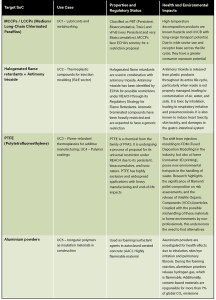
Hazardous Properties: Medium/long chain chlorinated paraffins, halogenated flame retardants, and PFAS pose significant health and environmental risks. Key Functions: These substances play an important role in enhancing the performance and safety of many products by acting as flame retardants, plasticizers, and surfactants. The need for alternatives: The EU’s chemicals strategy for sustainability calls for safer and more sustainable alternatives to support environmental protection and supply chain resilience.
Our mission: Advancing chemical innovation
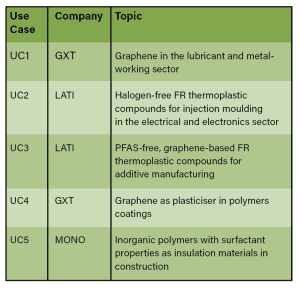
The project will contribute to the transformation of industrial value chains such as metal processing, construction, injection molding and 3D printing by developing new alternatives to environmentally hazardous substances. DESIDERATA addresses a significant market gap for which no functional replacement currently exists.
DESIDERATA applies the European Commission’s Safe and Sustainable by Design (SSbD) framework to guide the development of alternative solutions. By incorporating safety and sustainability early in innovation, the project supports the transition to a cleaner, more sustainable industry, minimizing the use of substances of concern and reducing negative impacts on human health, the environment and the climate. The insights gained will guide policy makers in refining and expanding the SSbD framework across Europe’s chemical and materials manufacturing sectors.
Our use case: Innovative, safe and sustainable materials
Targeted environmentally hazardous substances
MCCP/LCCP (medium chain/long chain chloride)
Paraffin) Halogenated flame retardant – Antimony trioxide PTFE (Teflon – Polytetrafluoroethylene) Aluminum powder
goals and objectives
The project has three bold goals:
Development of innovative substances and materials that can replace environmentally hazardous substances. Application of the SSbD framework to the entire value chain and development of new materials. Providing data and computational tools to accelerate digital research and innovation (R&I) and reduce the time needed from design to market.
To achieve these ambitious goals, a set of objectives was defined to support the implementation of the project in five different areas.
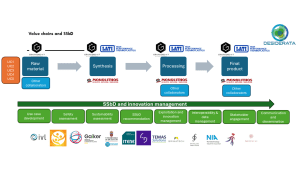
Project goals:
Developing new materials: Creating SSbD-compliant alternative materials, pushing the boundaries of innovation in five industrial sectors and promoting research and development excellence in Europe. Promote safer materials: Promote safer and more sustainable alternatives to the market. Enhanced interoperability: Improve data sharing across the value chain. Demonstration of the SSbD framework: Test and validate the framework through an industrial use case. Maximize impact: Foster collaboration with industry and civil society to ensure all sustainable development pillars are considered and all stakeholders are involved.
consortium
DESIDERATA was designed by a strong multidisciplinary consortium encompassing all the necessary expertise to achieve the above goals. It is coordinated by the Luxembourg University of Science and Technology (LIST).
The innovation action involves six partners from large enterprises and small and medium-sized enterprises (SMEs) with a dominant presence in the industry.
These are supported by two universities, six research and technology organizations (RTOs), and two non-profit research or industry associations.
Graphene-XT, LATI and MONO are the main developers of the new materials, which are expected to be integrated into their product portfolios and enter the market as true replacements for SoCs.
RTOs and universities (LIST, GAIKER, ITENE, UBU, IVL, TAU) collaborate with specialized companies (TEMASOL, NEOVILI, Equator Company, BRIR, PHOENIX-SEP) specializing in different assessment areas within the SSbD framework. They cover human and environmental safety, environmental and socio-economic sustainability, but also provide expertise in market analysis, portfolio development and market integration of new products. ENTELOS and NIA will complement the consortium by promoting knowledge sharing, whether through facilitating data/results interoperability or engaging key policy and industry stakeholders, respectively. It therefore supports the implementation of SSbD in parallel with the promotion of regulations and future policies in the EU.
Register in the stakeholder group to receive further information related to the DESIDERATA project.
Please email the consortium.
understand

This project has received funding from the European Union’s Horizon Research and Innovation program (IA for Digital, Industry and Space) and the Swiss Cantonal Secretariat for Education, Research and Innovation (SERI) under grant agreement number 101178011.
Please note: This is a commercial profile
This article will also be published in the quarterly magazine issue 25.
Source link
