
Digg is trying again, this time as an AI news aggregator
Dig is back from the dead. Also.
The reboot of Kevin Rose’s once-popular link-sharing site was shut down in March after the company changed direction, just months after launching. Originally redesigned as a competitor to the massive community forum site Reddit, the new Digg was unable to effectively manage the bot traffic that entered its platform and found itself unable to differentiate itself from its competitors enough to make an impact.
The startup laid off staff and said it was time to go back to square one. Rose, a partner at True Ventures, returned full-time to work on the new version of Digg in April.
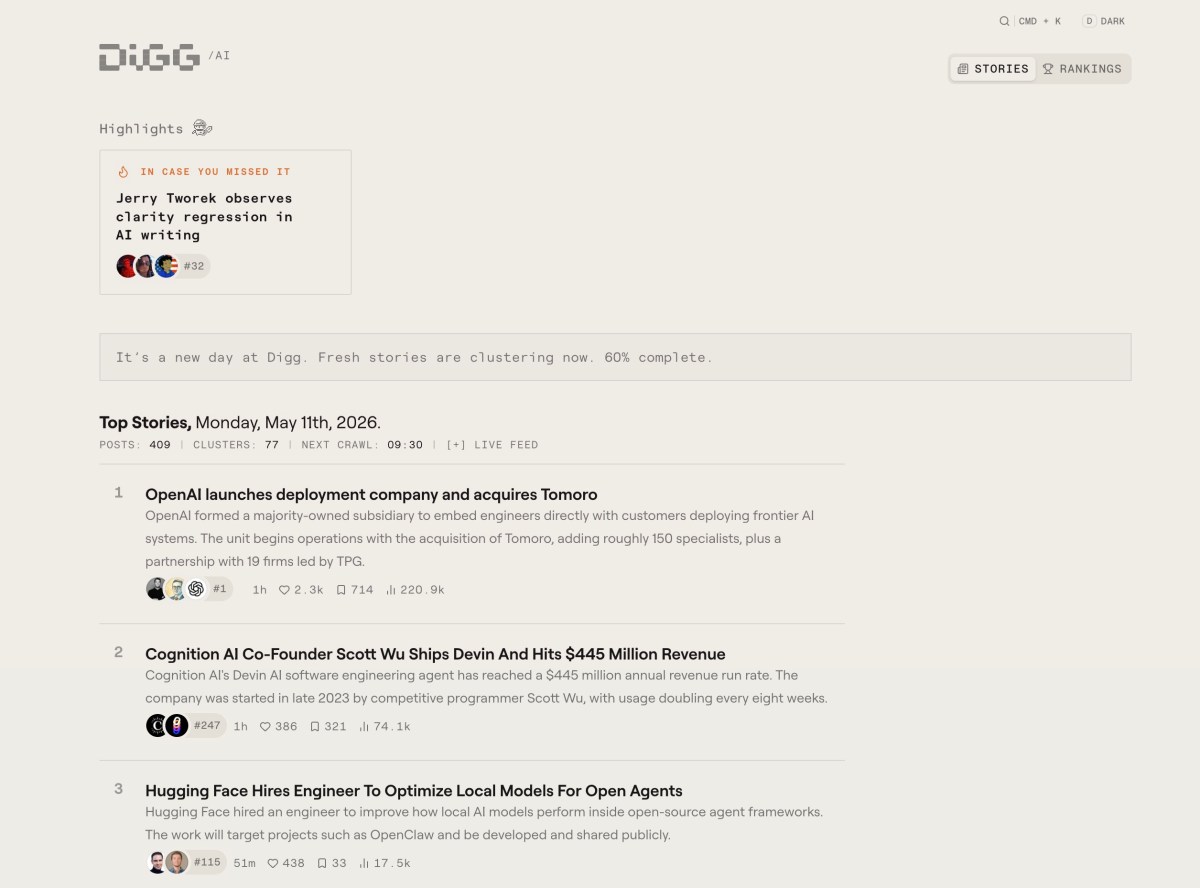
On Friday evening, the founders previewed links to the newly redesigned Digg. Digg now looks less like a Reddit clone and more like the news aggregator it once was.
This time, the site focuses on news rankings, especially AI news.
In an email to beta testers, the company said the site’s goal is to “track the most influential voices in the space” and surface news that is actually worth “paying attention to.” AI is where Digg is testing this idea, but if it’s successful, it plans to expand to include other topics.
The email warned that the site is still raw and “buggy” and is designed to give users a first look rather than a public debut.
On the current homepage, Digg displays four main articles at the top. One for the most viewed articles, one for the most discussed articles, one for the trending articles, and one for “In case you missed it” headings.
Below that is a ranked list of the day’s top stories, complete with engagement metrics such as views, comments, likes, and saves. However, it’s important to note that these metrics are not generated by Digg itself. Instead, Digg ingests content from X in real time to determine what’s being discussed, while also performing sentiment analysis, clustering, and signal detection to determine what matters most.
As Rose said about X, when OpenAI CEO Sam Altman tackles a story about AI, it almost always sets off a chain reaction that includes deep discussion and propagation of the topic across X. The new Digg will be able to track that increase in engagement.

This may be of interest to data geeks as it reveals the impact of engagement on X-based charts and graphs and provides a way to track signals among what can be a lot of noise on X. But it’s unclear whether there’s enough fundamental value here for everyday users, other than that @sama’s tweet might spread something.
The site ranks the top 1,000 people involved in AI, as well as top companies and top politicians focused on AI issues.

For those who don’t have time to spend tracking the latest AI news, Digg can be a useful resource. But it’s unclear why people turn to Digg more regularly than their favorite news app, RSS reader, or even the X “For You” feed when they want to catch up on trends. Especially since there are currently no discussions happening on Digg’s site.
Digg may also struggle as it moves to other topics, as AI news remains one of the few areas where there is active discussion about X. There hasn’t been similar traction in other areas, especially since Musk’s acquisition of Twitter created an ecosystem of competitors that now includes Meta’s creator-focused Threads. Many non-technical discussions now take place outside of X, or entirely outside the public Internet.
But if Digg really gains traction, it could become a valuable source of traffic to websites for publishers whose businesses are being decimated by a drop in clicks due to Google’s algorithm changes and AI Overviews, the AI-generated overviews that Google displays at the top of search results. AI-generated summaries often answer users’ questions before Google clicks through to a website.
If you buy through links in our articles, we may earn a small commission. This does not affect editorial independence.
Source link

