
DuckDuckGo installs increase by 30% as users reject Google’s AI search ‘force-feeding’
Last week, after Google announced a major overhaul of search, I overheard a woman on the phone saying she was switching to DuckDuckGo because “you can opt out of using AI.”
“Google is no longer Google,” she said. It seems others had the same idea.
At I/O, Google’s annual developer conference, the company said the traditional list of blue links will be replaced with AI agents that answer queries, perform tasks, and run background monitoring agents.
The backlash was fierce.
Some argue that this will kill the open web, while others share concerns that AI summaries will surface inaccurate responses and take control away from users who don’t want to use AI. It also overcomplicates something simple. Try searching Google for the word “ignored.”
In response to Google’s changes, many people have started defecting to DuckDuckGo. DuckDuckGo is a privacy-focused alternative, but it was never able to break away from Google’s dominance, which accounts for only about 2% of the U.S. search market.
At Google’s 2023 search antitrust trial, DuckDuckGo CEO Gabriel Weinberg testified that Google’s exclusive default search agreement hurt the company’s ability to market itself as the default on other browsers.
“Google is force-feeding AI with no way to opt out,” Weinberg said in a statement Tuesday, referring to Google’s search overhaul. “As a result, their outcomes are getting worse, not better. We want to give users control and be a place where they can decide how much or how much AI they want.”
Now, it looks like DuckDuckGo is starting to benefit as consumers flee AI.
According to DuckDuckGo, app installs in the U.S. increased an average of 18.1% week over week from May 20 to May 25, compared to May 13 to May 18. Growth was sustained for six consecutive days and peaked at 30.5% on May 25, the company said. The install rate was even higher on iOS, with an average week-over-week increase of 33% and a peak of 69.9%.
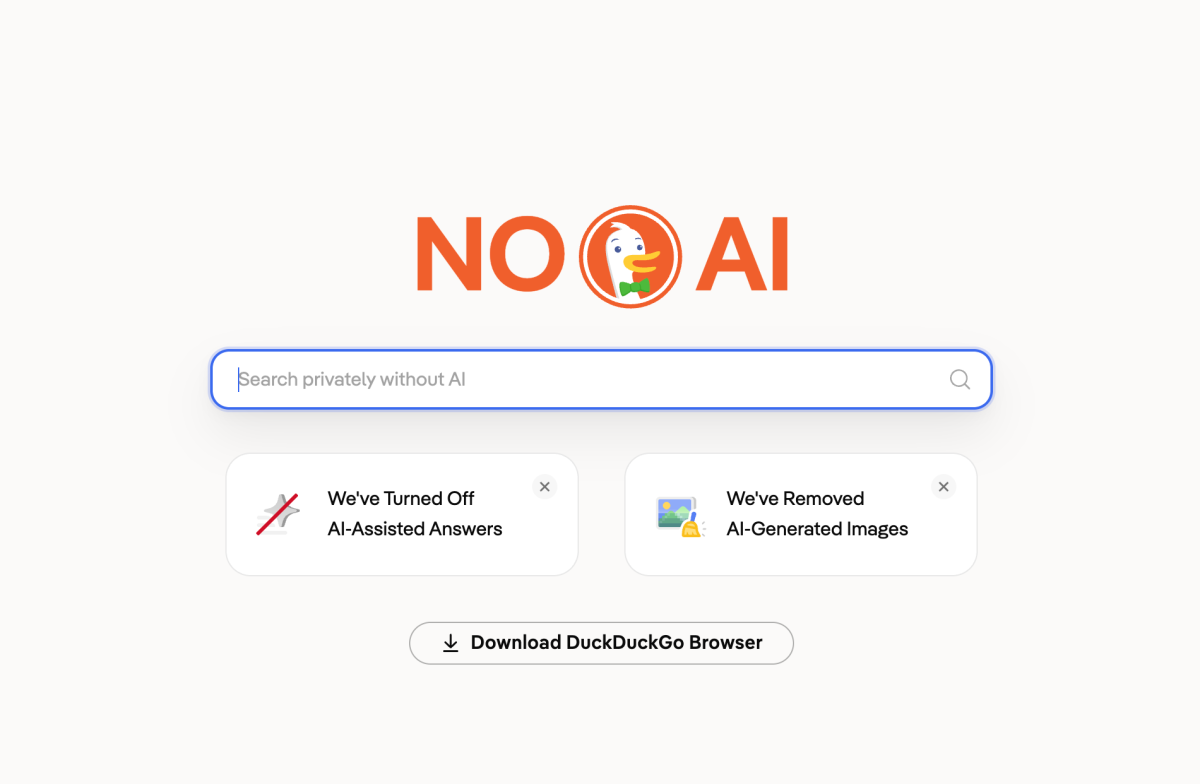
The search engine also announced that visits to its non-AI search page, noai.duckduckgo.com, recorded an average WoW growth of 22.7%, reaching 27.7% on May 24th. All AI features, such as AI-assisted answers and AI-generated images, are turned off by default on this page.
The company said the trend was even stronger in the U.S., where DuckDuckGo users continued to increase over the Memorial Day weekend, when traffic typically drops.
DuckDuckGo offers its own AI product called Duck.ai. It’s free and doesn’t require users to create an account, but it provides access to models such as Anthropic’s Claude 4.5 Haiku, Meta’s Llama 4 Scout, Mistral’s Small 3 24B, and OpenAI’s GPT-5 mini. All chats are private because DuckDuckGo removes user IP addresses before requests reach model providers, deletes conversations within 30 days, and ensures chats are not used for training.
“We respect not only your choices, but also your privacy,” Weinberg said. “Everything you do on DuckDuckGo is private. Your search history or chats are not collected, and nothing is used for AI training.”
DuckDuckGo also offers Search Assist, which is similar to Google’s AI Overview, and AI Image Filter, which excludes images created by AI from search results.
DuckDuckGo’s chief communications and policy officer, Kamil Bazbaz, said that despite the differences in philosophy, both of these AI capabilities are among the company’s most popular features.
“People just want options,” BuzzBuzz said.
TechCrunch has reached out to Google for comment.
If you buy through links in our articles, we may earn a small commission. This does not affect editorial independence.
Source link

