
IJCLab’s role in shaping the future of particle accelerator science
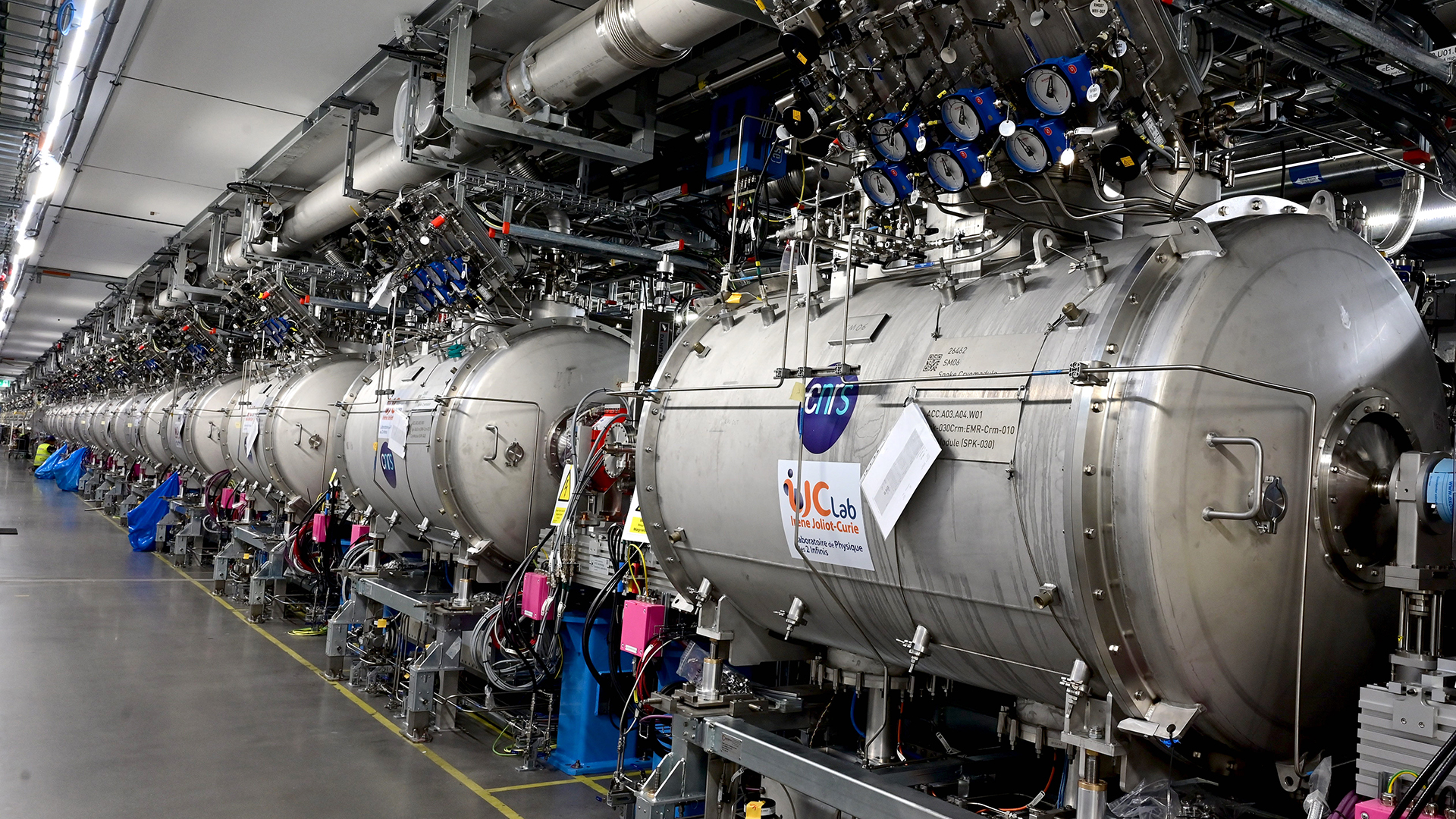
Meeting future facility demands requires not only superior technology but also the ability to bridge basic research, innovation, and industrial implementation. At IJCLab, this integrated approach is driving important advances that will underpin tomorrow’s accelerators.
Particle accelerators are strategic research infrastructures that support Europe’s scientific leadership, technological autonomy and innovation capacity. They enable major advances across a wide range of fundamental sciences, including particle physics, nuclear physics, chemistry, biology, and materials science, while also supporting high-impact applications in healthcare, security, environmental sustainability, and advanced technology. Continued investment in accelerator science and technology is therefore essential to maintain Europe’s global competitiveness and provide the next generation of research infrastructure.

Central hub for accelerator science and innovation
Within this context, the accelerator physics pole of the Irène Joliot-Curie Institute (IJCLab) in Orsay, France, occupies a unique strategic position. Fully specialized in the research, design and development of particle accelerators, we bring together significant expertise across the entire innovation chain, from basic research and development (R&D) to system integration and contribution to large-scale facilities. The IJCLab serves as a central hub for accelerator science at both national and European level by focusing the majority of national efforts on accelerator research and development. Its activities are embedded in a dense network of international cooperation, enabling strong interaction with leading research institutes (CERN, CEA, STFC, DESY…), laboratories (GANIL, PSI, JLAb, Fermilab…) and industrial partners (Thales Electron Devices, Research Instruments-GmbH, Zanon Research &novation, CNIM Systèmes Industriels, Amplitude, ACS…).
Bridging large-scale infrastructure, innovation, and enabling technology
IJCLab’s Accelerator Physics Pole pursues a coherent strategy based on three complementary pillars: direct contribution to large-scale research infrastructure, exploration of innovative accelerator concepts, and development of key enabling technologies.
On the infrastructure side, IJCLab plays a key role in the design, production and industrialization of critical components of large international facilities. Past contributions to projects such as SPIRAL-2 and the European X-ray Free Electron Laser (Eu-XFEL), and more recently the European Spallation Source (ESS), Proton Improvement Program II (PIP-II), and MYRRHA, demonstrate the company’s ability to work at the interface between research institutions and industry in large-scale international collaborations. Past and current contributions are supported by dedicated local technology platforms including SUPRATECH, ALTO, vacuum and surface platforms and strong in-house engineering capabilities built within the engineering and accelerator poles covering key areas such as mechanical design, electronics, IT, RF systems, cryogenics, vacuum technology and surface treatments.
This integrated environment enables the development, certification, and industrial transfer of advanced accelerator components. This engagement will not only support the delivery of key scientific infrastructure, but also contribute to strengthening Europe’s technological sovereignty in key areas such as superconducting RF systems and high-power RF technology.
Addressing technical challenges of next-generation accelerators
The research and development activities carried out at IJCLab are essentially driven by the requirements for next-generation accelerator infrastructure, in particular the Future Circular Collider (FCC-ee), which has been identified as a priority for the high-energy physics community following the 2025 update of the European Strategy for Particle Physics (ESPP). Such facilities require unprecedented levels of beam stability, energy efficiency, and operational reliability. These activities are carried out in close collaboration with major international laboratories and research infrastructures, ensuring strong links with global developments in accelerator science.

Based on extensive experience gained through contributions to large-scale facilities, research activities are focused on high-performance superconducting RF (SRF) systems and high-power, high-reliability RF technologies. In this context, IJCLab is developing a complete 800 MHz SRF system of mutual interest for both FCC research and the local PERLE project, and will be the first facility to test this system with high current beams. In parallel, advanced beam dynamics studies are addressing key limitations related to collective effects, nanobeam handling and stability in the interaction region, polarization measurements, and optimization of positron production schemes.
IJCLab’s other major initiative is dedicated to energy recovery linacs (ERLs), working on the design, installation, and future operation of the PERLE facility. This project aims to verify the operation of an unprecedented high current ERL, first in a single-turn configuration and then in a multi-turn configuration. PERLE will be carried out within an international cooperation framework involving major accelerator laboratories from around the world and will be an important step towards the realization of a new generation of ERL-based facilities. The results of this project are expected to significantly increase the maturity of ERL technology, open new vistas for large-scale accelerator infrastructure, and place IJCLab at the forefront of high-current ERL development worldwide.
These activities are complemented by the development of RF techniques for beam instrumentation and diagnostics, advanced surface treatments for high-gradient operation, and improved overall accelerator efficiency.
These efforts rely on consistent experimental platforms and prototyping infrastructure through local and international collaboration, enabling rapid iterations during design, validation, and integration. This integrated approach allows IJCLab to bridge the gap between upstream research and large-scale implementation and address the technical challenges associated with future high-brightness, energy-efficient accelerator facilities. In this context, these developments are closely aligned with major European initiatives, including FCC-ee research, while maintaining broad applicability across a wide range of accelerator-based infrastructures.

Exploring new frontiers in accelerator technology
Beyond activities that directly support large-scale infrastructure, IJCLab is also active in exploring new acceleration technologies, working closely with international research efforts.
In particular, research on laser plasma acceleration and THz-driven acceleration aims to explore new areas of high-gradient acceleration. Leveraging our expertise in traditional accelerator technology, we have a particular focus on beam transport, beam quality maintenance, and the integration of advanced diagnostics. These exploration activities widen the technological landscape and contribute to preparing potential breakthroughs for future generations of compact and efficient accelerators.
Training, talent development and global initiatives
In addition to contributing to science and technology, IJCLab’s accelerator physics pole plays an important role in education and knowledge transfer. Located on the Paris-Saclay campus and jointly operated under the supervision of CNRS and the Université Paris-Saclay, the laboratory benefits from a strong academic environment that fosters close interaction between research, education and innovation.
This environment supports a high level of international attractiveness, both in collaborative research programs and in the recruitment and training of doctoral students and young researchers. Through doctoral student supervision, internships, and professional training programs, IJCLab contributes to the development of the next generation of accelerator scientists and engineers and fosters a dynamic, internationally connected research community.
Combining cutting-edge research, strong engagement with key international infrastructure and a continuous commitment to innovation and training, IJCLab is well-positioned to help shape the future of accelerator science in Europe. Its integrated approach ensures that advances in basic research are effectively translated into technologies and systems that can meet the challenges of tomorrow’s accelerator-based infrastructure.
Please note: This is a commercial profile
This article will also be published in the quarterly magazine issue 26.
Source link

