

Close Menu
  • Home
  • Identity
  • Inventions
  • Future
  • Science
  • Startups
  • Spanish
What's Hot

Google rolls out AI ‘flight ticket’ tool globally, adds new travel features to search

New Assessment ClickFix Campaign Offers Amatera Stealer and NetSupport RAT

PowerLattice attracts investment from former Intel CEO Pat Gelsinger for power-saving chiplets

Facebook X (Twitter) Instagram
  • Home
  • About Us
  • Advertise with Us
  • Contact Us
  • DMCA
  • Privacy Policy
  • Terms & Conditions
  • User-Submitted Posts
Facebook X (Twitter) Instagram
Fyself News
  • Home
  • Identity
  • Inventions
  • Future
  • Science
  • Startups
  • Spanish
Fyself News
Home » James Webb Telescope detects five ‘building blocks of life’ for the first time in the Milky Way’s outer ice
Science

James Webb Telescope detects five ‘building blocks of life’ for the first time in the Milky Way’s outer ice

userBy userOctober 28, 2025No Comments3 Mins Read
Share Facebook Twitter Pinterest Telegram LinkedIn Tumblr Email Copy Link
Follow Us
Google News Flipboard
Share
Facebook Twitter LinkedIn Pinterest Email Copy Link

Scientists have discovered, for the first time, the complex building blocks of life in the ice surrounding a star in the Milky Way.

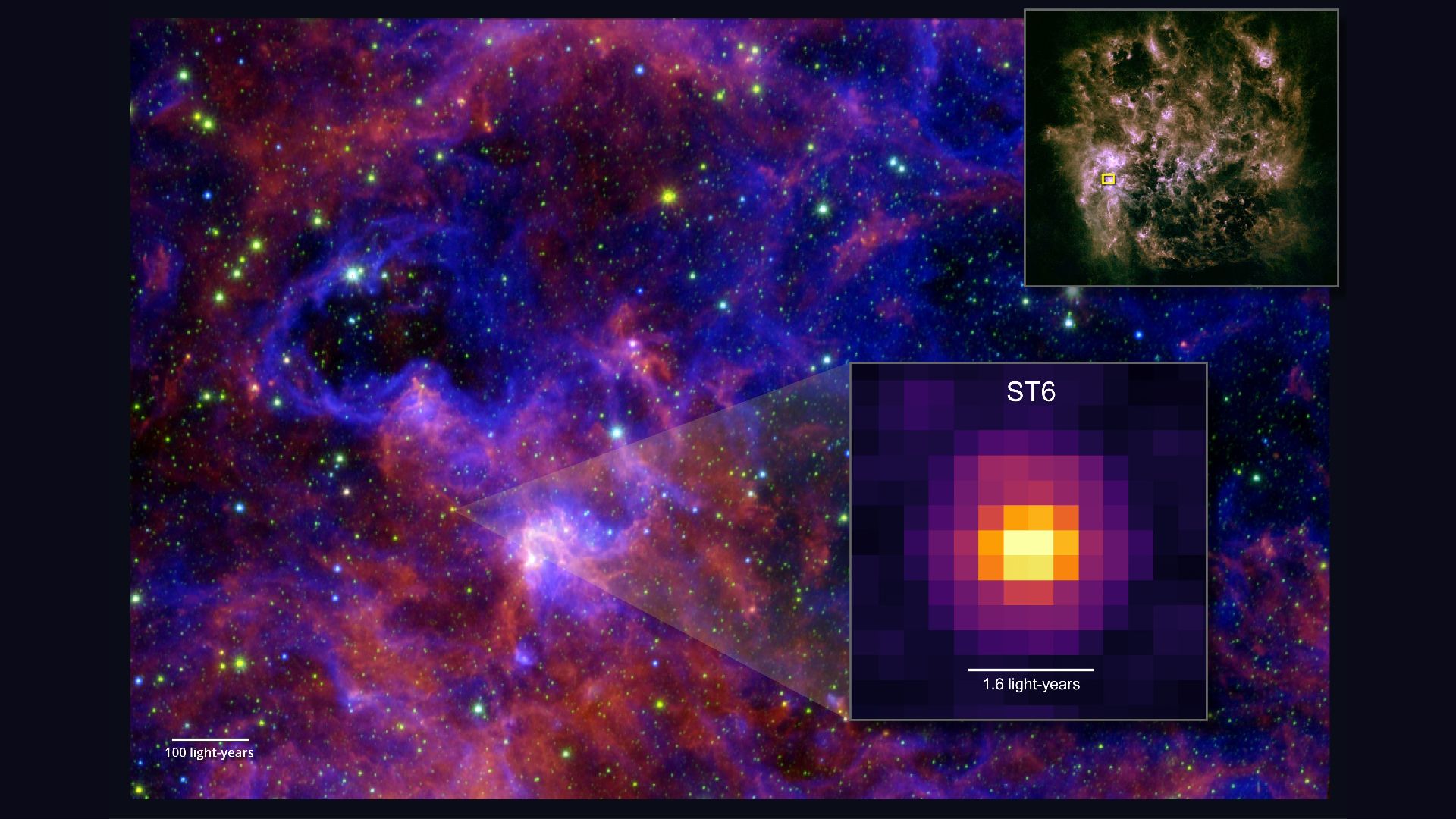
Using the James Webb Space Telescope (JWST), researchers detected five large carbon-based compounds around protostars in the Large Magellanic Cloud, a small galaxy that orbits close to the Milky Way. The discovery could help scientists learn how complex molecules formed in the early universe, according to research published Oct. 20 in Astrophysical Journal Letters.

The Large Magellanic Cloud is a dwarf galaxy 160,000 light-years from Earth that is part of the Local Group, a collection of gravitationally bound galaxies that includes the Milky Way. The Large Magellanic Cloud is full of hot, glowing stars that are bathed in ultraviolet light. It also has fewer elements heavier than helium than the Milky Way. These conditions make them similar to those expected in galaxies in the early universe.

you may like

“What we learn in the Large Magellanic Cloud can be applied to understanding more distant galaxies when the universe was younger,” study co-author Marta Sewilo, an astronomer at the University of Maryland and NASA’s Goddard Space Flight Center, said in a statement. “The harsh conditions tell us more about how complex organic chemistry can occur in primitive environments where there are far fewer heavy elements such as carbon, nitrogen and oxygen available for chemical reactions.”

In March 2024, researchers aimed JWST at a developing star called ST6 in the Large Magellanic Cloud. Using instruments that measure infrared light, they discovered five complex carbon-based molecules in the ice around the star: methanol, acetaldehyde, ethanol, methyl formate, and acetic acid.

Of the five molecules, only methanol has been detected so far in protostars outside the Milky Way. Acetic acid, the main component of vinegar, had never even been conclusively found in space ice until now.

“Before Webb, methanol was the only complex organic molecule definitively detected in the ice around protostars, even in our galaxy,” Sewilo said. “The superior quality of the new observations has allowed us to collect an unprecedented amount of information from a single spectrum.”

Get the world’s most fascinating discoveries delivered straight to your inbox.

The researchers also discovered a signal that may be caused by a chemical called glycolaldehyde, but further research is needed to confirm its presence. Glycolaldehyde reacts with other molecules to form a type of sugar called ribose, which is a key component of ribonucleic acid (RNA), which is essential for life.

The discovery of such complex molecules in the Large Magellanic Cloud suggests that chemical reactions on the surface of dust particles can produce complex molecules even under harsh conditions, the researchers said. In future studies, the researchers plan to look for these and similar molecules around other protostars, both in the Milky Way and in nearby galaxies.

“This discovery represents a major advance in understanding how complex chemistry emerges in the universe and opens new possibilities for studying how life originated,” Sewilo said in a statement.


Source link

#Biotechnology #ClimateScience #Health #Science #ScientificAdvances #ScientificResearch
Follow on Google News Follow on Flipboard
Share. Facebook Twitter Pinterest LinkedIn Tumblr Email Copy Link
Previous ArticleA “miracle” photo that shows Comet Lemon and a meteor intertwined on Earth
Next Article Super Teacher is developing an AI tutor for elementary schools — see us at Disrupt 2025
user
  • Website

Related Posts

How did metamorphosis evolve? |Live Science

November 17, 2025

Vera Rubin Observatory’s first image reveals hidden structure leading up to the Milky Way trailing behind nearby galaxies — Space Photo of the Week

November 16, 2025

Were there female gladiators in ancient Rome?

November 16, 2025
Add A Comment
Leave A Reply Cancel Reply

Latest Posts

Google rolls out AI ‘flight ticket’ tool globally, adds new travel features to search

New Assessment ClickFix Campaign Offers Amatera Stealer and NetSupport RAT

PowerLattice attracts investment from former Intel CEO Pat Gelsinger for power-saving chiplets

Luminal raises $5.3 million to build a better GPU code framework

Trending Posts

Subscribe to News

Subscribe to our newsletter and never miss our latest news

Please enable JavaScript in your browser to complete this form.
Loading

Welcome to Fyself News, your go-to platform for the latest in tech, startups, inventions, sustainability, and fintech! We are a passionate team of enthusiasts committed to bringing you timely, insightful, and accurate information on the most pressing developments across these industries. Whether you’re an entrepreneur, investor, or just someone curious about the future of technology and innovation, Fyself News has something for you.

Meet Your Digital Twin: Europe’s Cutting-Edge AI is Personalizing Medicine

TwinH: The AI Game-Changer for Faster, More Accessible Legal Services

Immortality is No Longer Science Fiction: TwinH’s AI Breakthrough Could Change Everything

The AI Revolution: Beyond Superintelligence – TwinH Leads the Charge in Personalized, Secure Digital Identities

Facebook X (Twitter) Instagram Pinterest YouTube
  • Home
  • About Us
  • Advertise with Us
  • Contact Us
  • DMCA
  • Privacy Policy
  • Terms & Conditions
  • User-Submitted Posts
© 2025 news.fyself. Designed by by fyself.

Type above and press Enter to search. Press Esc to cancel.