
Jeff Bezos, you almost made a good point.
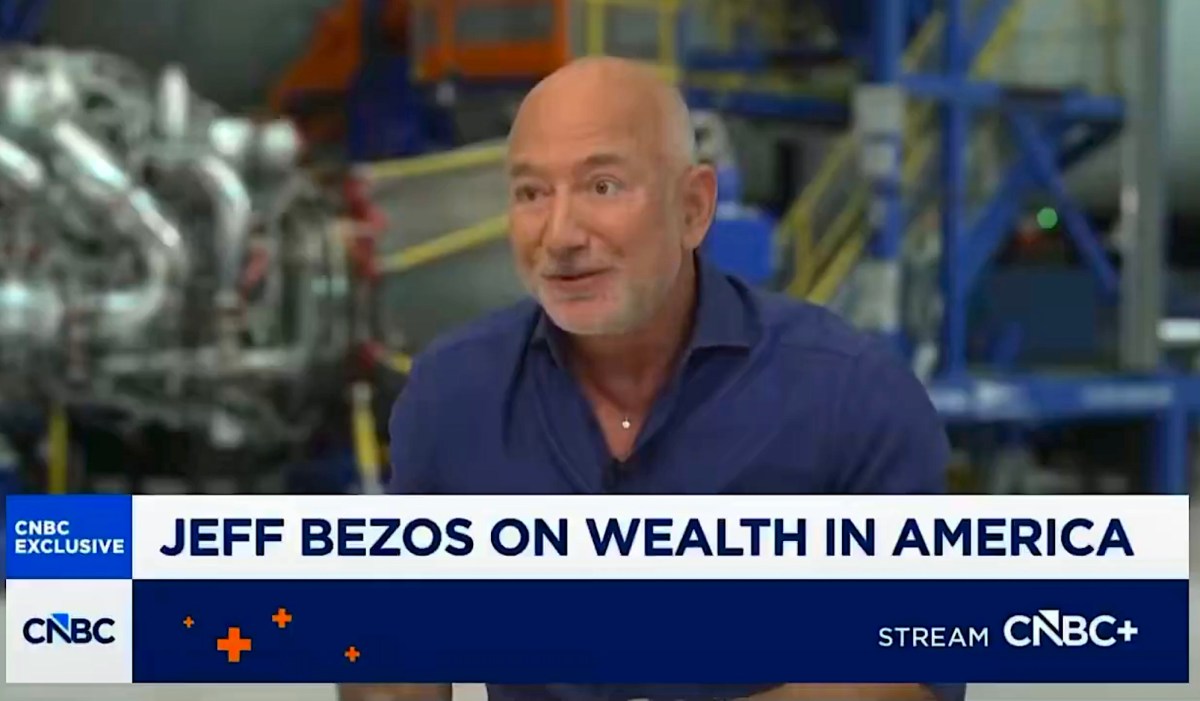
On Wednesday morning, Jeff Bezos said in an interview with CNBC that Americans in the bottom half of income brackets shouldn’t pay taxes.
“Why is a nurse in Queens who makes $75,000 a year paying more than $1,000 a month in taxes?” Bezos said. “That’s $1,000 that could be used for rent, groceries, etc… To me, it’s kind of ridiculous that we’re doing something like this. They shouldn’t be asking this nurse in Queens to send money to Washington. They should send her an apology.”
Mr. Bezos claims that the bottom half of income earners account for only 3% of total tax revenue, but people like the nurse spend about 16% of their pay to generate that negligible share. She is paying a meaningful personal price for funding rounding errors in the federal budget.
It may seem surprising that this moment of empathy would come from Mr. Bezos, one of the world’s richest people. Billionaires like Bezos take advantage of holes in the tax system to pay income taxes on a small percentage of their annual profits. In 2007 and 2011, Bezos paid no income taxes at all. According to research by ProPublica, Bezos’ wealth increased by $127 billion from 2006 to 2018, while his income was reported at $6.5 billion. This amounted to a huge tax bill of $1.4 billion, but the tax rate was only about 1%.
This is not illegal. Americans are not taxed on unrealized gains. This means that even if Amazon’s stock swells and Bezos becomes even richer, he will only pay taxes if he sells the stock. The ultra-wealthy do everything they can to preserve their investments. Instead, they take out huge loans using their stock as collateral, live on those loans, and avoid paying taxes because those loans are technically debt.
Has Jeff Bezos finally realized how unfair this is? Does he now understand the frustration of the middle class, who can’t take out loans on piles of company stock to avoid reporting capital gains?
“[Senator] “Elizabeth Warren has made this point repeatedly… Even though you and others pay huge amounts of taxes, you can probably pay a lower tax rate than me,” CNBC reporter Andrew Ross Sorkin asked Bezos.
It is highly unlikely that Mr. Bezos would invite Sen. Warren to dinner at one of his many mansions. In his words, the United States has a spending problem, not a revenue problem.
“We already have the most progressive tax system in the world,” Bezos said. “The top 1 percent of taxpayers pays 40 percent of all tax revenue. The bottom half pays just 3 percent.”
But Bezos still pays taxes at a lower rate than most Americans. This fact remains true even after paying taxes on the Amazon stock he sold to fund the space exploration company he owns, Blue Origin.
“If people want to pay me billions more, let’s have that discussion, but don’t pretend like that’s going to solve the problem,” Bezos said. “You can double the taxes I pay, but that won’t help.” [nurse] In Queens. ”
Even when juxtaposed against the massive $7.4 trillion federal budget, it’s basically hard to imagine that Bezos couldn’t find some productive use for the billions more in taxes he might pay.
That nurse in Queens would certainly benefit if she could reliably take public transportation to work, or if she could actually send her children to a well-resourced public school. Perhaps she would appreciate being able to go to the hospital in an emergency without having to worry about how to pay thousands of dollars in medical bills.
Of course, these fanciful scenarios depend on our trust that the government will properly distribute our tax dollars in a way that is useful.
Bezos added: “If you really want to have a progressive tax system, you want that money to actually be useful, not just to fit into some sort of administrative bureaucracy.”
But money looks different when it becomes something real and tangible. It’s a finite number that shows up in your bank account every two weeks and should immediately cover your rent, groceries, car payments, student loans, and other debts.
If it’s naive to daydream about what we could achieve if billionaires paid their fair share of taxes, so be it. It is naive to think that we can build a data center on the moon.
If you buy through links in our articles, we may earn a small commission. This does not affect editorial independence.

