
LHC detects extremely rare single top quark for the first time

An incredibly rare phenomenon known as a single top quark has been observed as part of an LHC experiment, paving the way for scientists to gain a deeper understanding of the fundamental forces of nature.
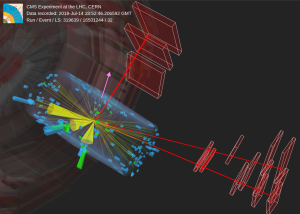
The Large Hadron Collider (LHC) observed this single top quark along with W and Z particles. This is an extremely rare process in which proton collisions occur only once in a trillion.
Finding this event in LHC data is like searching for a needle in a haystack the size of an Olympic stadium.
Pointing to new physics beyond the standard model
The production of a single top quark, W boson, and Z boson, known as the tWZ production, opens a new window into understanding the fundamental forces of nature.
By studying the production of tWZ in detail, physicists can examine how the top quark interacts with the weak power provided by the W and Z bosons.
Furthermore, the top quark is the heaviest known fundamental particle, meaning it has the strongest interaction with the Higgs field, so studying the tWZ process could provide a deeper understanding of the Higgs mechanism.
It may also reveal signs of new phenomena and physics that go beyond the Standard Model.
Advanced analytical techniques to identify tWZ products
However, observing the generation of tWZ is not easy. Not only is this one of the rarest Standard Model processes currently observable at the LHC, it is also extremely complex to analyze.
This process is similar to another process known as ttZ production, in which top and antitop quarks are produced along with the Z boson. This ttZ generation occurs approximately 7 times more frequently than the tWZ generation. This means there is a lot of background noise that researchers need to identify and account for.
Alberto Belvedere, a researcher working with CMS on DESY, explains, “Due to its rarity and similarity to the ttZ process, observing the production of tWZ requires advanced analytical techniques, including cutting-edge machine learning.”
Using machine learning algorithms, the researchers were able to separate the signal from tWZ generation from background data.
Uncovering nature’s most elusive secrets at the LHC
The CMS collaboration found that the rate of tWZ formation was slightly higher than predicted by theory.
Future data and analysis will reveal whether this is just a statistical variation, or whether it could be the first hint of something beyond the known laws of physics.
“When unknown interactions and particles are involved, the observed deviation between the measured and predicted rates of tWZ production increases rapidly with increasing energy of the outgoing particles, an effect specific to the tWZ process,” said Roman Kogler, CMS co-investigator at DESY.
So far, the CMS collaboration has observed an extremely rare phenomenon in which a proton-proton collision occurs only once in a trillion.
This rare single top quark phenomenon is yet another reminder of the LHC’s ability to reveal nature’s most elusive secrets as part of its experiments.
Source link

