



New simulations reveal that the dark matter near the center of our galaxy is not as round as previously thought, but is “flattened.” The discovery may point to the origin of the mysterious high-energy glow that has puzzled astronomers for more than a decade, but further research is needed to rule out other theories.
“When the Fermi Space Telescope pointed at the center of the galaxy, too many gamma rays were measured,” researcher Mourits Mikkel Mur of Germany’s Potsdam Leibniz Institute for Astrophysics and Estonia’s University of Tartu told Live Science in an email. “Various theories are competing to explain what is producing that excess, but no one yet has a definitive answer.”
Scientists early on suggested that the glow was caused by dark matter particles colliding with each other and annihilating them. However, the flattened shape of the signal did not match the spherical halo assumed in most dark matter models. This discrepancy has led many scientists to favor an alternative explanation for millisecond pulsars, ancient fast-spinning neutron stars that emit gamma rays.
you may like
Now, a study led by Mull, published October 16 in the journal Physical Review Letters, casts doubt on long-held assumptions about the shape of dark matter. Using advanced simulations of the Milky Way, Mull and his colleagues found that the dark matter near the center of the galaxy is not perfectly circular, but rather flat, similar to the observed gamma-ray signal.
persistent space puzzle
Gamma rays are the most energetic form of light. They are often produced in the universe’s most extreme environments, such as violent explosions of stars or matter swirling around black holes. But even after accounting for known sources, astronomers consistently find an unexplained glow emanating from the Milky Way’s center.
One explanation that has been proposed is that the radiation comes from dark matter, the invisible matter that makes up most of the mass of the universe. Some models suggest that dark matter particles occasionally collide, and some of their mass may be converted into bursts of gamma rays.
“There are no direct measurements of dark matter, so we don’t know much about it,” Mull said. “One theory is that dark matter particles can interact and annihilate. When two particles collide, they release energy as high-energy radiation.”
However, this theory fell out of favor because the flat, disk-like shape of the gamma rays did not match the hypothesized shape of the dark matter halo, which is thought to be spherical.
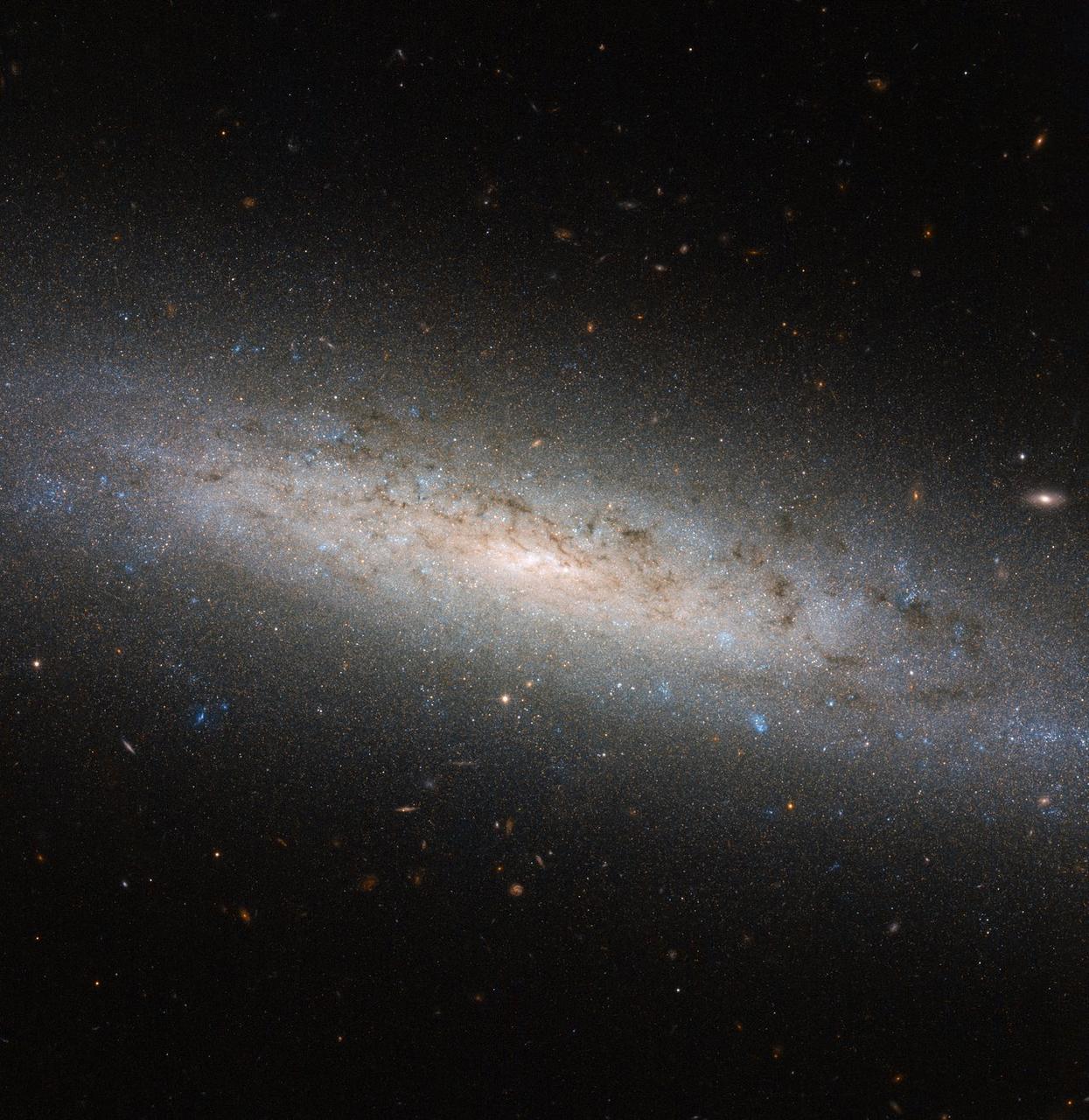
Rethinking the shape of dark matter
Mull and his colleagues set out to reconsider the basic assumption that dark matter inside galaxies must be spherical. The research team studied how dark matter behaves near the galactic center using high-resolution computer simulations known as the “HESTIA suite” that recreate galaxies like the Milky Way in a realistic space environment.
The researchers found that past mergers and gravitational interactions can distort the distribution of dark matter, flattening it into elliptical or box-like shapes. This is very similar to the star bulge seen in the middle of our galaxy.
you may like
“Our most important result is that we show that the reason the dark matter interpretation is not supported stems from a simple assumption,” Mull said. “We found that dark matter near the center is flat, not spherical. This brings us one step closer to using clues coming from the center of the galaxy to reveal what dark matter actually is.”
This revised picture means that the gamma-ray pattern expected from the disappearance of dark matter could naturally be very similar to what astronomers observe. In other words, the dark matter explanation may have been underestimated because scientists were using the wrong geometry.
what happens next
The new findings strengthen the case that dark matter is the origin of gamma-ray signals, but they do not end the debate. To distinguish between dark matter and pulsars, astronomers need sharper observations.
“A clear sign of a stellar explanation will be the discovery of enough pulsars to explain the gamma-ray glow,” Mull said. “New telescopes with higher resolution are already being built, which could help answer this question.”
Future instruments such as the Square Kilometer Array (SKA) and Cherenkov Telescope Array (CTA) will favor the pulsar explanation if they reveal many small, point-like sources at the centers of galaxies. If instead, the radiation remained smooth and diffuse, the dark matter scenario would gain support.
“The ‘smoking gun’ for dark matter would be a signal that exactly matches the theoretical predictions,” Mur said, adding that such confirmation would require both improved modeling and better telescopes. “Even before the next generation of observations, our models and predictions are steadily improving. One of our future prospects is to find other places where we can test our theory, such as the central regions of nearby dwarf galaxies.”
The gamma-ray excess mystery has been going on for more than a decade, and each new study adds another piece to the puzzle. Whether the glow comes from dark matter, pulsars, or something entirely unexpected, Mull’s findings highlight how the very structure of galaxies holds important clues. By reshaping our understanding of the Milky Way’s dark core, scientists are inching closer to answering one of the most profound questions in modern astrophysics: What actually is dark matter?