
NASA reveals first phase of giant moon base plan
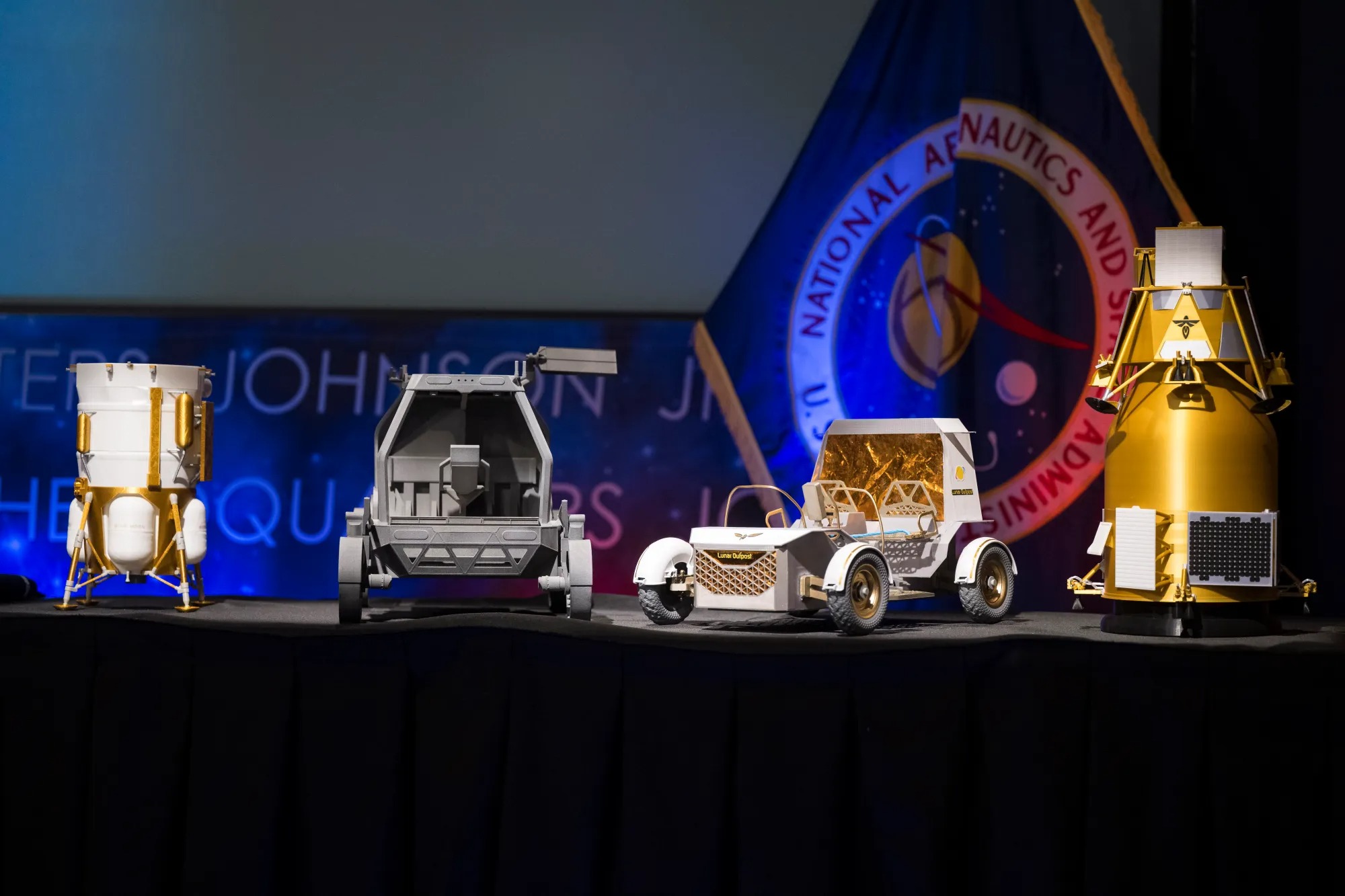
NASA has announced the first phase of a mission to deliver a vast lunar base near the moon’s south pole. The lander, buggy, and drone were all commissioned by Blue Origin and Firefly Aerospace.
Following the success of Artemis II’s lunar orbit, NASA is moving forward with plans to establish a lunar base.
Tuesday revealed the first three of more than a dozen planned missions, as well as multiple multimillion-dollar contracts awarded to U.S. companies to design and deliver new robots and technological equipment.
The first three moon-based missions are:
Lunar Base I: On this mission, scheduled for this fall, Blue Origin’s Blue Moon Mark 1 Endurance lander will deliver payloads such as a stereo camera for the Lunar Plume Surface Research Instrument to study how thrusters interact with the moon’s surface, and a laser retroreflector array that will use reflected laser light to help determine the orbiting spacecraft’s more precise location. The mission is scheduled to land on Shackleton Connecting Ridge to test the ability to reduce risk for a future manned Artemis landing mission in 2028. Lunar Base II: A second mission, also planned for late 2026, will leverage Astrobotic’s Griffin lander, including Astrolab’s FLIP rover, to mature mobility systems that will inform future Lunar Terrain Vehicle (LTV) operations. Lunar Base III: The third mission in 2026 will fly selected payloads through NASA’s Lunar Payload and Research Initiative. Lunar Vertex will fly on Intuitive Machines’ Nova-C Trinity lunar lander to study the moon’s vortices to better understand surface evolution and material behavior under extreme conditions. The mission includes payloads from ESA (European Space Agency) and the Korea Institute of Astronomy and Space Science.
Artemis astronauts plan to land on the moon as early as 2028
Next year’s Artemis III mission will see astronauts practice docking the lunar lander developed by Blue Origin and SpaceX with NASA’s Orion capsule in Earth orbit.
A mission to land two astronauts is scheduled soon. Work to build the infrastructure to support the lunar base, including a power grid, will take place between 2029 and the 2030s, with a third phase in which a dedicated permanent habitat will be built in the late 2030s.
“Then we’ll be able to say, ‘We’re going to be here forever and we’re not going to give up,'” said Carlos García Galán, NASA’s lunar base program director.
“The moon base will be the first outpost for America and humanity on another celestial world,” said NASA Administrator Jared Isaacman. “Every mission, manned or unmanned, will be a learning opportunity for us to return to the moon, build the infrastructure to stay there, and acquire the skills necessary to live and operate in one of the harshest and most dangerous environments imaginable. We will aim for science, we will seek everything we can get from an economic and technological perspective, we will seek innovations that will make life better on Earth, and we will prepare for where we inevitably go next.”
A permanent lunar base is thought to be an important part of future expeditions to the solar system. Isaacman acknowledged that these programs were designed to establish a lunar economy, advance scientific research, and lay the foundation for future exploration of Mars.
“For those who have been patient, the grand return is at hand, and we have no intention of slowing down,” Isaacman said. “We’re really just getting started.”
Over $627 million in contracts signed
NASA has confirmed two $219 million and $220 million contracts with Astrolab and Lunar Outpost for the construction and delivery of the LTVS, awarded under the Phase 1 High Achievement Mission Task Order of the Lunar Terrain Vehicle Services contract.
Astrolab’s Manned Lunar Reconnaissance Vehicle (CLV-1) is a manned lunar rover designed to transport crew, supplies, and support remote operations. It has a mass of approximately 2,000 pounds and can travel up to 6 miles per hour on flat terrain.
Lunar Outpost’s Pegasus is a lighter and faster modification of the Eagle spacecraft, capable of reaching speeds of 9 miles per hour with manual, autonomous, or remote control.
To deliver these rovers to the Moon’s south pole region, NASA awarded Jeff Bezos’ Blue Origin $188 million and an option period worth $280.4 million on two task orders. This includes an option period based on initial performance. NASA has the option to extend the task order for payload delivery.
NASA plans to invite more vendors for collaboration on lunar technology through the OnRamp Competition and is already planning the next round of opportunities to compete for Commercial Lunar Payload Services (CLPS) 1.0 and 2.0 task orders as Phase 1 technology demonstrations are defined and planned for moon-based missions.
Source link

