

Close Menu
  • Home
  • Identity
  • Inventions
  • Future
  • Science
  • Startups
  • Spanish
What's Hot

Google Gemini Prompt Injection Flaw Exposes Private Calendar Data via Malicious Invites

Rogue agents and shadow AI: Why VCs are betting big on AI security

Now, the Metaverse begins!

Facebook X (Twitter) Instagram
  • Home
  • About Us
  • Advertise with Us
  • Contact Us
  • DMCA
  • Privacy Policy
  • Terms & Conditions
  • User-Submitted Posts
Facebook X (Twitter) Instagram
Fyself News
  • Home
  • Identity
  • Inventions
  • Future
  • Science
  • Startups
  • Spanish
Fyself News
Home » New images of Comet Another Atlas (C/2025 K1) reveal it splits apart before approaching Earth
Science

New images of Comet Another Atlas (C/2025 K1) reveal it splits apart before approaching Earth

userBy userNovember 13, 2025No Comments3 Mins Read
Share Facebook Twitter Pinterest Telegram LinkedIn Tumblr Email Copy Link
Follow Us
Google News Flipboard
Share
Facebook Twitter LinkedIn Pinterest Email Copy Link

New observations have revealed that the ‘other’ Comet Atlas has broken apart, turning into a cloud of debris spilling into space.

The comet, called C/2025 K1 (ATLAS), was discovered in May by astronomers from the Asteroid Earth Impact Last Alert System (ATLAS) and passed through perihelion, or the closest point to the sun, on October 8. It has no relation to the famous interstellar comet 3I/ATLAS, except that it was discovered at the same time and by the same telescope network.

Early observations seem to suggest that comet K1 survived a pass around our star a minimum distance of 31 million miles (50 million kilometers), or about four times closer than comet 3I/ATLAS.

you may like

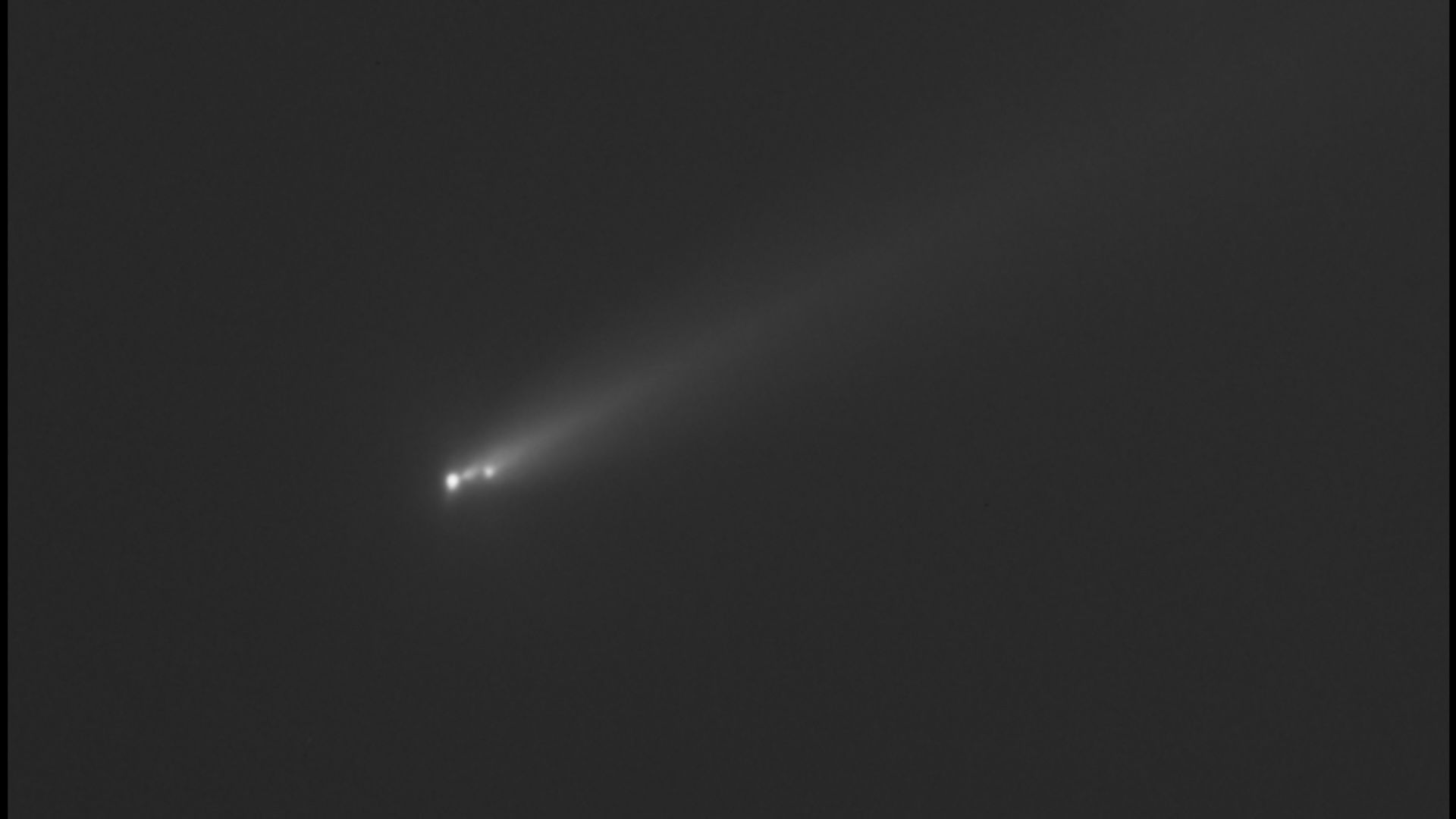
But new observations made by astronomer Gianluca Masi in Manciano, Italy, show that the gravitational pull of the voyage around the sun was too much for the comet, causing it to break up into several pieces, or clouds.

“Several parts (subnuclei or debris clouds) are visible, as well as a plume just below the leading debris (first debris from the left),” Masi, an astronomer at the Campo Catino Observatory and founder of the Virtual Telescope Project, wrote in an update.

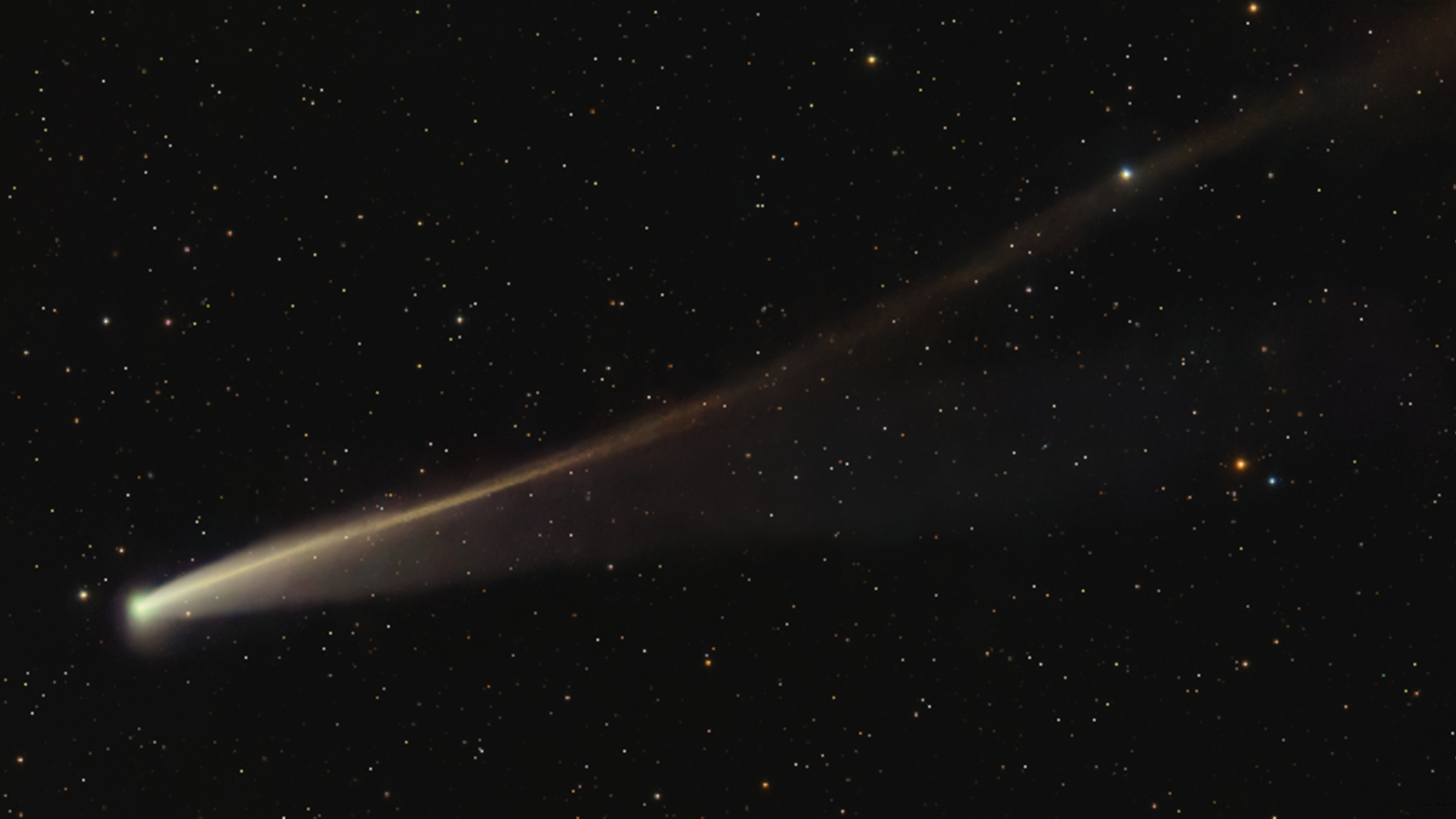
The collapse of C/2025 K1 was heralded by a sudden brightening event near perihelion that changed the comet from the greenish hue seen in many comets that fly close to the Sun (caused by the presence of diatomic carbon, which fluoresces in sunlight) to a striped golden ribbon.

The cause of this change is unknown. Some scientists have speculated that the color change may be related to the relative lack of carbon-containing molecules in the comet’s coma, the cloud of ice, gas, and dust around its body.
Get the world’s most fascinating discoveries delivered straight to your inbox.

Photo of a golden comet with a long waving tail in the night sky

Recent photos of C/2025 K1 (ATLAS) show it emitting a golden glow after passing its closest point to the Sun. (Image credit: Dan Bartlett)

According to The Sky Live, if you want to see an exploded comet for yourself, take a peek into the constellation Leo. There it shines with a magnitude of 9.9. (In astronomy, lower magnitudes correspond to brighter objects; for example, Regulus, the brightest star in the constellation Leo, has an apparent magnitude of about 1.35.) The comet is still too faint to see with the naked eye, but it can be spotted with a powerful telescope or stargazing binoculars.

The comet’s survivors are scheduled to make their closest approach to Earth on November 25th. It will come within about 37 million miles (60 million kilometers), or less than half the average distance between Earth and the sun.


Source link

#Biotechnology #ClimateScience #Health #Science #ScientificAdvances #ScientificResearch
Follow on Google News Follow on Flipboard
Share. Facebook Twitter Pinterest LinkedIn Tumblr Email Copy Link
Previous ArticleFive months later, bottles of $1,200 Besties All-In Tequila are finally starting to ship.
Next Article Russian hackers create 4,300 fake travel websites to steal hotel guests’ payment data
user
  • Website

Related Posts

James Webb Telescope reveals clearest look yet at black hole’s edge – and it could solve major galactic mysteries

January 19, 2026

NASA launches Pandora telescope to take JWST’s search for habitable worlds to a new level

January 18, 2026

Strange discovery reveals ‘missing link’ in planet formation: ‘This fundamentally changes the way we think about planetary systems’

January 18, 2026
Add A Comment
Leave A Reply Cancel Reply

Latest Posts

Google Gemini Prompt Injection Flaw Exposes Private Calendar Data via Malicious Invites

Rogue agents and shadow AI: Why VCs are betting big on AI security

Now, the Metaverse begins!

BioticsAI, winner of Disrupt’s Battlefield competition in 2023, receives FDA approval for its AI-powered fetal ultrasound product

Trending Posts

Subscribe to News

Subscribe to our newsletter and never miss our latest news

Please enable JavaScript in your browser to complete this form.
Loading

Welcome to Fyself News, your go-to platform for the latest in tech, startups, inventions, sustainability, and fintech! We are a passionate team of enthusiasts committed to bringing you timely, insightful, and accurate information on the most pressing developments across these industries. Whether you’re an entrepreneur, investor, or just someone curious about the future of technology and innovation, Fyself News has something for you.

Castilla-La Mancha Ignites Innovation: fiveclmsummit Redefines Tech Future

Local Power, Health Innovation: Alcolea de Calatrava Boosts FiveCLM PoC with Community Engagement

The Future of Digital Twins in Healthcare: From Virtual Replicas to Personalized Medical Models

Human Digital Twins: The Next Tech Frontier Set to Transform Healthcare and Beyond

Facebook X (Twitter) Instagram Pinterest YouTube
  • Home
  • About Us
  • Advertise with Us
  • Contact Us
  • DMCA
  • Privacy Policy
  • Terms & Conditions
  • User-Submitted Posts
© 2026 news.fyself. Designed by by fyself.

Type above and press Enter to search. Press Esc to cancel.