


Amid evolving regulatory demands, customer pressures, and environmental standards, there is an urgent need for manufacturers to improve visibility and understanding of hazardous PFAS chemicals in their products.
PFAS has moved from a niche chemical problem to a strategic test of how global manufacturing systems manage risk, redesign products, and protect public health.
PFAS have been woven into coatings, membranes, surfactants, lubricants, and critical performance materials for decades across sectors such as automotive, aerospace, batteries and gigafactories, food and beverage, life sciences, pharmaceuticals, electronics, industrial equipment, energy systems, apparel, and chemicals.
At the same time, regulators and courts in North America, Europe, and Asia Pacific are rapidly tightening their expectations. TSCA PFAS reporting in the United States, CERCLA hazardous substance designations, state-level product bans, the new EU REACH “universal restrictions,” and stricter water and waste standards all share a common premise:
Manufacturers need to know and be able to prove where PFAS chemicals are present in their products and supply chains.
For most companies, that assumption remains far from reality. The fundamental problem is not a lack of effort. It’s a lack of visibility.
Why PFAS is now a board and policy priority
PFAS are unusual because they concentrate multiple forces at once.
Tightening regulations. The new proposed requirements span TSCA reporting, CERCLA liability, national product bans, “currently unavoidable use” regimes, EU REACH restrictions, and sector-specific rules. Each regime defines PFAS slightly differently and moves along its own timeline. Litigation and Liability. Companies from all sectors are being drawn into remediation, cost recovery, and product liability efforts. Legal arguments increasingly hinge on what companies “knew or should have known” about their use and release of PFAS. Customer and value chain pressures. OEMs and global brands are requiring suppliers to certify PFAS-free or PFAS-controlled products and are beginning to factor PFAS into their sourcing decisions and long-term partnerships. ESG and capital markets. PFAS exposure shows up in ESG ratings, lender due diligence, and investor questions. Companies that cannot quantify or explain their PFAS footprint are considered high risk.
For boards, PFAS chemicals are no longer just an EHS or regulatory topic. It concerns strategy, capital allocation, product roadmaps, reputation, and more.
Visibility gaps in complex manufacturing supply chains
A central issue is the visibility of PFAS. Most manufacturers, even the most sophisticated, work with partial, inconsistent, or outdated information. Five structural challenges exist in almost every sector:
PFAS are buried in product complexity
Modern products can contain thousands of parts and materials sourced from multi-tiered global supply chains. PFAS may be present in surface treatments, polymer additives, films, or specialty lubricants that are several layers away from the OEM. Document is incomplete by design
Safety data sheets and specifications often omit PFAS as impurities at low levels, or suppliers claim trade secrets. These omissions may be legally compliant, but leave downstream manufacturers blind. Data is fragmented and unstructured
Relevant information is stored in ERP and PLM systems, purchasing records, supplier portals, SDS libraries, email attachments, and lab reports. Format may also vary by supplier, country, and year. Definitions and Lists Continue to Evolve PFAS may be defined structurally, by list, or functionally, and their scope changes in response to advances in science and policy. A chemical that is “out of range” one year may be “in range” the next. Manual, one-time process
Supplier surveys, spreadsheet inventories, and ad hoc SDS checks are manageable for tens or hundreds of materials rather than tens of thousands, but quickly become obsolete as portfolios and regulations change.
The result is a PFAS blind spot. Companies will be required to sign PFAS declarations, submit regulatory reports, and claim “PFAS-free” based on a data foundation that everyone acknowledges is incomplete.
Why traditional toolkits won’t last until 2026
Most organizations use a combination of four tools: supplier surveys, SDS reviews, selective lab testing, and static inventory. Each has a role to play, but they cannot shoulder all of the expectations of PFAS in 2026.
Supplier surveys rely on upstream knowledge and goodwill, and often yield inconsistent answers. SDS reviews are time consuming and limited by the declarations. Although laboratory testing is powerful, it is too expensive and too narrow to map PFAS chemicals across a product portfolio. Static inventories and one-time PFAS “projects” quickly become outdated as products, suppliers, and regulations evolve.
As regulations have expanded to include annual reporting, PFAS limits and bans, PFAS cannot be managed as a one-time reporting activity. This should be treated as an ongoing data and decision-making issue.
That requires a different kind of infrastructure. In other words, an infrastructure that can continuously transform scattered, messy information into a living, defensible PFAS inventory.
Actual capabilities of PFAS AI (a platform dedicated to AI-first)
The term “AI” has a broad meaning. For PFAS, the key question is not whether AI is being used, but whether the AI is specific to PFAS chemistry, product, regulatory, and supply chain data.
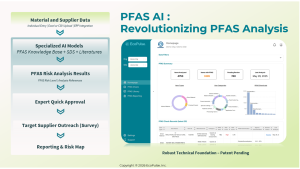
EcoPulse represents the next generation of PFAS detection and supply chain intelligence, the PFAS AI Platform (patent pending). Designed specifically for PFAS analysis, it uses specialized large-scale language models, a curated knowledge base, and workflow automation to deliver fast, reliable insights.
1. Unparalleled depth of analysis
PFAS AI goes far beyond a simple “yes/no” answer. It accomplishes the following:
Chemical-level insights Regulatory classification Evidence-supported decisions Quantitative estimates where possible
This level of detail creates trust internally, with regulators, and with customers.
2. Scale and efficiency
PFAS AI can analyze thousands of materials in a timely manner, allowing companies to quickly build a near-complete PFAS inventory. This eliminates manual review bottlenecks and reduces reliance on time-consuming supplier surveys. Recent enterprise pilots and deployments have demonstrated clear comparisons.
Manual review (for comparable results):
1 hour/10 documents PFAS AI Review: 30 seconds/10 documents
Assuming a labor cost of $100 per hour, the savings for analyzing 10,000 documents is approximately $100,000. This is a very impressive amount, especially for a company with hundreds of thousands of documents to review.
3. Audit-ready documentation
All results come with traceable logic, references, and structured evidence to create documentation suitable for:
• TSCA (US EPA) and similar reports from other countries.
country
• PFAS submissions by state
• Customer inquiries
• Internal audit
• Litigation defense
4. Unified Workflow for Compliance Teams
PFAS AI is not a replacement for experts. It accelerates their work. Built-in review and QA workflows allow teams to confidently validate analyzes, track decisions, and maintain a complete history for future audits.
5. Path to broader compliance
Although PFAS is urgent today, the PFAS AI approach could be extended to additional substance management. Companies adopting an AI knowledge base model are now building an infrastructure for future continuous compliance.
5 Questions Business Executives Should Ask About PFAS Data
Do we really know where PFAS are in our products and supply chains, or are we relying on assumptions?
As a company executive, you should insist on seeing a product-level and material-level view of PFAS exposure and a clear explanation of how that view was constructed. If the answer is “we think” rather than “this is our documented inventory,” then you have work to do.
Can you defend your PFAS disclosures and decisions to regulators, customers, or courts?
Regulators, investors, and litigators will increasingly ask not just what the PFAS position is, but how we arrived at that position. For a sample of the product, you should be able to see the underlying documentation, logic, and expert approvals that support the PFAS determination.
How quickly can you update your PFAS views if regulations, suppliers, or product design change?
The PFAS regime is evolving. New lists, thresholds, and prohibitions will continue to emerge. How long does it take today to update a portfolio’s PFAS view after a major change, such as new EU restrictions, the withdrawal of a key supplier, or a platform redesign?If the answer is measured in quarters or years, the risks are high. Modern PFAS data approaches should be able to rerun analyzes in days or weeks rather than rebuilding them from scratch.
Where does PFAS risk intersect with our growth strategy and capital allocation?
PFAS are more than just a compliance cost. It’s a strategic variable. It can affect the viability of future product lines, the economics of a particular site, and the attractiveness of acquisitions. Seek a PFAS risk overlay to your strategy.
Which growing products are most exposed to PFAS? Which sites are at greatest regulatory or remediation risk? Where might PFAS restrictions create a competitive disadvantage or advantage? Are we using PFAS-specific technology, or are we trying to solve the 2026 problem with tools from the 1990s?
Spreadsheets, email surveys, and static inventory can no longer keep up with regulatory expectations and portfolio complexity. By using PFAS-specific AI and data infrastructure, teams can benefit from:
Capture and harmonize PFAS-related data at scale Interpret PFAS chemicals and regulations, not just keywords Create transparent, audit-ready inventories
What will “good” look like in 2026?
In 2026, the PFAS conversation will be less about awareness and more about performance.
Both require the same foundation. It’s a defensible shared understanding of PFAS chemicals in real products and real supply chains.
EcoPulse’s PFAS AI is not a substitute for policy, science, or leadership. However, it is a practical and efficient way to close PFAS blind spots, turning scattered documentation into decision-level insights and helping industry, regulators, and investors move from crisis response to long-term, evidence-based PFAS strategies.
Schedule a demo to explore PFAS AI and try it out using your own materials/components. You can also email us at contact@ecopulsenow.com for any questions or feedback. Ecopulse website
This article will be published in an upcoming PFAS Special Focus Publication in January.
Source link
