
PFAS destruction and eVTOL project wins first ERS grant from University of Toledo
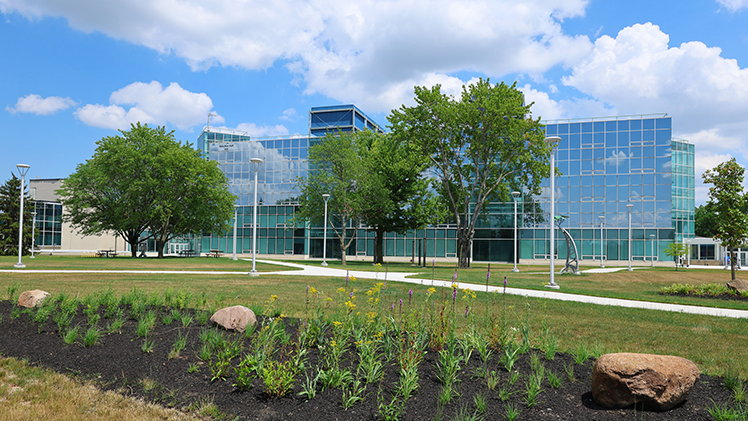
Projects selected for funding from the newly formed Engineering Research Society (ERS) include research into destroying PFAS and using AI to advance aerodynamic modeling for electric vertical takeoff and landing (eVTOL) aircraft.
The University of Toledo College of Engineering announced its first grant award from the Engineering Research Society (ERS). This was an important step toward strengthening the university’s research profile as part of UTledo’s designation as a Carnegie R1 research institution.
ERS is a membership-based organization co-led by alumni Don Warner (Class of ’76) and Deb Dauer (Class of ’81) and was established to support and advance research within the College of Engineering. Since its inaugural meeting, which brought together founding members, faculty, alumni, and supporters, the association has raised $800,000 toward its original gift goal of $1 million.
“These projects exemplify the quality, relevance and interdisciplinary strength of our undergraduate research, and reflect the very purpose of ERS to provide major external funding and timely seed support to foster broader impact,” said Mohammad Elahiniyah, Dean of the School of Engineering and ERS member. “We are grateful to everyone who contributed to the success of this first ERS event, and we look forward to continuing to build on the momentum of engineering research, innovation, and collaboration across the university.”
The winning presentation focused on AI and PFAS
After the first round of research presentations, ERS members voted to award seed funding to two faculty research teams to accelerate their projects in preparation for major external grant applications.
AI-driven aerodynamic modeling for future air mobility (eVTOL)
The first project, titled “AI-driven aerodynamic modeling for future air mobility (eVTOL),” will be led by Dr. Chunhua Sheng, professor in the Department of Mechanical, Industrial, and Manufacturing Engineering and director of the Computational Fluid Dynamics Laboratory, and Dr. Qiuying Zhao, associate professor of engineering technology. Their research leverages artificial intelligence to advance aerodynamic modeling of electric vertical takeoff and landing (eVTOL) aircraft, a rapidly expanding field in aerospace and transportation engineering.
Integrated plasma biological treatment for PFAS destruction
The second funded project, “Integrated Plasma Biological Processing for PFAS Destruction,” is led by Abbas Semnani, Ph.D., Dean’s Fellow in the College of Engineering, associate professor in the Department of Electrical Engineering and Computer Science, and director of the Adaptive Radio Frequency and Plasma Laboratory, along with Dr. Yong Seo, professor in the Departments of Civil and Environmental Engineering and Chemical Engineering, Peter Hess Fellow, and director of the COE Water and Environmental Research Initiative. This multidisciplinary project combines plasma and biological treatment methods to destroy per- and polyfluoroalkyl substances (PFAS), persistent environmental pollutants known as “forever chemicals” because of their resistance to natural degradation and associated public health risks.
ERS will support two projects each year with funding
The Engineering Research Society distributes grants annually from the UToledo Foundation’s endowment to support two categories of researchers. One is a junior faculty member seeking start-up funding for a promising new project, and the other is an established researcher who needs bridge funding to secure an external grant.
Research areas supported by ERS include advanced manufacturing, artificial intelligence, automation, biomedical devices, energy systems, engineering education, materials development, and sustainability. Membership is available to individuals, corporations, and organizations interested in supporting this effort.
Source link

