

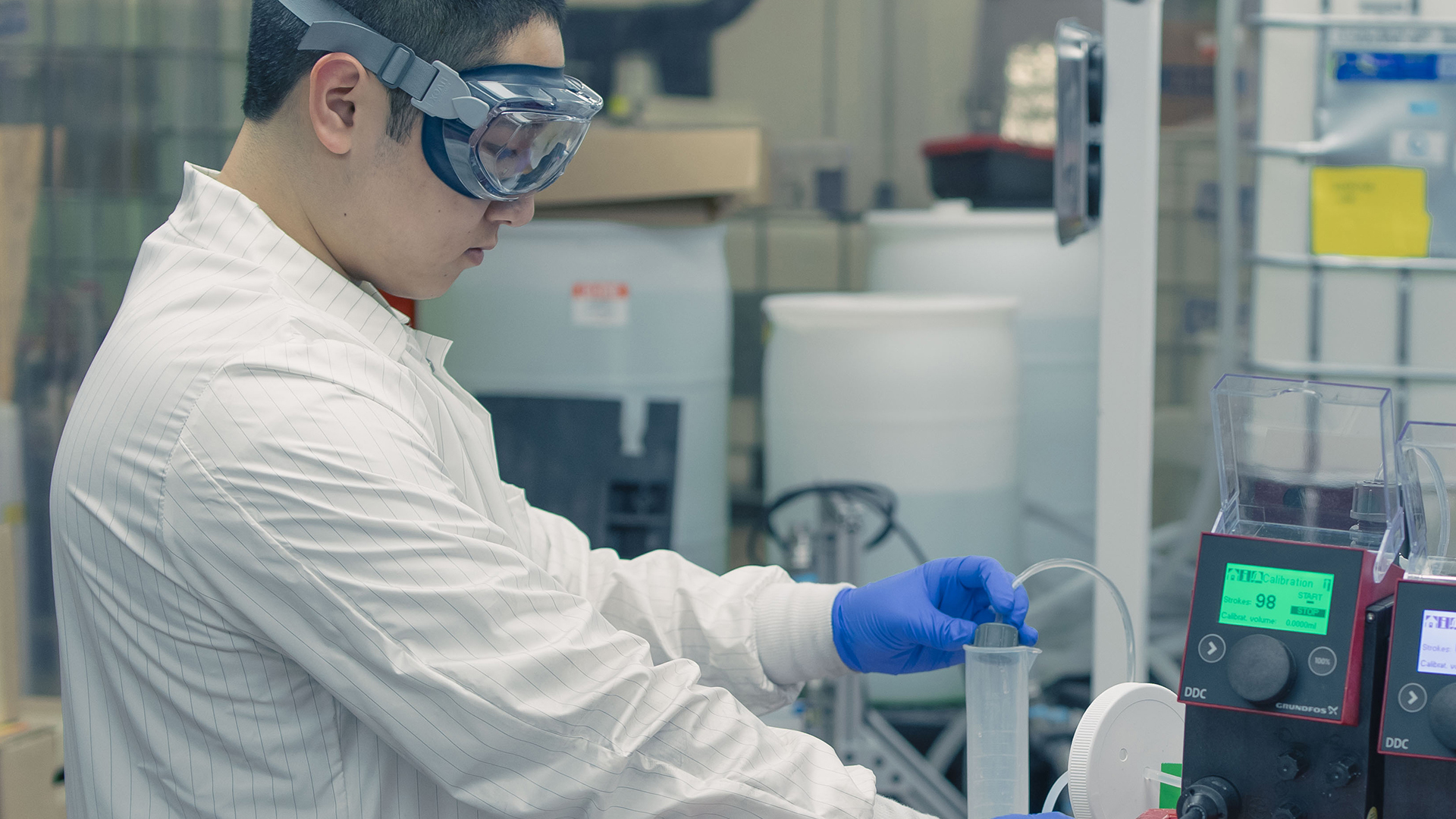
In a recent commercial optimization run with a major industrial manufacturer, ClarosTechUV™ destroyed up to 99.99% of targeted PFAS compounds, including long, short, and ultra-short chains, and treated hundreds of thousands of gallons of process water.
In an industry facing increasing regulatory pressure against PFAS (“forever chemicals”), traditional “trap and contain” techniques are insufficient. Granular activated carbon (GAC), ion exchange resins, membranes, and sorbents can remove PFAS from wastewater, but they do not solve the problem. Simply moving it downstream creates PFAS concentrates that must be disposed of, incinerated, or special treated, often at significant cost.
As waste restrictions tighten and regulatory oversight increases, the real costs of containment become unsustainable. What is needed is destruction, not capture.
Industry is moving from PFAS treatment to PFAS removal
Why destruction is important:
Collected PFAS becomes waste and must be disposed of. Disposal options are limited and costs are rising. Remove waste before it leaves the facility.
ClarosTechUV™ uses a proprietary UV photochemical process to integrate with a wide range of industrial flow conditions, from small volume process streams to high flow applications, and is built to scale as your processing needs evolve. The system is designed for real industrial wastewater rather than laboratory simulations, and its performance has been verified under typical manufacturing wastewater conditions.
Main advantages of the system:
Permanently destroys up to 99.99% of targeted PFAS compounds, including long, short, and ultra-short chains. Commercial-scale operations across industrial flow conditions. Lower operating costs compared to collection/disposal cycles. Operates at ambient temperature and pressure with a compact footprint.
ClarosTechUV™ meets the needs of manufacturers and other industrial operators who want to remove PFAS at the source before their wastewater enters broader wastewater or disposal streams.
How ClarosTechUV™ works
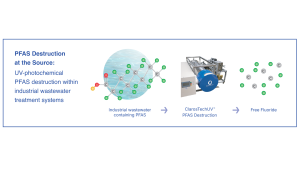
Rather than transferring PFAS to secondary waste, ClarosTechUV™ uses a patented UV photochemical system to break down PFAS molecules. This treatment is done on a large scale in high-flow wastewater systems, allowing the facility to efficiently treat large volumes of water.
Where it fits into your industrial wastewater workflow
ClarosTechUV™ integrates seamlessly into industrial wastewater treatment systems. PFAS-containing effluents from manufacturing or chemical processing can be treated directly, operated as an upstream pretreatment step in other processes, or to replace collection and disposal cycles that repeatedly generate waste. In each case, they offer a scalable alternative to approaches that rely on transport, recycling, incineration, or long-term waste disposal.
Compared to traditional PFAS recovery technologies, treatment trains incorporating ClarosTechUV™ avoid producing concentrated PFAS waste streams that require downstream disposal. This supports mitigating risks related to regulatory compliance, scrutiny, and potential litigation.
Validating PFAS Destruction with ClarosLabs™: Analysis to Establish Confidence
Effectively destroying PFAS requires reliable measurements, not assumptions. The absence of PFAS in wastewater must be demonstrated by robust high-resolution analysis, especially for short-chain and ultra-short-chain species that often evade standard testing.
ClarosLabs™ supports your ClarosTechUV™ implementation with comprehensive analytical services. They detect and quantify PFAS across a wide range of PFAS compounds before treatment and confirm destruction after treatment. This establishes a defensible record of regulatory compliance and internal risk management.
ClarosLabs™ analysis scope includes:
Quantitative measurement of over 40 PFAS compounds across long, short, and ultrashort chains. Screen a wider range of over 9,000 PFAS chemicals. Advanced detection workflows including combustion ion chromatography (CIC), high-resolution mass spectrometry, and other regulatory-grade methods for total organic fluorine (TOF) measurements.
ClarosLabs™ provides defensible PFAS removal verification. This evidence-based approach gives downstream stakeholders, regulators, and compliance teams confidence that PFAS will not only be migrated, but destroyed.
Commercial and regulatory benefits of in-situ destruction
Eliminate dependence on disposal and reduce recurring costs
For many industrial operations, PFAS management is not just about treatment, but also about disposal burdens such as used media recycling, incineration, hazardous waste transportation, manifesting, and ongoing regulatory compliance. By implementing ClarosTechUV™, industrial wastewater manufacturers can completely avoid these recurring costs.
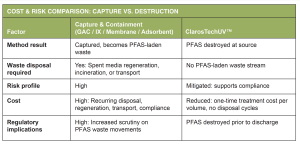
This shift from a waste-dependent model to a source-destroying model offers the potential for long-term cost savings, especially for facilities that treat large volumes of high-concentration PFAS-containing wastewater.
Address regulatory implications
As PFAS regulations expand and enforcement increases, managing PFAS-containing waste comes with regulatory and reputational risks. Destroying PFAS at the source can help reduce these risks by reducing reliance on disposal, transportation, and incineration routes that are facing increasing scrutiny.

Streamlined compliance path
Claros Technologies offers a path forward for manufacturers and industrial users who produce wastewater containing PFAS. It is a closed-loop, scalable solution that destroys PFAS before discharge or final disposal, avoiding potential regulatory complexities associated with PFAS-containing waste streams and discharge permits.
From optimization to commercial deployment
Based on successful optimization runs with industry partners, Claros and its collaborators are now moving towards a full commercial installation, marking a significant step in broader industry adoption.
This means facilities no longer need to rely on intermittent collection and disposal cycles and can employ high-flow PFAS removal integrated into their regular wastewater management workflows.
Destruction of PFAS in industrial wastewater:
ClarosTechUV™ provides a scalable path to destroy PFAS at their source, reducing reliance on waste markets and supporting regulatory compliance.
This article will be published in an upcoming PFAS Special Focus Publication in January.
Source link
