
Close Menu
  • Home
  • Identity
  • Inventions
  • Future
  • Science
  • Startups
  • Spanish
What's Hot

Europe’s auto workers need to be retrained for electrification

Mira Murati’s startup Thinking Machines Lab loses two co-founders to OpenAI

California launches investigation, Musk denies knowledge of Grok’s images of minors

Facebook X (Twitter) Instagram
  • Home
  • About Us
  • Advertise with Us
  • Contact Us
  • DMCA
  • Privacy Policy
  • Terms & Conditions
  • User-Submitted Posts
Facebook X (Twitter) Instagram
Fyself News
  • Home
  • Identity
  • Inventions
  • Future
  • Science
  • Startups
  • Spanish
Fyself News
Home » Scientists invent a way to create and dye rainbow-colored fabric in the lab using E. coli
Science

Scientists invent a way to create and dye rainbow-colored fabric in the lab using E. coli

userBy userNovember 15, 2025No Comments3 Mins Read
Share Facebook Twitter Pinterest Telegram LinkedIn Tumblr Email Copy Link
Follow Us
Google News Flipboard
Share
Facebook Twitter LinkedIn Pinterest Email Copy Link

Scientists used genetically modified bacteria to simultaneously create and color fabric in a one-pot method. Compared to current methods that rely on fossil fuels, this new technology provides a simpler and more sustainable way to produce colored fabrics.

In a new study published Nov. 12 in the journal Trends in Biotechnology, researchers created cellulose-based fabrics that span the colors of the rainbow by varying the conditions used to grow bacteria.

Synthetic fibers “are highly dependent on chemical synthesis and post-processing steps, which are energy-intensive, labor-intensive, and harmful to the environment,” said study lead author Sang Yeop Lee, a professor in the Department of Chemical and Biomolecular Engineering at the Korea Advanced Institute of Science and Technology. Such processes can emit large amounts of greenhouse gases and contaminate water and soil with heavy metals and carcinogens, Lee told LiveScience in an email.

you may like

Therefore, in recent years there has been a growing trend to use alternative methods of producing natural fibers from bacterial fermentation. Cellulose is a promising target because it is a material that mimics the natural fibers found in textiles such as cotton. Typically, various bacteria convert glucose into cellulose fibers to provide structural support and protection from other microorganisms. However, cellulose produced by bacteria is naturally white and often needs to be dyed after processing.

Lee and his team have now simplified this process by growing cellulose-producing bacteria alongside microbes that produce natural colorants. The research team created two classes of pigments using color-producing strains of Escherichia coli (E. coli). One is the dark violacein (which produces colors such as purple, blue, and green) and the other is the warm carotenoid (which produces colors such as red, orange, and yellow).

First, the researchers genetically modified the metabolic pathway of a strain of Komagataeibacter xylinus bacteria to increase cellulose production during fermentation. Violacein-producing E. coli was then added to the reaction vessel, resulting in fabrics dyed purple, blue, and green.
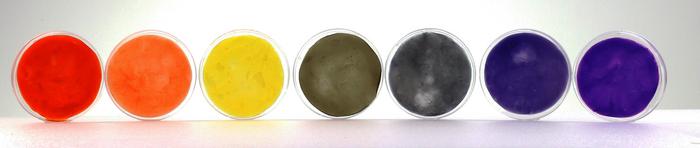
Seven colored circles including red, orange, yellow, green, gray and purple

Textiles of any color made by E. coli using the team’s new method. (Image credit: Zhou et al., Trends in Biotechnology)

However, the team was unable to achieve warm tones using the same method because the bacteria did not produce enough dye to dye the cellulose fabric, probably due to insufficient bacterial growth. To overcome this problem, they added pre-grown and treated cellulose to cultures of carotenoid-producing E. coli. Using this co-culture method, they were able to dye the fabric red, orange and yellow, completing the team’s iridescent palette.

Get the world’s most fascinating discoveries delivered straight to your inbox.

Overall, the method “eliminates the need for separate dyeing and cleaning processes,” Lee said, adding that this helps reduce chemical waste and water consumption.

The colored bacterial cellulose showed overall strong stability against acids, bases, heat treatments, and washing. However, the team noted that further work is needed to fully test these materials, particularly to confirm their resistance to industrial detergents and mechanical abrasion.

Going forward, Lee hopes to “expand the current seven-color platform more broadly” and scale up the process to an industrial level while maintaining consistent quality. Further changes in the way bacteria produce cellulose could open up other uses for the material, such as biodegradable packaging, he said.


Source link

#Biotechnology #ClimateScience #Health #Science #ScientificAdvances #ScientificResearch
Follow on Google News Follow on Flipboard
Share. Facebook Twitter Pinterest LinkedIn Tumblr Email Copy Link
Previous ArticleFive Americans plead guilty to helping North Korean IT workers break into 136 companies
Next Article Medieval Hungarian duke was murdered in a brutal and systematic attack, forensic analysis reveals
user
  • Website

Related Posts

Largest crowdsourced search for alien information, data from collapsed Arecibo Observatory reveals 12 billion “signals of interest”

January 13, 2026

Giant iceberg A23a, once the world’s largest iceberg, finally dies after 40 years at sea, turning into a bright “blue mush”

January 13, 2026

Artemis 2 mission update: NASA prepares first manned Artemis mission to the moon, deployment imminent

January 13, 2026
Add A Comment
Leave A Reply Cancel Reply

Latest Posts

Europe’s auto workers need to be retrained for electrification

Mira Murati’s startup Thinking Machines Lab loses two co-founders to OpenAI

California launches investigation, Musk denies knowledge of Grok’s images of minors

AI models are starting to decipher high-level math problems

Trending Posts

Subscribe to News

Subscribe to our newsletter and never miss our latest news

Please enable JavaScript in your browser to complete this form.
Loading

Welcome to Fyself News, your go-to platform for the latest in tech, startups, inventions, sustainability, and fintech! We are a passionate team of enthusiasts committed to bringing you timely, insightful, and accurate information on the most pressing developments across these industries. Whether you’re an entrepreneur, investor, or just someone curious about the future of technology and innovation, Fyself News has something for you.

Castilla-La Mancha Ignites Innovation: fiveclmsummit Redefines Tech Future

Local Power, Health Innovation: Alcolea de Calatrava Boosts FiveCLM PoC with Community Engagement

The Future of Digital Twins in Healthcare: From Virtual Replicas to Personalized Medical Models

Human Digital Twins: The Next Tech Frontier Set to Transform Healthcare and Beyond

Facebook X (Twitter) Instagram Pinterest YouTube
  • Home
  • About Us
  • Advertise with Us
  • Contact Us
  • DMCA
  • Privacy Policy
  • Terms & Conditions
  • User-Submitted Posts
© 2026 news.fyself. Designed by by fyself.

Type above and press Enter to search. Press Esc to cancel.