
Two of the most mysterious particles in the universe may be colliding invisibly throughout the universe. This discovery could solve one of the biggest remaining problems with the Standard Model of cosmology.
These two elusive building blocks, dark matter and neutrinos (or “ghost particles”), are ubiquitous in the universe but remain poorly understood. In a study published in the journal Nature Astronomy on January 2, an international team of researchers found evidence that dark matter and neutrinos can collide, transferring momentum between them in the process.
This surprising interaction may help explain why there are fewer dense regions such as galaxies in the universe than expected; in other words, the universe is not as “clumpy” as cosmologists think, the researchers said in a statement.
you may like
Dark matter and neutrinos remain a mystery
Dark matter is a mysterious invisible substance that makes up 85% of the matter in the universe. As its name suggests, dark matter does not emit light, so its existence has only been inferred indirectly from the effects of gravity, as observed in cosmological investigations.
Neutrinos are subatomic particles with infinitesimal mass and no electric charge, so they rarely interact with other particles. Neutrinos are produced in huge quantities by various nuclear processes such as nuclear fusion in stars and supernovae. Every second, about 100 billion neutrinos pass through one square centimeter of your body, Live Science previously reported.
However, according to a major model of cosmology known as the Lambda Cold Dark Matter Model (Lambda CDM), dark matter and neutrinos should not interact. The purpose of the Standard Model is to theoretically explain the large-scale structure of the universe.
cosmological conundrum
But this recent study provides new evidence that dark matter and neutrinos may interact after all, as other researchers have been arguing for the past two decades.
If dark matter and neutrinos actually collide, transferring momentum to each other in the process, this discovery could prompt a reconsideration of the lambda CDM model. Such collisions could also help explain the S8 tension, the discrepancy between the predicted clumps of the universe and the actual clumps.
“This tension does not mean that the standard cosmological model is wrong, but it may suggest that it is incomplete,” study co-author Eleonora Di Valentino, a senior research fellow at the University of Sheffield in the UK, explained in a statement. “Our study shows that interactions between dark matter and neutrinos may help explain this difference, providing new insights into how structure forms in the Universe.”
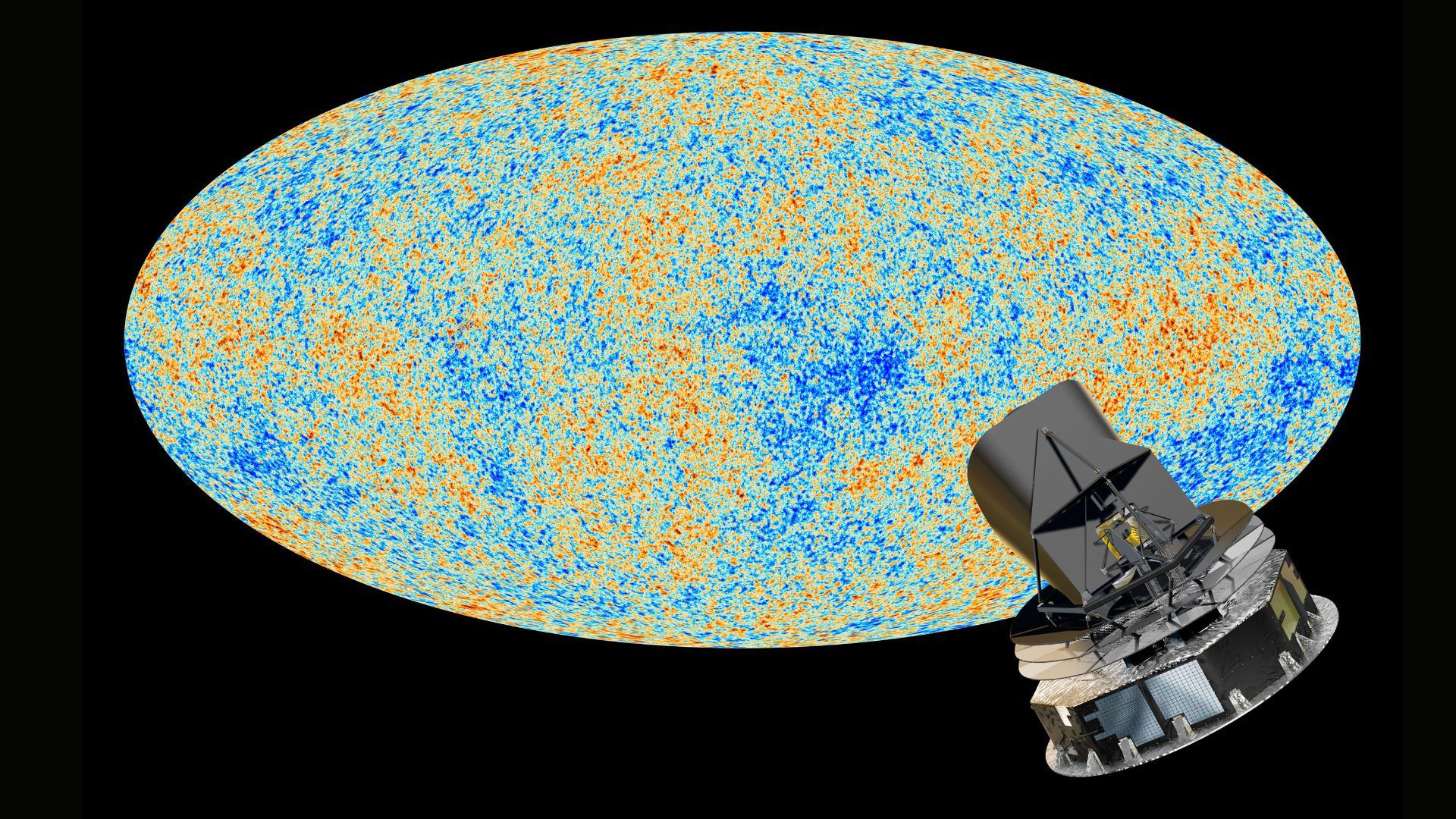
The discrepancy stems from researchers’ finding that the current universe is not as dense as predicted, based on observations of the cosmic microwave background radiation (CMB), the first light emitted by the universe when it was only 380,000 years old.
you may like
“The claim that the structure of the universe is ‘less cohesive’ is best understood in a statistical sense, rather than as a change in the appearance of individual galaxies or galaxy clusters, which refers to the less efficient growth of cosmic structure over time,” study co-author William Jaret, a cosmologist at the University of Hawaii, told Live Science in an email.
unraveling multiple pieces of evidence
The researchers sought to integrate evidence from CMB energy and density fluctuations and baryon acoustic oscillations (BAOs) – pressure waves that have been “frozen” in time since the beginning of the universe – with more recent observations of the large-scale structure of the universe.
Data on the early universe came from the Atacama Space Telescope in Chile and the European Space Agency’s space-based Planck telescope, which was designed to study the CMB. The late-universe data came from the Victor M. Blanco Telescope in Chile and the Sloan Digital Sky Survey, a 20-year effort to create 3D maps of millions of galaxies spanning more than 11 billion light-years.
The researchers also incorporated cosmic shear data from dark energy surveys. Cosmic shear is the distortion of a distant object by weak gravitational lensing, which occurs when a large structure in the foreground bends the fabric of space-time and changes the path of light traveling from the distant object to the detector.
Finally, the researchers combined these data to model the evolution of the universe. By accounting for the collisions of dark matter with neutrinos and the resulting momentum exchange, the simulations produced a model universe that better matches real observations.
However, there is reason to remain cautious, as there is only a 3-sigma level of certainty in the interaction of dark matter and neutrinos. This means that there is a 0.3% chance that this result is a fluke. Although it falls short of the scientific gold standard of 5 Sigma, it is significant enough to warrant additional research. This is because, if confirmed, this interaction would prove a “fundamental breakthrough in cosmology and particle physics” and provide a potential solution to the problem of the lumpiness of the universe.
In a separate statement, Sebastian Trojanowski, a theoretical physicist and research team leader at Poland’s National Center for Nuclear Research, said: “The final verdict will come from future large-scale surveys of the sky, such as by the Bela C. Rubin Observatory, and from more precise theoretical studies.” “These scenarios will allow us to determine whether we are witnessing new discoveries in the dark region or whether further adjustments to our cosmological models are needed. But each of these scenarios brings us closer to solving the mystery of dark matter.”
Zu, L., Giarè, W., Zhang, C. et al. A solution to the S8 tension due to the interaction of neutrinos and dark matter. Nat Astron (2026). https://doi.org/10.1038/s41550-025-02733-1
