
Close Menu
  • Home
  • Identity
  • Inventions
  • Future
  • Science
  • Startups
  • Spanish
What's Hot

Google warns of active exploitation of WinRAR vulnerability CVE-2025-8088

UK hydrogen industry poised for expansion, but policy slows momentum

Fake Python Spellchecker package on PyPI delivers hidden remote access Trojan

Facebook X (Twitter) Instagram
  • Home
  • About Us
  • Advertise with Us
  • Contact Us
  • DMCA
  • Privacy Policy
  • Terms & Conditions
  • User-Submitted Posts
Facebook X (Twitter) Instagram
Fyself News
  • Home
  • Identity
  • Inventions
  • Future
  • Science
  • Startups
  • Spanish
Fyself News
Home » Scientists say new ‘stochastic computing’ paradigm could significantly reduce power consumption in AI chips
Science

Scientists say new ‘stochastic computing’ paradigm could significantly reduce power consumption in AI chips

userBy userJanuary 16, 2026No Comments4 Mins Read
Share Facebook Twitter Pinterest Telegram LinkedIn Tumblr Email Copy Link
Follow Us
Google News Flipboard
Share
Facebook Twitter LinkedIn Pinterest Email Copy Link

Scientists in the United States and Japan have used a new type of component in artificial intelligence (AI) chips that uses less energy when performing advanced calculations. The new system allows more operations to run in parallel, allowing the chip to reach optimal output more efficiently.

Most computers rely on bits (0s and 1s that represent digital information and are used by programs to execute instructions), but some specialized technologies, such as neuromorphic chips, use probabilistic bits (p-bits) instead.

The P bit can be randomly switched between 0 and 1, allowing the system to explore many possible combinations of 0 and 1 before deciding on the most likely or useful outcome. This type of reasoning and decision making is known as probabilistic computing.

you may like

Although p-bit randomness is useful, developers need to control how often they generate 0s or 1s so that they can guide the system to a better answer. Therefore, most p-bits are constructed using digital-to-analog converters (DACs) that use analog voltages to bias in either direction. However, these are bulky and consume a lot of power.

“Reliance on analog signals has hindered progress,” study co-author and materials science professor Shunsuke Fukami said in a statement. “So we found a digital method to adjust the behavior of the p-bits without the need for the large, clunky analog circuitry typically used.”

Instead of a DAC, the scientists built p-bits using a magnetic tunnel junction (MTJ), a small device that spontaneously switches between 0 and 1 at random, and fed this stream of bits into local digital circuitry. Depending on how long the circuit takes to combine these random 0s and 1s, and how each is counted and weighted, the p bits in the final output can be mostly 0s or mostly 1s.

Scientists presented their findings at the 71st International Conference on Electronic Devices, held in San Francisco on December 10, 2025. This work was carried out in collaboration with Taiwan Semiconductor Manufacturing Company (TSMC), the world’s largest semiconductor foundry.

Get the world’s most fascinating discoveries delivered straight to your inbox.

The settings of the circuit can be adjusted by the user or program to control how strongly the p bits favor one value. Importantly, this control is fully digital, so it requires far less space and power on-chip than a traditional DAC.
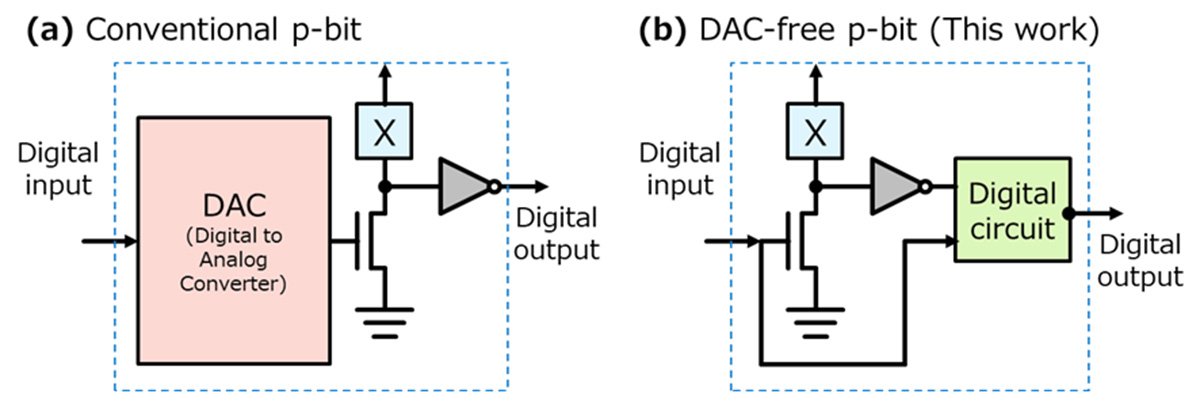
Schematics of conventional DAC-based p-bit (a) and proposed DAC-less p-bit (b).

Schematics of conventional DAC-based p-bit (a) and proposed DAC-less p-bit (b). (Image credit: Shunsuke Fukami, Kerem Camsari, etc.)

Self-organized behavior increases efficiency

Another advantage of the new approach is that p-bits can demonstrate “self-organizing” behavior, the scientists said. In a DAC, an analog signal continuously biases the p bits when the user specifies a priority of mostly 1s or 0s. They all feel this push at the same time, creating the risk that they all produce output at the same time.

Ideally, the p-bit outputs would be generated alternately, so you could read the previous p-bit output and use that information to decide whether it is more beneficial to switch to 0 or 1 for the overall computation.

In the new system, as the user adjusts the desired bias settings, a digital signal is sent to a local control circuit for each p bit. Since every circuit uses its own timing to generate subsequent outputs, it naturally avoids updating the p bits at the same time. Staggering the outputs also allows the chip to perform computations more efficiently, as multiple p bits can work in parallel and explore multiple possible solutions simultaneously.

So far, the cost of using DACs has prevented p-bits from mass production and use in commercial AI hardware, but scientists think this breakthrough could change that. Efficiency benefits can help reduce the significant environmental impact of current AI systems.

The team developing the MTJ-based p-bit has not yet published performance benchmarks compared to traditional DAC designs, so it is unclear at this stage how commercially viable it will be. Thermal stability and reliability in controlling switching current are known challenges for MTJs. Nevertheless, the research team is optimistic that their seminal breakthrough will make probabilistic computing more accessible in other fields, such as solving routing problems in logistics and rapidly exploring vast numbers of solutions in scientific discovery.


Source link

#Biotechnology #ClimateScience #Health #Science #ScientificAdvances #ScientificResearch
Follow on Google News Follow on Flipboard
Share. Facebook Twitter Pinterest LinkedIn Tumblr Email Copy Link
Previous ArticleHuman Origins Quiz: How much do you know about the human story?
Next Article British astronomers discover mysterious iron rod inside ring nebula
user
  • Website

Related Posts

Shark attacks in Hawaii spiked in October, and scientists think they know why.

January 27, 2026

In vitro fertilization hormones could one day be administered via painless ‘microneedle’ patches, early research suggests

January 27, 2026

A 1,400-year-old Zapotec tomb discovered in Mexico has a giant owl sculpture symbolizing death

January 26, 2026
Add A Comment
Leave A Reply Cancel Reply

Latest Posts

Google warns of active exploitation of WinRAR vulnerability CVE-2025-8088

UK hydrogen industry poised for expansion, but policy slows momentum

Fake Python Spellchecker package on PyPI delivers hidden remote access Trojan

Road pavement evaluation using low-cost AI technology

Trending Posts

Subscribe to News

Subscribe to our newsletter and never miss our latest news

Please enable JavaScript in your browser to complete this form.
Loading

Welcome to Fyself News, your go-to platform for the latest in tech, startups, inventions, sustainability, and fintech! We are a passionate team of enthusiasts committed to bringing you timely, insightful, and accurate information on the most pressing developments across these industries. Whether you’re an entrepreneur, investor, or just someone curious about the future of technology and innovation, Fyself News has something for you.

Castilla-La Mancha Ignites Innovation: fiveclmsummit Redefines Tech Future

Local Power, Health Innovation: Alcolea de Calatrava Boosts FiveCLM PoC with Community Engagement

The Future of Digital Twins in Healthcare: From Virtual Replicas to Personalized Medical Models

Human Digital Twins: The Next Tech Frontier Set to Transform Healthcare and Beyond

Facebook X (Twitter) Instagram Pinterest YouTube
  • Home
  • About Us
  • Advertise with Us
  • Contact Us
  • DMCA
  • Privacy Policy
  • Terms & Conditions
  • User-Submitted Posts
© 2026 news.fyself. Designed by by fyself.

Type above and press Enter to search. Press Esc to cancel.