

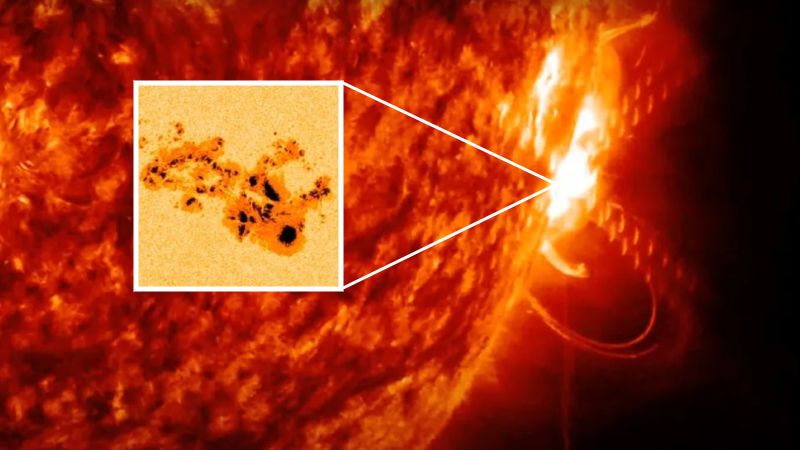
A record-breaking study of the giant sunspot that caused Earth’s largest geomagnetic storm in more than two decades has revealed surprising new details about the explosive dark region. This monster sunspot triggered nearly 1,000 solar flares in just over three months, and may have discreetly triggered the most powerful explosion of the current solar cycle.
Back in April 2024, astronomers discovered a group of sunspots growing on the sun’s surface. This new active region (AR), named AR 13664, rapidly expanded in size, eventually reaching 15 times the diameter of Earth by early May. Then a rapid barrage of X-class solar flares, the most powerful type of solar explosion, launched a series of coronal mass ejections (CMEs) toward Earth, hitting Earth’s magnetic field one after another.
you may like
But the sunspot’s journey didn’t end there. Like other giant sunspots, AR 13664 was able to survive several orbits around the sun, allowing researchers to monitor it for longer than normal and attracting much attention. (Sunspots are only visible in the Sun’s Earth-facing hemisphere for up to two weeks at a time before rotating out of sight, but will reappear if they survive to pass behind our home star.)
In a new study published Dec. 5 in the journal Astronomy & Astrophysics, researchers analyzed observations of AR 13664 over 94 consecutive days from April 16, 2024 to July 18, 2024. This corresponds to approximately 3.3 revolutions around the sun. Thanks to images captured by NASA’s Solar Orbiter orbiting the sun, researchers were able to monitor the sunspot as it rotates out of sight.

“This is a milestone in solar physics,” study lead author Ioannis Kontogiannis, a solar physicist at the Swiss Federal Institute of Technology Zurich (ETH Zurich), said in a statement. “This is the longest continuous image series ever created for a single active region.”
In their paper, the researchers found that AR 13664 triggered a total of 969 solar flares. This includes 38 X-class flares and 146 M-class flares, which can also affect the Earth’s magnetic field. The rest are low-level flares, including C-class and B-class flares, and do not pose a threat to Earth. Most of the largest flares were directed away from Earth, so no additional geomagnetic storms were generated.
The largest flare was an explosion believed to have a magnitude of X16.5 that occurred on the opposite side of the sun from Earth on May 20, 2024. This is much more powerful than the X9 explosion on October 3, 2024, which is currently listed as the most powerful flare in the past eight years. However, AR 13664’s explosion is partially obscured by its position on the sun, so researchers are unable to officially declare a new record.
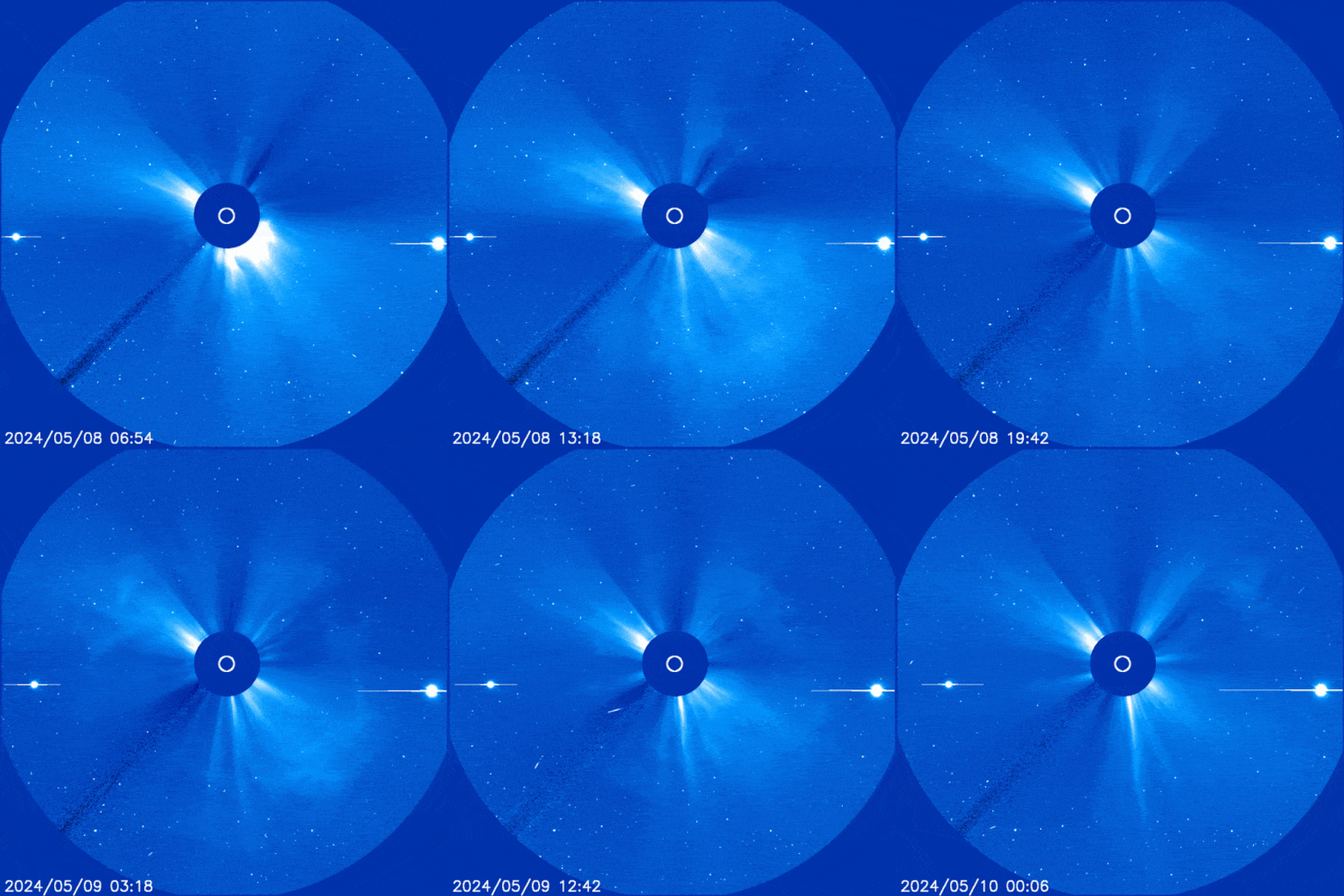
AR 13664’s epic journey around the Sun is a reminder of the immense power of our home planet, especially during solar maximum, the most active period of the Sun’s roughly 11-year solar cycle, when the number of sunspots and solar storms increases rapidly.
We’re likely just coming out of the latest solar maximum, which began in early 2024, much earlier than scientists originally expected. This peak phase was much more active than previous maxima, with 2024 marking the first peak in visible sunspots in 23 years and a record number of X-class flares.
Researchers behind the new study note that studying these phenomena could help scientists more accurately predict similar phenomena in the future. This is important because these phenomena can affect Earth-orbiting spacecraft and some ground infrastructure.
“We live with this star, so it’s very important to observe it and try to understand how it works and how it affects our environment,” Kontogiannis said.
Source link
