
Close Menu
  • Home
  • Identity
  • Inventions
  • Future
  • Science
  • Startups
  • Spanish
What's Hot

Consumer watchdog warns about Google’s AI agent shopping protocols — Google says she’s wrong

Ring founder details camera company’s ‘intelligent assistant’ era

Doctors think AI can play a role in medicine, but maybe not as chatbots

Facebook X (Twitter) Instagram
  • Home
  • About Us
  • Advertise with Us
  • Contact Us
  • DMCA
  • Privacy Policy
  • Terms & Conditions
  • User-Submitted Posts
Facebook X (Twitter) Instagram
Fyself News
  • Home
  • Identity
  • Inventions
  • Future
  • Science
  • Startups
  • Spanish
Fyself News
Home » This week’s science news: Runaway black holes, human ancestors discovered in Casablanca caves, vaccine schedule cuts
Science

This week’s science news: Runaway black holes, human ancestors discovered in Casablanca caves, vaccine schedule cuts

userBy userJanuary 10, 2026No Comments5 Mins Read
Share Facebook Twitter Pinterest Telegram LinkedIn Tumblr Email Copy Link
Follow Us
Google News Flipboard
Share
Facebook Twitter LinkedIn Pinterest Email Copy Link

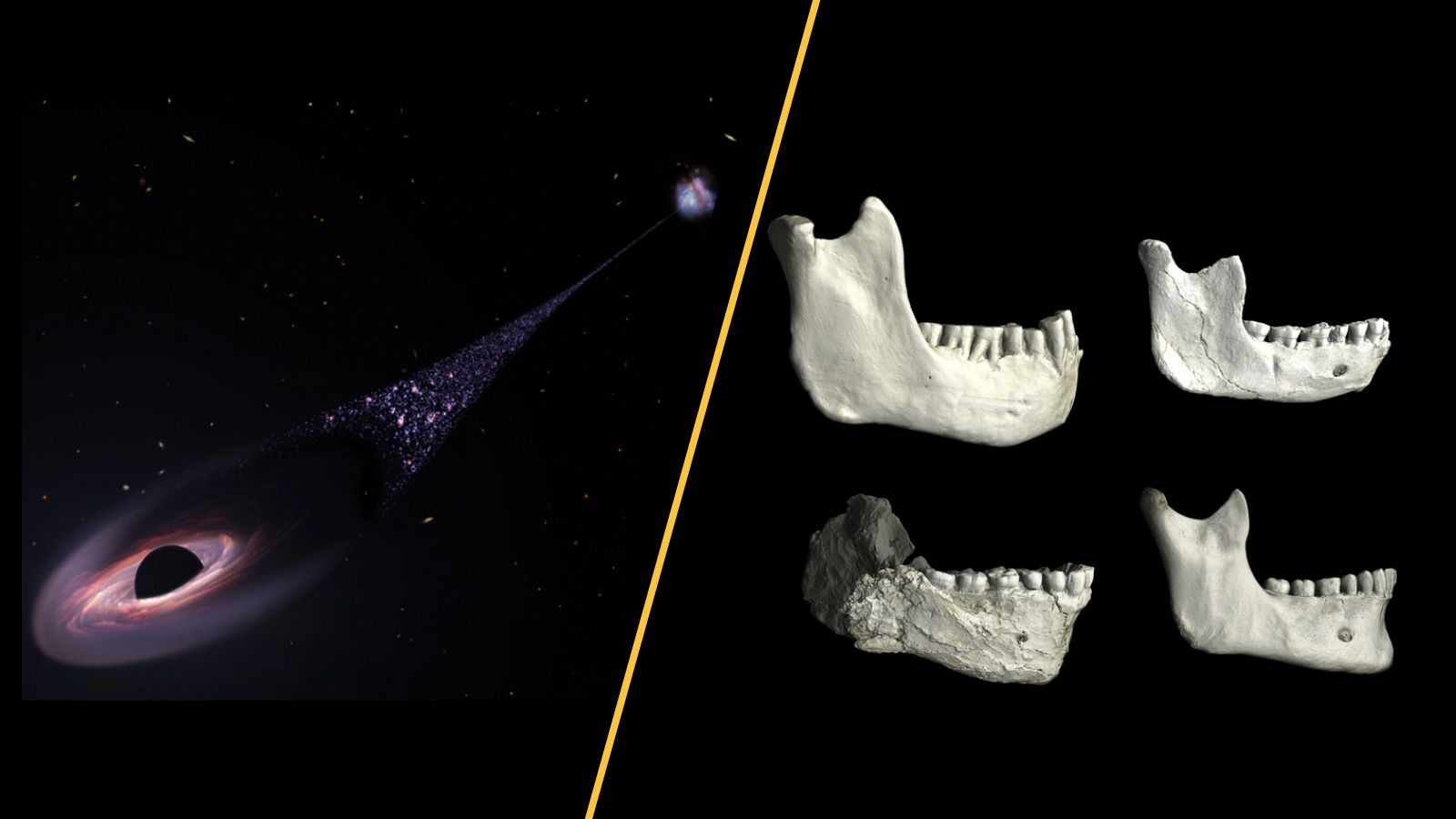
This week’s science news is full of discoveries from the world’s best telescopes, with the James Webb Space Telescope confirming the existence of a runaway supermassive black hole escaping from its host galaxy at 2.2 million miles per hour (3.6 million km per hour).

This black hole leaves an astonishing contrail of stars in its wake, backed up by more than 50 years of research. And it’s not the only celestial object this week showing evidence for a long-standing astronomical theory. There’s also Cloud 9, a failed galaxy discovered by the Hubble telescope that appears to be held together by dark matter.

Meanwhile, NASA’s SPHEREx (short for Space History, Reionization Era, and Ice Explorer Spectrophotometer) has unveiled the first complete cosmic all-sky mosaic. ALMA in Chile has discovered a collection of galaxies that are too hot to exist. And the first images from the newly established Vera C. Rubin Observatory reveal a giant asteroid spinning at record-breaking speeds.

Ancestors of humans and Neanderthals discovered in Casablanca
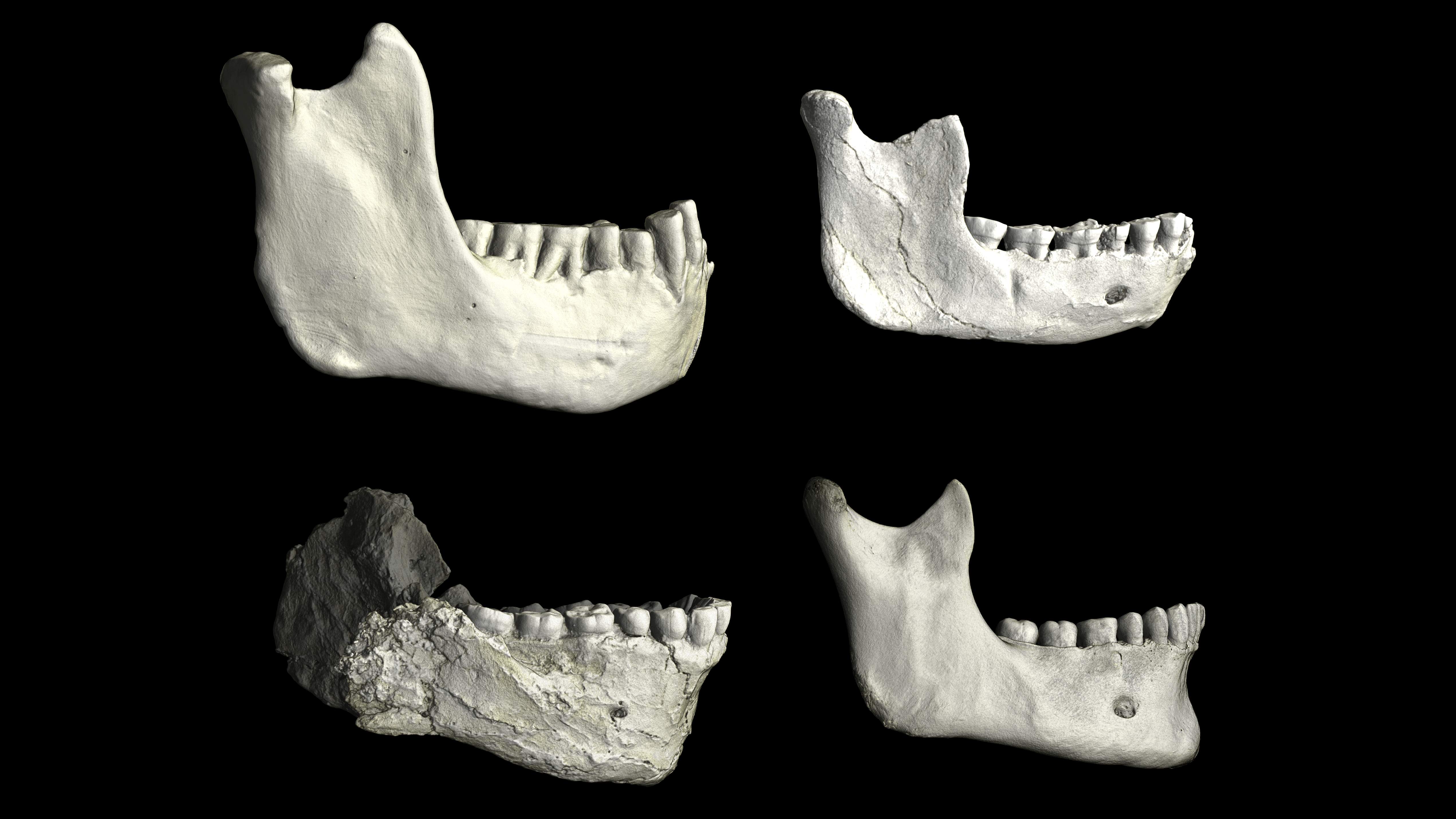
A series of four lower jaws of ancient and modern humans on a black background

A discovery inside a Moroccan cave has changed the potential origin story of humanity. (Image credit: Philipp Ganz/Max Planck Institute for Evolutionary Anthropology)

A collection of 773,000-year-old bones discovered in a Moroccan cave this week confirms the likely origin of modern humans, which moved from East Africa to West Africa.

Although there are many fossil hominins in Africa dating back to at least about 1 million years ago and beyond 500,000 years ago, a gap exists between these two points, making it difficult to trace the evolutionary history of humans.

That’s why the discovery of new fossils found in Casablanca’s Hominid Cave is a very exciting development for paleoanthropologists, believed to be those of Neanderthals and Denisovans, the last common ancestors of modern humans.

Discover more archeology news:

Get the world’s most fascinating discoveries delivered straight to your inbox.

-One of Siberia’s last shamans was an 18th-century woman whose parents were related, a DNA study reveals

– A 60,000-year-old poison arrow from South Africa is the oldest poison weapon ever discovered.

– Small bumps in 7-million-year-old fossil suggest ancient apes walked upright and may even be human ancestors

life’s little mysteries

A very nice wild red and white Maine Coon cat sitting on a pine tree in the winter snowy forest.

Have any known feline breeds occurred naturally? (Image credit: Sergei Ginak/Getty Images)

There are over 600 million cats in the world, but have any of the approximately 10% that are purebred evolved naturally? Or are they all the result of human choices? The answer is more complicated than it seems at first glance.

—If you enjoyed this, sign up for the Life’s Little Mysteries newsletter

US government cuts pediatric vaccine schedule
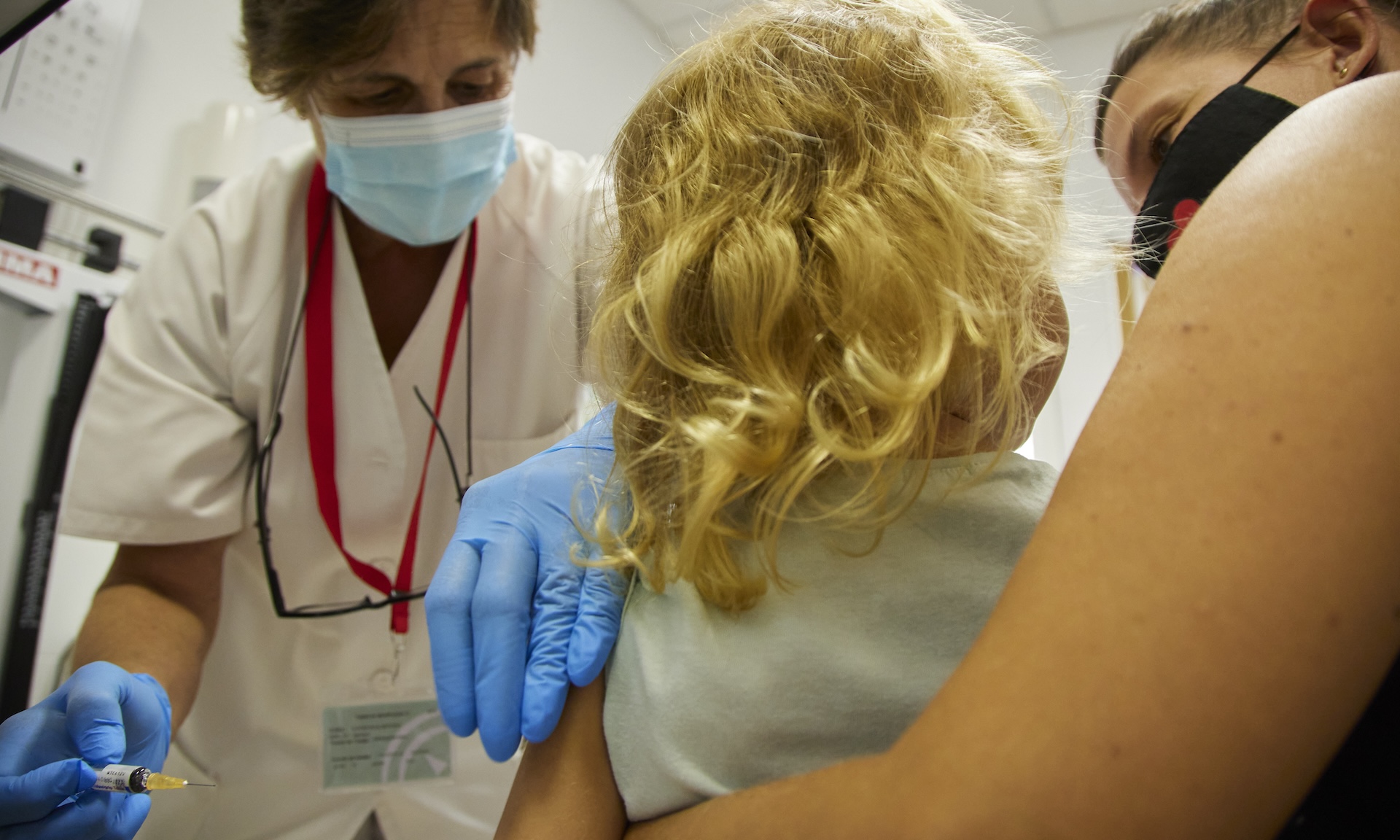
girl receiving influenza vaccine

Officials say the move will bring the U.S. into line with other developed countries, but experts say it will lead to more sick children. (Image credit: Europa Press News via Getty Images)

Federal health officials this week announced unprecedented changes to the childhood vaccination schedule, reducing the number of shots widely recommended for children under 18 from about 17 to 11.

This unilateral decision is a step toward reducing the number of vaccines given to children, a long-standing goal of Health and Human Services Secretary Robert F. Kennedy Jr. and other vaccine skeptics. Officials say the move will bring the U.S. closer together with other developed countries, but experts say the decision lacks scientific support and will lead to more sick children.

Check out more health news:

—A new U.S. food pyramid recommends a very high-protein diet, beef tallow and full-fat dairy as healthy fat options

— Leonardo da Vinci’s DNA may be embedded in his art — and scientists think they’ve succeeded in extracting some of that DNA

— Early research suggests ‘mitochondrial transfer’ to nerves may relieve chronic pain

Also featured in this week’s science news

— Greenland’s giant ice dome disappeared 7,000 years ago — is melting at the temperatures we’re aiming for today

—A rare 2,000-year-old war trumpet discovered in England that may be related to Celtic Queen Boudica

—Satellites in orbit could start colliding with each other within three days, reveals new theoretical ‘CRASH Clock’

—Hundreds of iceberg earthquakes shake the crumbling edge of Antarctica’s terminal glacier

something for the weekend

If you’re looking for something a little longer to read over the weekend, here are some of the best science histories, sky-watching guides, and quizzes published this week.

—Sophie Germain, the first woman to win France’s prestigious Grand Prix Mathematics, whose ticket to the award ceremony was ignored because it was “lost in the mail”—January 9, 1816 [Science history]

— Jupiter will outshine every star in the sky this weekend — How to see the “King of Planets” at opposition [Skywatching]

–How much do you know about Tyrannosaurus, the king of dinosaurs? [Quiz]

Science in pictures

The Wolf Moon rises next to the Corno Grande and Pizzo Cefalone peaks in Italy.

The Wolf Moon rises next to the Corno Grande and Pizzo Cefalone peaks in Italy. (Image credit: Lorenzo Di Cola/NurPhoto via Getty Images)

The first full moon of 2026, known as the Wolf Moon, shone brightly in the skies of the Northern Hemisphere earlier this week. The biggest and brightest full moon of the year will be visible until November, but in case you missed the spectacle, we’ve put together this handy gallery of photos of the moon from around the world.

Follow Live Science on social media

Want more science news? Follow our Live Science WhatsApp channel to keep up with the latest discoveries. It’s the best way to get expert reports on the go, but even if you don’t use WhatsApp, you can use Facebook, X (formerly Twitter), Flipboard, Instagram, TikTok, Bluesky, and LinkedIn.


Source link

#Biotechnology #ClimateScience #Health #Science #ScientificAdvances #ScientificResearch
Follow on Google News Follow on Flipboard
Share. Facebook Twitter Pinterest LinkedIn Tumblr Email Copy Link
Previous ArticleDionysus and his erect penis depicted on a 2,500-year-old bone needle discovered in Sicily
Next Article Unusual ‘Platypus Galaxy’ discovered with James Webb Telescope could challenge our understanding of galaxy formation
user
  • Website

Related Posts

Ethereal ice structures swirl next to Chicago during extreme cold waves accelerated by the polar vortex — Earth seen from space

January 13, 2026

DNA from ancient viral infections aids embryo development, mouse study finds

January 12, 2026

Metal compound identified as potential new antibiotic thanks to robot performing ‘click chemistry’

January 12, 2026
Add A Comment
Leave A Reply Cancel Reply

Latest Posts

Consumer watchdog warns about Google’s AI agent shopping protocols — Google says she’s wrong

Ring founder details camera company’s ‘intelligent assistant’ era

Doctors think AI can play a role in medicine, but maybe not as chatbots

Long-running web skimming campaign steals credit cards from online checkout pages

Trending Posts

Subscribe to News

Subscribe to our newsletter and never miss our latest news

Please enable JavaScript in your browser to complete this form.
Loading

Welcome to Fyself News, your go-to platform for the latest in tech, startups, inventions, sustainability, and fintech! We are a passionate team of enthusiasts committed to bringing you timely, insightful, and accurate information on the most pressing developments across these industries. Whether you’re an entrepreneur, investor, or just someone curious about the future of technology and innovation, Fyself News has something for you.

Castilla-La Mancha Ignites Innovation: fiveclmsummit Redefines Tech Future

Local Power, Health Innovation: Alcolea de Calatrava Boosts FiveCLM PoC with Community Engagement

The Future of Digital Twins in Healthcare: From Virtual Replicas to Personalized Medical Models

Human Digital Twins: The Next Tech Frontier Set to Transform Healthcare and Beyond

Facebook X (Twitter) Instagram Pinterest YouTube
  • Home
  • About Us
  • Advertise with Us
  • Contact Us
  • DMCA
  • Privacy Policy
  • Terms & Conditions
  • User-Submitted Posts
© 2026 news.fyself. Designed by by fyself.

Type above and press Enter to search. Press Esc to cancel.