
Transforming biomedical research and innovation
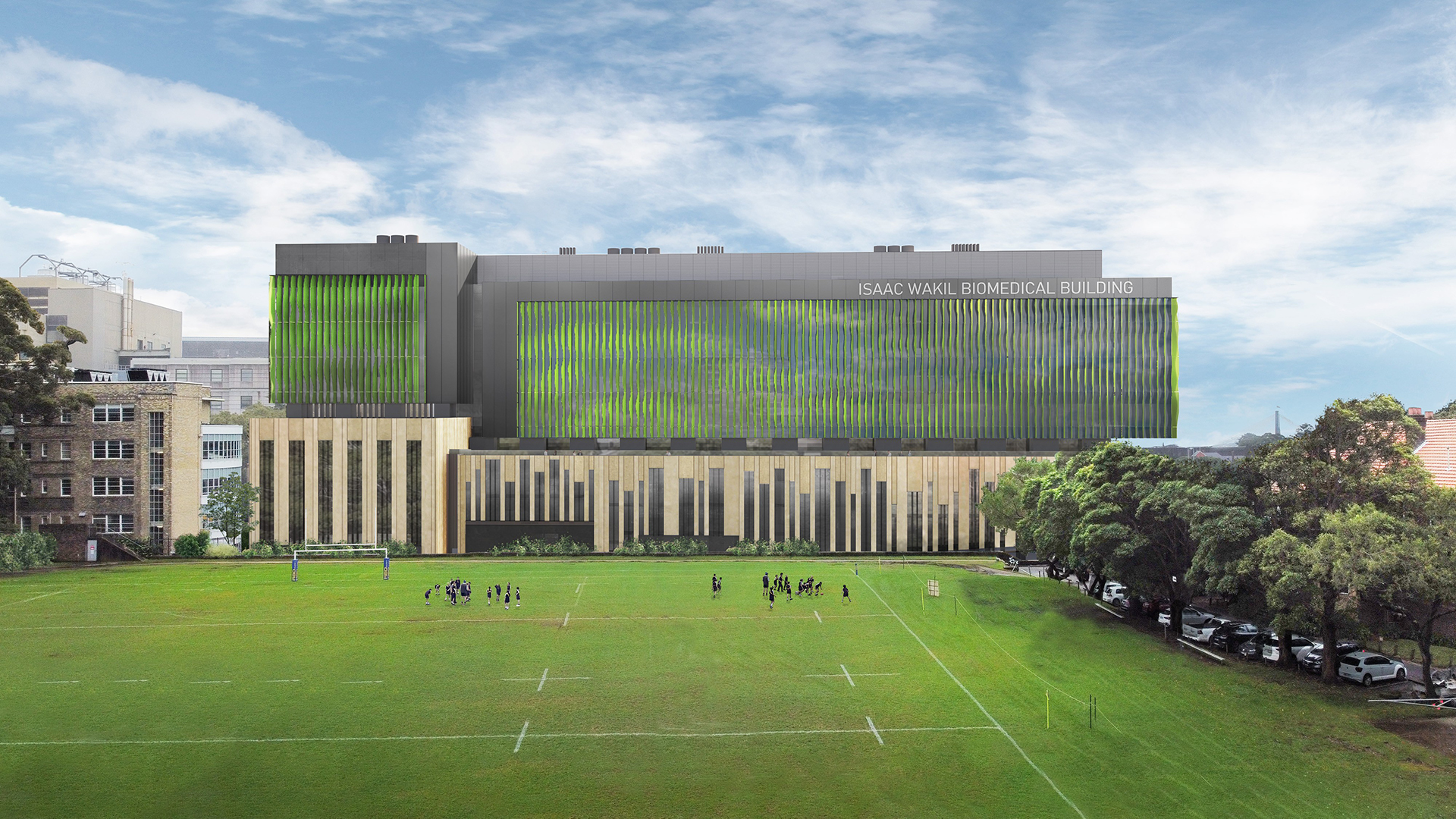
Scheduled for completion in 2028, the Sydney Biomedical Accelerator will become a globally significant hub for biomedical research, innovation and translation in Sydney, Australia.
Currently in the construction phase, the Sydney Biomedical Accelerator (SBA) is a visionary partnership between the University of Sydney, Sydney Local Health District and the New South Wales Government. This partnership brings together clinicians, researchers, academics and industry to solve some of the world’s most complex health challenges. This provides an attractive platform for international collaboration, offering partners the opportunity to engage in collaborative research, clinical translation and industry-driven innovation.
Once built and operational, the SBA will support innovative research, translation, and commercialization to accelerate scientific discoveries that lead to better health outcomes. By leveraging the University of Sydney’s long-standing partnership with international collaboration, particularly with Europe, the SBA will greatly benefit from existing relationships and collaboration as we work towards a vision that closely aligns with the overarching direction of the European Framework Programme.
To find out more about the SBA and what it brings to Australia’s healthcare research landscape, The Innovation Platform spoke to SBA Executive Director Professor Victoria Cogger.
Can you briefly summarize the Sydney Biomedical Accelerator and how it aims to foster research and innovation to tackle complex health challenges?
The SBA is a once-in-a-generation opportunity to establish a globally significant hub for biomedical research, innovation and translation in the heart of Sydney, Australia’s largest city and gateway to the world.
The A$780 million partnership is centered around 36,000 square meters of purpose-built, world-class, AI-enabled facilities that foster a collaborative ecosystem designed to rapidly translate scientific discoveries into real-world health outcomes.
From 2028, the Sydney Biomedical Accelerator will span the University of Sydney’s Camperdown campus and the adjacent Royal Prince Alfred Hospital campus, creating a global concentration of biomedical research talent, facilities and capacity, creating optimal conditions for translational research from bench to bedside.
The SBA will be at the heart of the Sydney Health and Innovation District, the nexus of Australia’s largest and most important innovation district, Tech Central, supporting a $42 billion economy, 100,000 workers and home to more than 150 research institutes and centers of excellence.
Also key to SBA’s success is its active and embedded model with industry, start-ups, patient organizations, and other clinical and academic institutions. This includes meaningful clinician and consumer engagement to ensure that real-world experience shapes both the problems addressed and the solutions developed.
This integrated model provides international partners with a unique environment for rapid clinical translation and real-world validation.
SBA brings together researchers from a wide range of disciplines beyond medicine and science, recognizing the important role that academic expertise and research in fields ranging from engineering and law to the humanities and arts can play in research discoveries related to health and medicine.
How important is international cooperation to the project?
Europe is a major source of research collaboration for the University of Sydney. Since 2016, the University has published more than 34,000 co-authored publications with academics from European universities and institutions, primarily in the UK, Germany, France, Italy, the Netherlands and Switzerland.
To date, the University of Sydney has provided more than A$2 million in match funding to the European Partnership. This has supported our talented researchers with over 100 collaborative research projects, early career mobility awards, collaborative workshops, and more.
This continued collaboration, and the deep exchange of talent, expertise and ideas between the EU and Australia, is critical to enabling the SBA to attract and convene the world’s top talent, secure and sustain resources for the most impactful biomedical research and innovation, while supporting new and expanded partnerships within the Horizon Europe consortium and related programs.

The Australian Government’s commitment to fast-track its relationship with Horizon Europe opens the door to new and stronger opportunities for the SBA, particularly in innovation and commercialization.
We are excited about the potential for international commercialization partnerships. As a small market, Australia needs a strong relationship with the EU and active, early engagement with regulators to accelerate translation in a way that reduces risk, time and unnecessary costs and benefits patients worldwide.
How has the EU/Horizon Europe supported this project so far?
In conceptualizing the SBA, our team visited major EU accelerators and precincts, including the Karolinska Institutet, the universities of Edinburgh, Glasgow, Cambridge, Oxford, King’s College and UCL, drawing inspiration from and learning from the world’s leading and established locations.
Many of our researchers are already collaborating with EU collaborators and working on EU-funded research. For example, Professors Elizabeth New and Michael Cassiou from the Department of Chemistry receive funding from the European Commission.
Personally, I have worked with Horizon Europe on two separate programs. In 2017, my team and I joined the research and innovation framework program Innovative Training Networks (ITN)-DeLIVER to contribute to research into liver-targeted drugs. In 2021, we partnered again with the University of Tromsø and others for Horizon Europe – MSCA-2022-DN-01- ImAGE-D to develop new imaging modalities focused on understanding the biology of aging.
While the SBA itself does not yet hold EU-branded project funding, it is positioned to be fully aligned with Horizon funding principles, building directly on the University of Sydney’s participation in Horizon 2020 and Horizon Europe’s collaboration across biomedical, clinical and translational research, which provides partnerships, expertise and international networks to support the SBA’s mission.
How will further strengthening of the EU-Australia relationship benefit the SBA and SBA-supported research?
I commend the Australian Government for announcing that it will fast-track its relationship with Horizon Europe. As part of the Group of Eight, the University of Sydney will contribute the association fees required to participate in the program.
Professor Mark Scott, Vice-Chancellor and President of the University of Sydney, said the move would recognize the world-class, high-quality research that Australian universities already carry out, while also enabling them to work with European universities and leading researchers from around the world to tackle some of the world’s biggest challenges. He added: “These international networks and collaborations are critical in our race to deliver life-changing research, often in collaboration with industry and institutions, building on decades of basic and applied research.”

“This will put Australian researchers and businesses at the heart of a global program of innovative research that has a direct impact on health, technology, sustainability and the wellbeing of our people.”
The SBA’s vision is closely aligned with the overarching direction of the European Framework Programme, particularly in its emphasis on health as a key societal challenge and translation as a core measure of impact. This includes a focus on collaborative research to address population health needs, alongside mechanisms to support the commercialization and scale-up of innovations. This is a principle embedded in SBA’s mission to accelerate biomedical discovery from the lab to the clinic to the marketplace.
Looking beyond 2027, it is expected to be the successor to Horizon Europe and represents an important opportunity to maintain and deepen EU-Australia research cooperation. The Australian association will now not only deliver immediate benefits through Horizon Europe, but also position Australian institutions, including the Sydney Biomedical Accelerator, as trusted and established partners in the formation and participation of the next EU Framework Program. Early integration into European research networks, governance structures and partnership ecosystems will ensure continuity of collaboration, strengthen Australia’s influence on emerging priorities and enable SBA to remain embedded in long-term multinational research initiatives beyond a single funding cycle.
This article will also be published in the quarterly magazine issue 26.
Source link

