
Close Menu
  • Home
  • Identity
  • Inventions
  • Future
  • Science
  • Startups
  • Spanish
What's Hot

Meta Inc. files suit over privacy concerns over AI smart glasses after employees review nude, sex and other footage

Anthropic CEO Dario Amodei may still be trying to strike a deal with the Pentagon

Oura acquires Doublepoint, a startup specializing in gesture recognition technology

Facebook X (Twitter) Instagram
  • Home
  • About Us
  • Advertise with Us
  • Contact Us
  • DMCA
  • Privacy Policy
  • Terms & Conditions
  • User-Submitted Posts
Facebook X (Twitter) Instagram
Fyself News
  • Home
  • Identity
  • Inventions
  • Future
  • Science
  • Startups
  • Spanish
Fyself News
Home » ‘Truly extraordinary’: Megalaser beaming at us from the far side of space is the brightest ‘cosmic light’ we’ve ever seen
Science

‘Truly extraordinary’: Megalaser beaming at us from the far side of space is the brightest ‘cosmic light’ we’ve ever seen

userBy userMarch 4, 2026No Comments4 Mins Read
Share Facebook Twitter Pinterest Telegram LinkedIn Tumblr Email Copy Link
Follow Us
Google News Flipboard
Share
Facebook Twitter LinkedIn Pinterest Email Copy Link

Astronomers have discovered a supercharged space laser beaming toward Earth from the far side of the universe. A beam of cosmic energy revealed in part by a strange space-time trick first predicted by Einstein is the brightest and most distant beam of its kind ever observed.

A natural laser called a “hydroxyl megamaser” is essentially a huge beam of electromagnetic radiation emitted when a pair of galaxies violently merge. During these cosmic collisions, giant gas clouds are compressed and large reservoirs of hydroxyl (OH) molecules are excited, emitting high-energy microwaves.

It is similar to an artificial laser that works by exciting particles and amplifying the resulting light waves with mirrors. However, in the case of a maser, microwaves are amplified instead of visible light, hence the “M” at the beginning of the name. (Laser is an acronym for “light amplification by stimulated emission of radiation.” If you replace “light” with “microwave,” you get maser.)

you may like

Researchers are particularly interested in megamasers because they can reveal how ancient galaxies form, grow, evolve, and die. As a result, they are often called “cosmic beacons”.

In a new study uploaded to the preprint server arXiv on February 13 and accepted for future publication in Monthly Notices: Letters, a journal of the Royal Astronomical Society, researchers using the MeerKAT telescope, a 64-radio receiving antenna in South Africa, have discovered a new hydroxyl megamaser coming from a pair of colliding galaxies, named HATLAS J142935.3-002836.
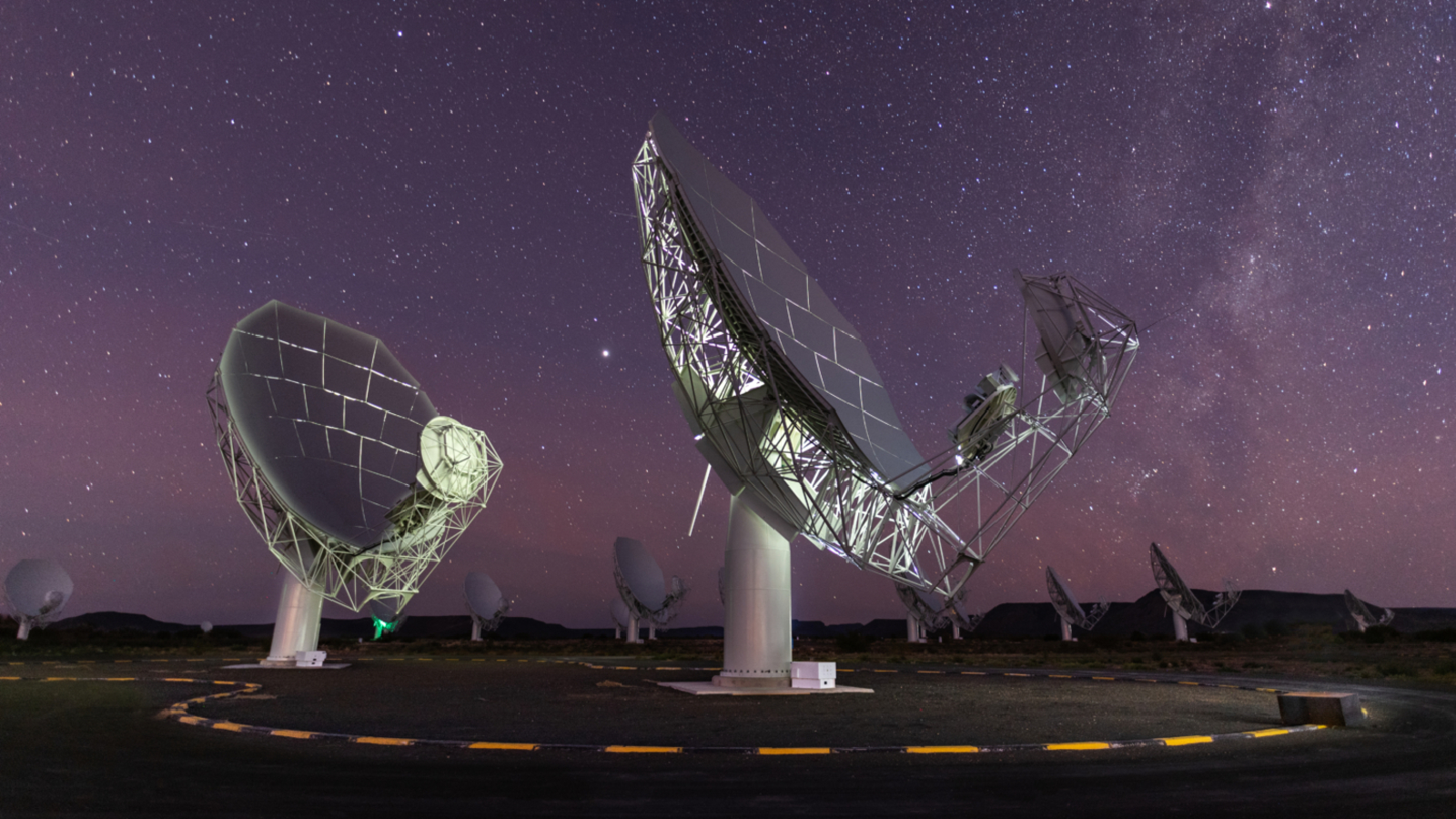
Photo of two radio receiving antennas pointed towards the night sky

The megamaser from HATLAS J142935.3–002836 was detected by the MeerKAT telescope in South Africa, which consists of 64 linked radar antennas. (Image credit: SARAO/MeerKAT)

The microwaves emitted by this system are so elongated, about 18 centimeters (7 inches or 1,665 megahertz) long, and so much brighter than other megamasers, that the researchers suggest that the signal should be classified as a “gigamaser” (the next theoretical next order of magnitude for these space lasers).

HATLAS J142935.3–002836 was first discovered in 2014 and is approximately 8 billion light-years from Earth. This means that the microwaves we see were emitted when the universe was about half its current age. This makes it the farthest megamaser ever confirmed.

Get the world’s most fascinating discoveries delivered straight to your inbox.

“This system is truly extraordinary,” study lead author Tato Manamela, an astronomer at the University of Pretoria in South Africa, said in a statement. “We are observing radio waves equivalent to lasers on the far side of the universe.”

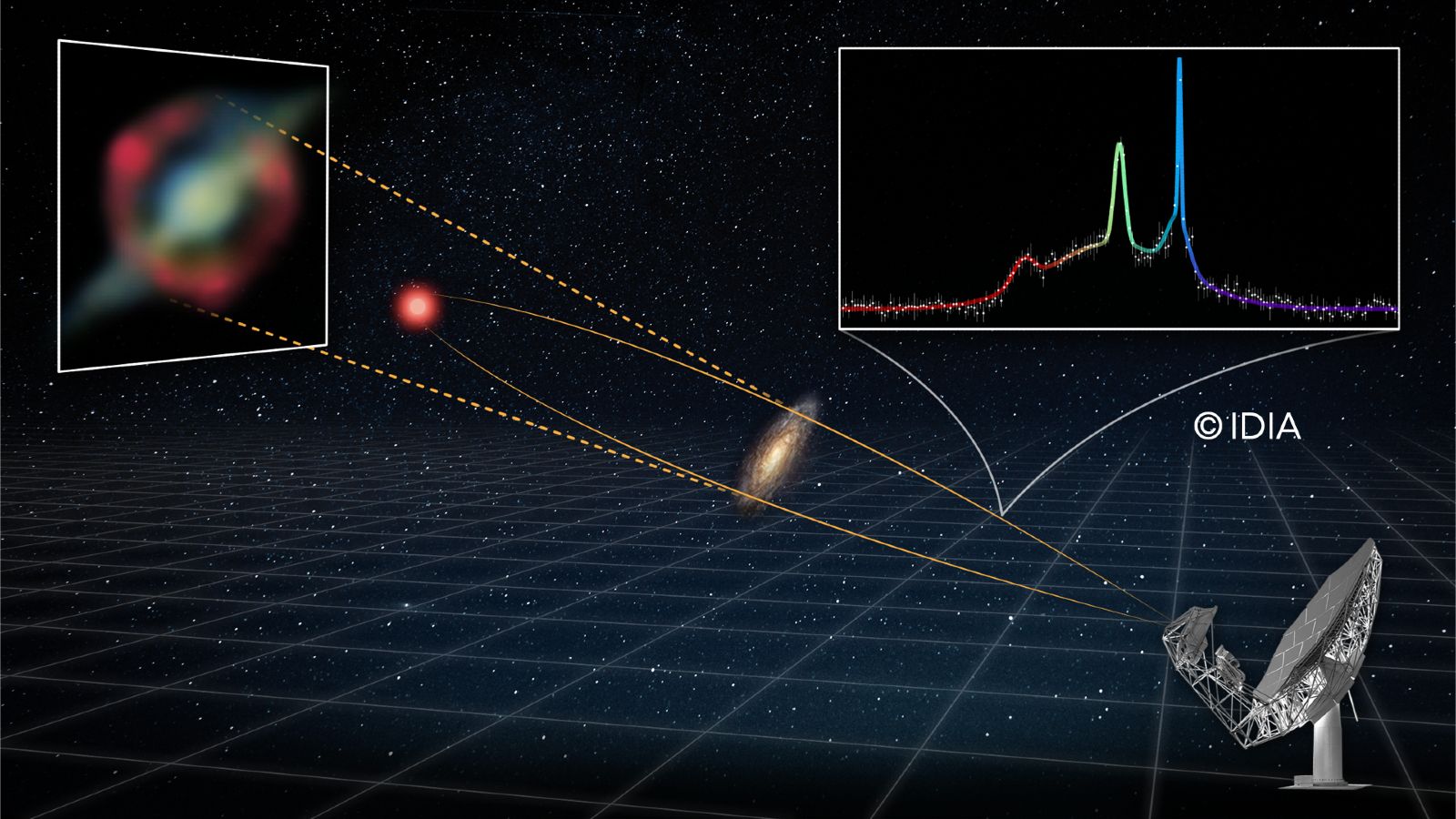
Signals from very far away are usually too weak to be picked up by telescopes like MeerKAT. However, the maser fire from HATLAS J142935.3–002836 was further amplified by a rare phenomenon called gravitational lensing, first predicted by Albert Einstein’s theory of relativity in 1905.
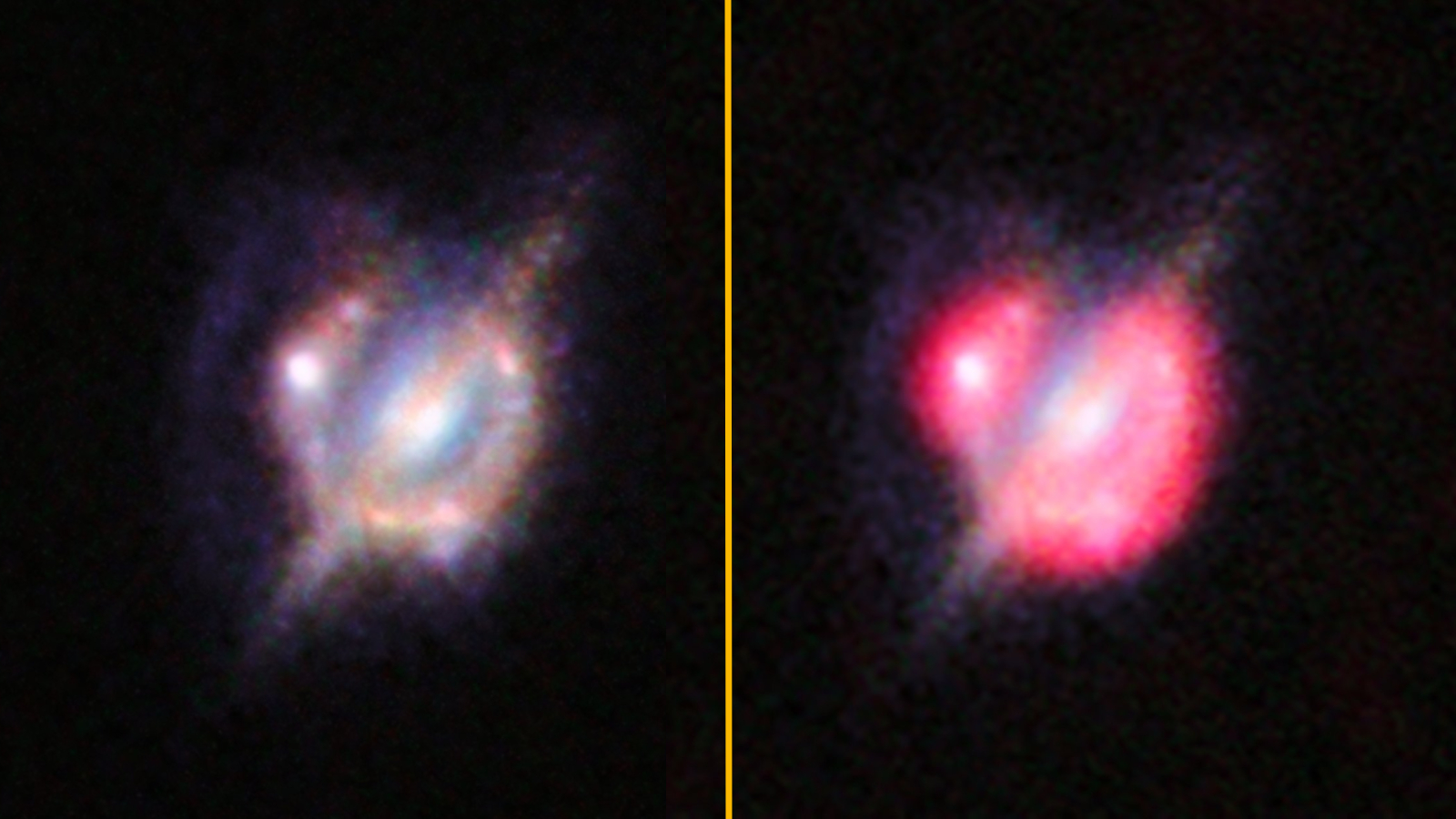
View images of the Einstein rings from studies taken with different telescopes side by side

HATLAS J142935.3–002836 is only visible to us thanks to a phenomenon known as gravitational lensing. These 2014 images, taken by the Hubble Space Telescope (left) and the Atacama Large Millimeter/Submillimeter Array (right) telescope (right), show a partial “Einstein ring” of magnified light from a distant galaxy merger. (Image credit: ALMA (ESO/National Astronomical Observatory/NRAO)/NASA/ESA/WM Keck Observatory)

Gravitational lensing occurs when electromagnetic radiation from a distant object, such as a galaxy, is bent around a massive object located directly between the source and the observer. Obviously, radiation doesn’t actually bend (because light always travels in a straight line). Instead, we travel through a distorted space-time, misshapen by the massive gravity of the central object.

From an observer’s perspective, this phenomenon often forms a ring of light around a central object, known as an “Einstein ring.” But the light source (in this case, the microwave source) is also magnified, making it much easier to analyze distant objects.

The research team now plans to direct MeerKAT at similar systems in hopes of discovering more secret megamasers and gigamasers lurking inside gravitational lensed objects. This could greatly increase the number of these rare space lasers that can be studied.

“This is just the beginning,” Manamela said. “We don’t want to find just one system. We want to find hundreds or thousands of systems.”


Source link

#Biotechnology #ClimateScience #Health #Science #ScientificAdvances #ScientificResearch
Follow on Google News Follow on Flipboard
Share. Facebook Twitter Pinterest LinkedIn Tumblr Email Copy Link
Previous Article149 hacktivist DDoS attacks hit 110 organizations in 16 countries after Middle East conflict
Next Article MacBook Neo, iPhone 17e, and everything else Apple announced this week
user
  • Website

Related Posts

Killer whale fin chewed up on Russian coast points to possible cannibalism, scientists say, could explain why some pods are so tightly bound together

March 4, 2026

NASA fixes Artemis II rocket that will carry astronauts around the moon for April launch

March 4, 2026

New study finds bird declines accelerating in three US hotspots

March 4, 2026
Add A Comment
Leave A Reply Cancel Reply

Latest Posts

Meta Inc. files suit over privacy concerns over AI smart glasses after employees review nude, sex and other footage

Anthropic CEO Dario Amodei may still be trying to strike a deal with the Pentagon

Oura acquires Doublepoint, a startup specializing in gesture recognition technology

Cisco confirms active exploitation of two vulnerabilities in Catalyst SD-WAN Manager

Trending Posts

Subscribe to News

Subscribe to our newsletter and never miss our latest news

Please enable JavaScript in your browser to complete this form.
Loading

Welcome to Fyself News, your go-to platform for the latest in tech, startups, inventions, sustainability, and fintech! We are a passionate team of enthusiasts committed to bringing you timely, insightful, and accurate information on the most pressing developments across these industries. Whether you’re an entrepreneur, investor, or just someone curious about the future of technology and innovation, Fyself News has something for you.

Castilla-La Mancha Ignites Innovation: fiveclmsummit Redefines Tech Future

Local Power, Health Innovation: Alcolea de Calatrava Boosts FiveCLM PoC with Community Engagement

The Future of Digital Twins in Healthcare: From Virtual Replicas to Personalized Medical Models

Human Digital Twins: The Next Tech Frontier Set to Transform Healthcare and Beyond

Facebook X (Twitter) Instagram Pinterest YouTube
  • Home
  • About Us
  • Advertise with Us
  • Contact Us
  • DMCA
  • Privacy Policy
  • Terms & Conditions
  • User-Submitted Posts
© 2026 news.fyself. Designed by by fyself.

Type above and press Enter to search. Press Esc to cancel.