

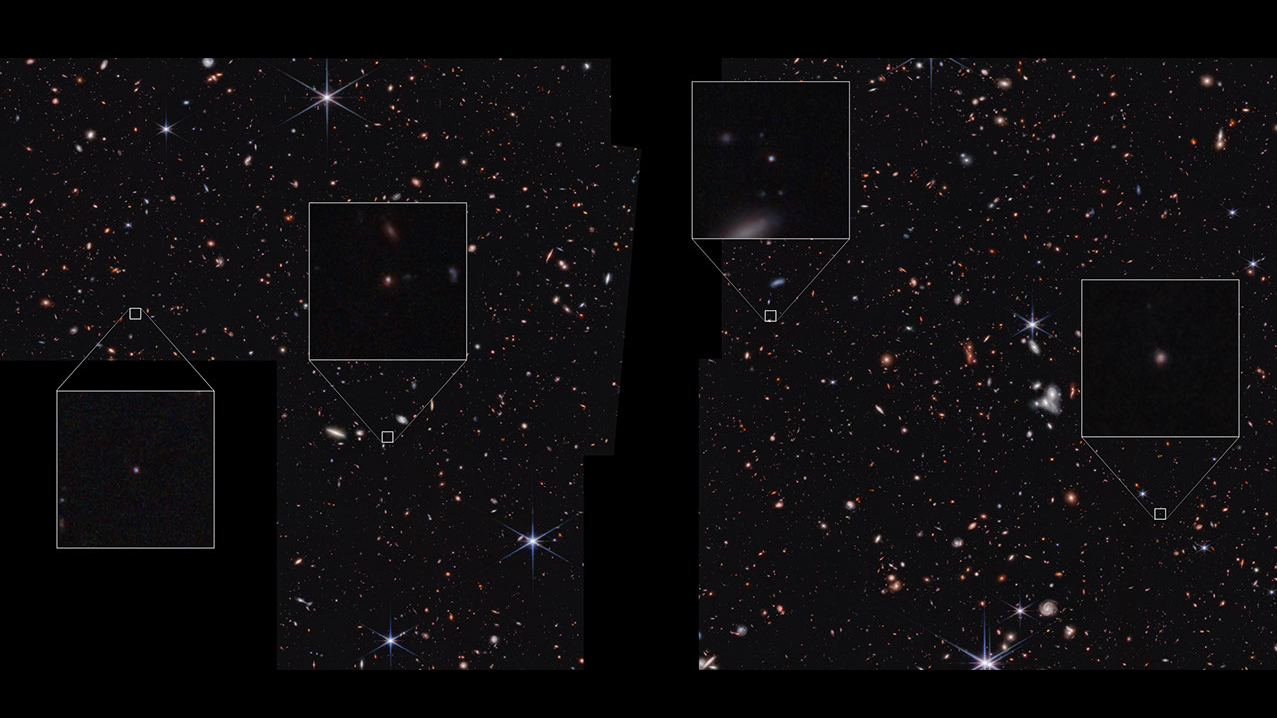
A new category of cosmic objects called “Platypus galaxies” defies explanation.
These nine strange cosmic objects discovered in archival data from the James Webb Space Telescope cannot be easily characterized by their features. Although they are small and compact, they are likely not active supermassive black holes or quasars, massive black holes that shine as brightly as galaxies, according to a new study.
Haojing Yang, an astronomer at the University of Missouri who led the research team, said he called the strange galaxy in the universe the “Platypus Galaxy” when presenting his findings at the 247th meeting of the American Astronomical Society in Phoenix this week.
you may like
“The detailed genetic code of the platypus provides additional information showing how rare this animal is, sharing genetic characteristics with birds, reptiles, and mammals,” Yang said in a statement explaining the research. This paper is available as a preprint via arXiv. “Taken together, the Webb images and spectra show that these galaxies have an unexpected combination of features.”
Looking at this collection of galactic features is like looking at a platypus, he added. “You think these things shouldn’t exist together, but it’s right in front of you and you can’t deny it,” he said.
For example, the spectrum of a typical quasar, a very bright and energetic object, has emission lines that look like hills. The spectrum also shows that gas is rapidly circulating around the central supermassive black hole.
However, the nine newly discovered galaxies have narrow, sharp spectra, indicating that the gas is moving more slowly. Some galaxies with narrow, sharp spectra have supermassive black holes at their centers, but unlike that group, the new galaxies don’t look like “dots” in images.
So if these mysterious objects aren’t quasars and harboring supermassive black holes, then what are they? One possibility is that they represent a newly discovered type of star-forming galaxy that existed in the early Universe, and that’s what JWST is optimized for observing.
But even that possibility confuses the research team, co-investigator and University of Missouri graduate student Vanjen Sun said in the same statement.
“From the low-resolution spectra we have, we cannot exclude the possibility that these nine objects are star-forming galaxies,” Sun said. “The data match. What’s strange about this case is that the galaxy is so small and compact, even though the Webb has the resolution to show a lot of detail at this distance.”
If so, JWST could be observing an even older type of galaxy than previously discovered. If that’s indeed what JWST is observing, perhaps there may be more to learn about how galaxies evolved, Yang said.
“I think this new study poses a question for us: How does the process of galaxy formation begin in the first place?” Yang said. “Could such small building block galaxies form silently before chaotic mergers begin, as their dot-like appearance suggests?”
The research team said they will need more galaxy samples to continue their research. Fortunately, JWST is still in the early stages of its observation period. The telescope is expected to launch in 2021 and remain in deep space for at least another 15 years, peering into distant objects in the early universe.
Source link
