
Close Menu
  • Home
  • Identity
  • Inventions
  • Future
  • Science
  • Startups
  • Spanish
What's Hot

China-linked DKnife AitM framework, routers targeted for traffic hijacking and malware distribution

CISA orders removal of unsupported edge devices to reduce risk to federal networks

Combat antimicrobial resistance with McGill rapid tests

Facebook X (Twitter) Instagram
  • Home
  • About Us
  • Advertise with Us
  • Contact Us
  • DMCA
  • Privacy Policy
  • Terms & Conditions
  • User-Submitted Posts
Facebook X (Twitter) Instagram
Fyself News
  • Home
  • Identity
  • Inventions
  • Future
  • Science
  • Startups
  • Spanish
Fyself News
Home » ‘Why is this happening?’: Scientists discover large group of ancient galaxies that are too hot to exist
Science

‘Why is this happening?’: Scientists discover large group of ancient galaxies that are too hot to exist

userBy userJanuary 6, 2026No Comments3 Mins Read
Share Facebook Twitter Pinterest Telegram LinkedIn Tumblr Email Copy Link
Follow Us
Google News Flipboard
Share
Facebook Twitter LinkedIn Pinterest Email Copy Link

Astronomers have discovered an unexpectedly hot cluster of galaxies in the early universe, casting doubt on theories of galaxy evolution.

This scorching galaxy cluster existed just 1.4 billion years after the Big Bang, burning up much earlier and hotter than current models of cluster formation would predict. The findings suggest that predicted patterns of cluster growth may need to be reconsidered, the researchers reported in the journal Nature on January 5th.

A galaxy cluster is a collection of dark matter and hundreds to thousands of galaxies, all held together by gravity. These galaxies are separated by a mixture of gases known as the intracluster medium. When a galaxy cluster forms, the intracluster medium heats up due to gravitational interactions within the cluster and energy release from young stars and black holes. But this process takes a long time, and scientists have rarely observed hot intracluster media in young galaxy clusters.

you may like

“Understanding galaxy clusters is key to understanding the largest galaxies in the universe,” study co-author Scott Chapman, an astrophysicist at Dalhousie University who conducted the study while at the National Research Council of Canada, said in a statement. “Most of these giant galaxies exist within galaxy clusters, and their evolution is greatly influenced by the extremely strong environment in which the clusters form, including the intracluster medium.”

In the new study, researchers used the Atacama Large Millimeter/Submillimeter Array (ALMA), a powerful radio telescope in Chile, to observe a bright, young galaxy cluster known as SPT2349-56. The light from this galaxy cluster was emitted just 1.4 billion years after the Big Bang. Although this galaxy cluster is relatively small, about the size of the Milky Way’s outer halo, it contains more than 30 active galaxies and three supermassive black holes, and forms stars more than 5,000 times faster than the Milky Way.

Using a phenomenon called the thermal Sunyaev-Zeldovich effect, the researchers found that the gas in the intracluster medium is at least five times hotter than the gas at a younger age predicted by current theories of cluster formation.
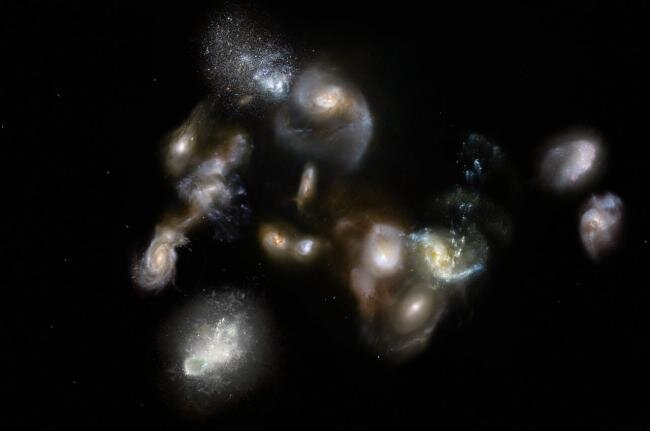
Rotating, glowing white, yellow, and blue spheres are placed seemingly randomly, but near a pitch-black background.

Artist’s impression of galaxy cluster SPT2349-56. (Image credit: ESO/M. Kornmesser)

“We did not expect to see such a hot star cluster atmosphere so early in the history of the universe,” study co-author Dazhi Zhou, a doctoral student in the Department of Physics and Astronomy at the University of British Columbia, said in a statement. “In fact, I was skeptical at first because the signal was too strong to be real.”

Get the world’s most fascinating discoveries delivered straight to your inbox.

But it was reality. This may mean that galaxy clusters may form sooner than expected.

“This shows that something in the early universe, perhaps the three recently discovered supermassive black holes in this cluster, was already pumping massive amounts of energy into its surroundings, shaping young star clusters much faster and more strongly than we thought,” Chapman said.

In future work, the researchers plan to investigate what this unusual galaxy cluster means for the formation and evolution of existing galaxy clusters.

“We want to understand how intense star formation, active black holes, and this superheated atmosphere interact, and what that can tell us about how modern galaxy clusters were built,” Zhou said. “How can all of this happen at once in such a new and compact system?”


Source link

#Biotechnology #ClimateScience #Health #Science #ScientificAdvances #ScientificResearch
Follow on Google News Follow on Flipboard
Share. Facebook Twitter Pinterest LinkedIn Tumblr Email Copy Link
Previous ArticleMobileye acquires humanoid robot startup Mentee Robotics for $900 million
Next Article Viral Reddit post claiming food delivery app scam turns out to be AI-generated
user
  • Website

Related Posts

7,500-year-old deer headdress discovered in Germany shows hunter-gatherers shared sacred objects and ideas with the region’s first farmers

February 5, 2026

How well can AI and humans work together? Scientists are looking to Dungeons & Dragons to find out.

February 5, 2026

Saltwater crocodiles crossed the Indian Ocean to the Seychelles before humans arrived and made them extinct.

February 5, 2026
Add A Comment
Leave A Reply Cancel Reply

Latest Posts

China-linked DKnife AitM framework, routers targeted for traffic hijacking and malware distribution

CISA orders removal of unsupported edge devices to reduce risk to federal networks

Combat antimicrobial resistance with McGill rapid tests

Asian State Assistance Group TGR-STA-1030 breaches 70 governments and infrastructure-related organizations

Trending Posts

Subscribe to News

Subscribe to our newsletter and never miss our latest news

Please enable JavaScript in your browser to complete this form.
Loading

Welcome to Fyself News, your go-to platform for the latest in tech, startups, inventions, sustainability, and fintech! We are a passionate team of enthusiasts committed to bringing you timely, insightful, and accurate information on the most pressing developments across these industries. Whether you’re an entrepreneur, investor, or just someone curious about the future of technology and innovation, Fyself News has something for you.

Castilla-La Mancha Ignites Innovation: fiveclmsummit Redefines Tech Future

Local Power, Health Innovation: Alcolea de Calatrava Boosts FiveCLM PoC with Community Engagement

The Future of Digital Twins in Healthcare: From Virtual Replicas to Personalized Medical Models

Human Digital Twins: The Next Tech Frontier Set to Transform Healthcare and Beyond

Facebook X (Twitter) Instagram Pinterest YouTube
  • Home
  • About Us
  • Advertise with Us
  • Contact Us
  • DMCA
  • Privacy Policy
  • Terms & Conditions
  • User-Submitted Posts
© 2026 news.fyself. Designed by by fyself.

Type above and press Enter to search. Press Esc to cancel.