Close Menu
  • Home
  • Identity
  • Inventions
  • Future
  • Science
  • Startups
  • Spanish
What's Hot

Veeam patches 7 critical backup and replication flaws that could allow remote code execution

Channel Surfer lets you watch YouTube like old-school cable TV

Why Rivian will keep the $45,000 base model R2 until “late 2027”

Facebook X (Twitter) Instagram
  • Home
  • About Us
  • Advertise with Us
  • Contact Us
  • DMCA
  • Privacy Policy
  • Terms & Conditions
  • User-Submitted Posts
Facebook X (Twitter) Instagram
Fyself News
  • Home
  • Identity
  • Inventions
  • Future
  • Science
  • Startups
  • Spanish
Fyself News
Home » Aurora heads toward Earth as perhaps the most active sunspot in years
Science

Aurora heads toward Earth as perhaps the most active sunspot in years

userBy userFebruary 2, 2026No Comments3 Mins Read
Share Facebook Twitter Pinterest Telegram LinkedIn Tumblr Email Copy Link
Follow Us
Google News Flipboard
Share
Facebook Twitter LinkedIn Pinterest Email Copy Link

Updated February 3rd at 11:00 AM ET: Monster sunspot region 4366 is currently facing Earth and shows no signs of weakening. It is the most active sunspot in the current solar cycle (period 25). NOAA predicts that a massive CME shot toward Earth is likely to occur this week. A minor (G1) geomagnetic storm is predicted to begin on Thursday (February 5), with the potential for aurora borealis to occur at lower latitudes than usual. Please stay tuned for further information.

A monster sunspot took aim at Earth after firing dozens of powerful flares on Sunday and Monday (February 1-2), including the most violent solar explosion in years.

According to a warning from the National Oceanic and Atmospheric Administration’s Space Weather Prediction Center (SWPC), geomagnetic activity will increase on Thursday (February 5), potentially producing more vivid auroras at lower latitudes than usual. However, it is still too early to be sure.

you may like

The sunspot, called Region 4366, suddenly appeared a few days earlier and quickly grew to about half the size of the infamous Carrington event sunspot, which in September 1859 produced the flare that caused the most destructive geomagnetic storm in recorded history. This rapid growth has made sunspot 4366 highly unstable. In the 24-hour period from Sunday to Monday, more than 20 solar flares occurred in the region, including at least 23 M-class flares and four X-class flares, among the most powerful solar flares, NASA said.

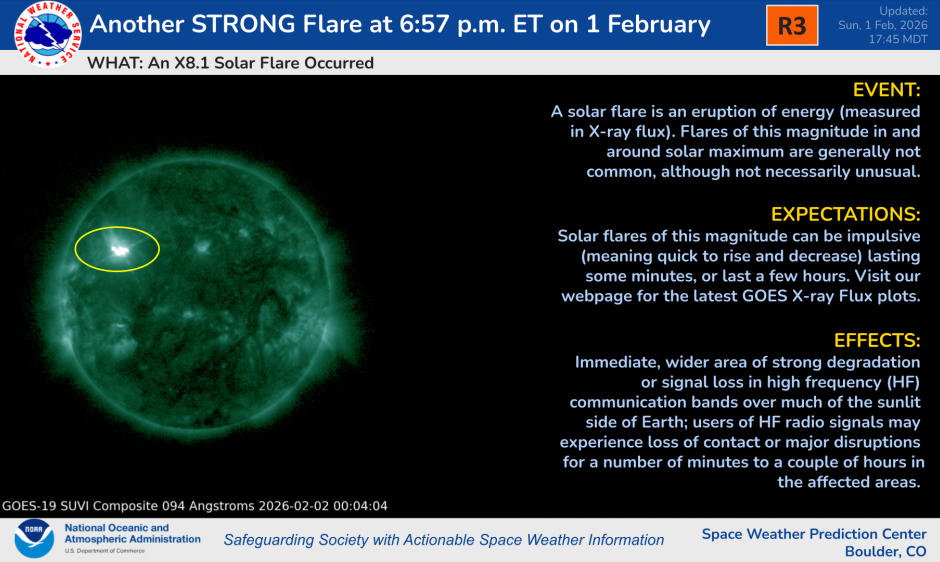
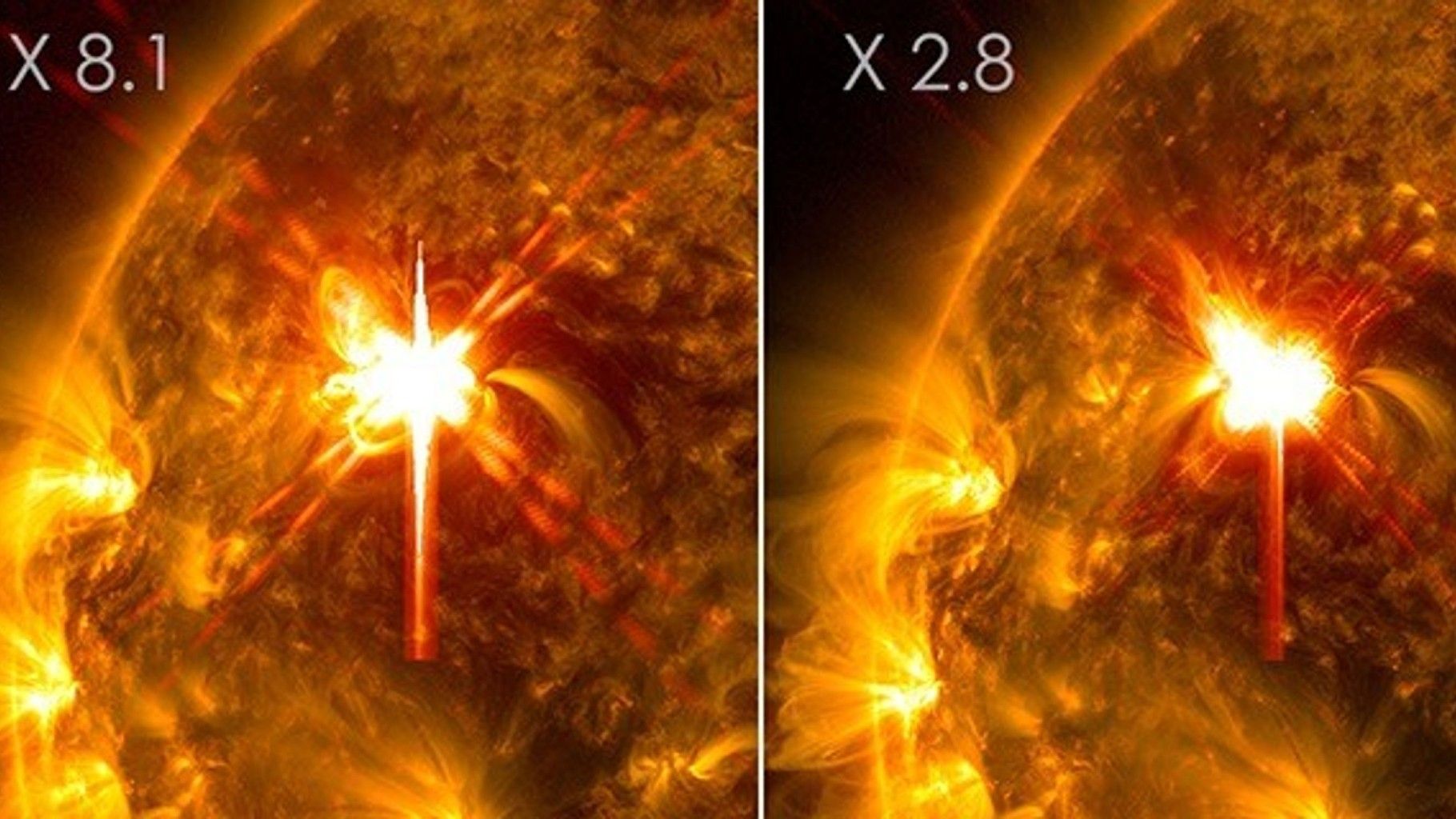
The intense activity peaked around 6:57 p.m. ET on Sunday, when the sunspot triggered a powerful solar flare of X8.1, according to SWPC. This was the single most powerful solar flare since October 2024, when the Sun began its X9.0 outburst.

According to Spaceweather.com, the recent X-class flare quickly caused a partial radio blackout in the South Pacific Ocean and shot a slow-moving plasma blast called a coronal mass ejection (CME) in Earth’s direction. SWPC predicts that this CME will just miss Earth as it passes by on February 5th, but could receive a faint hit.

If a CME were to clip Earth, charged solar particles would race toward Earth’s magnetic poles, creating bright auroras.

Get the world’s most fascinating discoveries delivered straight to your inbox.

The sun “wakes up”

NOAA solar flare alert

NOAA issued this warning in response to the flare eruption. (Image credit: NOAA)

Sunspots are vast, dark regions of magnetic instability that form in the Sun’s lower atmosphere. If the magnetic field lines near these regions become too entangled, they can violently snap back into place, causing solar flares and CMEs.

Sunspot activity peaks every 11 years, when the sun’s magnetic poles switch places during a period called solar maximum. The frequency and intensity of solar flares and CMEs also peak during this tumultuous period.

In 2024, NASA confirmed that solar maximum is well underway and that severe space weather could remain high until 2026. The result could be extremely rare and widespread auroral events, such as those observed in May 2024 when a monster CME pushed the aurora borealis all the way to South Florida. A recent study found that the sunspot that caused that storm remained on the sun for more than three months, causing nearly 1,000 solar flares during its lifetime.

Severe solar radiation storms can also have negative effects such as radio interference, GPS disruption, and damage to satellites and spacecraft.

The most powerful solar flare in 2025 was an X5.1 class eruption recorded in November. Sunspot 4366 has already broken records, but it remains to be seen whether it will persist to break its own records.


Source link

#Biotechnology #ClimateScience #Health #Science #ScientificAdvances #ScientificResearch
Follow on Google News Follow on Flipboard
Share. Facebook Twitter Pinterest LinkedIn Tumblr Email Copy Link
Previous ArticleWhat Snowflake and OpenAI’s deal says about the enterprise AI race
Next Article Preserved hair reveals how bad lead exposure was in the 20th century
user
  • Website

Related Posts

Study finds hidden early warning indicators in the Gulf Stream could signal AMOC collapse

March 12, 2026

Giant 10-seater flying taxi passes first flight test in China

March 12, 2026

‘Mass migration’ of stars away from the center of the Milky Way galaxy could explain why life exists in our solar system

March 12, 2026
Add A Comment
Leave A Reply Cancel Reply

Latest Posts

Veeam patches 7 critical backup and replication flaws that could allow remote code execution

Channel Surfer lets you watch YouTube like old-school cable TV

Why Rivian will keep the $45,000 base model R2 until “late 2027”

Tinder tries to lure people back to online dating with IRL events and virtual speed dating

Trending Posts

Subscribe to News

Subscribe to our newsletter and never miss our latest news

Please enable JavaScript in your browser to complete this form.
Loading

Welcome to Fyself News, your go-to platform for the latest in tech, startups, inventions, sustainability, and fintech! We are a passionate team of enthusiasts committed to bringing you timely, insightful, and accurate information on the most pressing developments across these industries. Whether you’re an entrepreneur, investor, or just someone curious about the future of technology and innovation, Fyself News has something for you.

Castilla-La Mancha Ignites Innovation: fiveclmsummit Redefines Tech Future

Local Power, Health Innovation: Alcolea de Calatrava Boosts FiveCLM PoC with Community Engagement

The Future of Digital Twins in Healthcare: From Virtual Replicas to Personalized Medical Models

Human Digital Twins: The Next Tech Frontier Set to Transform Healthcare and Beyond

Facebook X (Twitter) Instagram Pinterest YouTube
  • Home
  • About Us
  • Advertise with Us
  • Contact Us
  • DMCA
  • Privacy Policy
  • Terms & Conditions
  • User-Submitted Posts
© 2026 news.fyself. Designed by by fyself.

Type above and press Enter to search. Press Esc to cancel.