
Tracking Saharan dust plumes across Europe
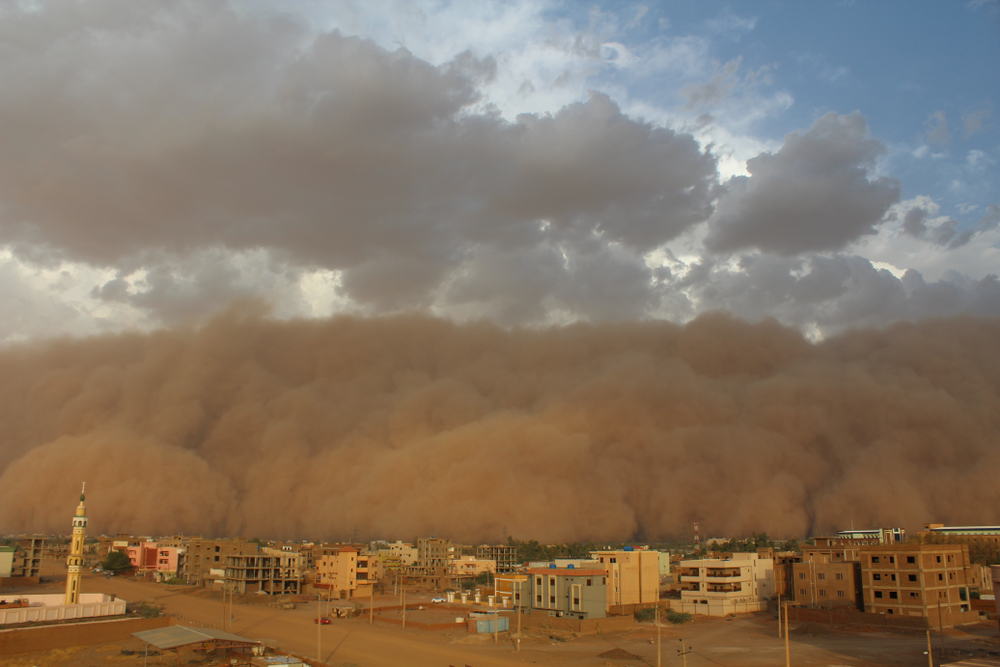
Mark Purrington, senior scientist at the Copernicus Atmospheric Monitoring Service (CAMS), explains how Saharan dust plumes from powerful storms are being transported into southern Europe and what this means for air quality, visibility and atmospheric monitoring.
Large plumes of Saharan dust regularly travel thousands of kilometers from North Africa to Europe, shaping skies, air quality, and atmospheric conditions far from their source. These phenomena are closely monitored by scientists because mineral dust is one of the most abundant airborne particles in the atmosphere and can affect everything from visibility and public health to weather patterns and climate processes.
CAMS is operated by the European Center for Medium-Range Weather Forecasts (ECMWF) and provides detailed forecasting and monitoring of atmospheric composition, including desert dust. By combining satellite observations and advanced atmospheric modeling, CAMS tracks how dust is lifted from the Sahara Desert and transported across the continent, helping authorities and researchers understand when and where impacts are likely to occur.
As a new Saharan dust plume develops and moves toward Europe, CAMS scientists are analyzing its size, trajectory, and potential impact on the entire region. CAMS senior scientist Mark Parrington spoke to Innovation News Network Editor-in-Chief Jack Thomas about how these phenomena form, how they are monitored over long distances, and what they reveal about the movement of particles through the atmosphere.
Mark will be speaking from Budapest this week. There, CAMS experts and policy makers will gather at the CAMS Policy Users Workshop to discuss the role of air monitoring in supporting air quality management across Europe.
What is happening now with this dust event? How does it compare to what we saw in late February?
What we are currently seeing is associated with the Borasca storm, which has been named “Regina” by the Portuguese Meteorological Agency (IPMA). This is a very powerful, tightly wound cyclonic low pressure system. This can generate strong easterly and southerly winds that can rapidly transport dust from the Sahara Desert to the western Mediterranean.
Typically, this first affects the Iberian Peninsula and then moves towards France. Some dust particles, particularly those in the upper atmosphere, can be carried further afield, reaching the UK, the North Sea and Scandinavia.
In our data, we focus on a parameter called aerosol optical depth. This measures the amount of particulate matter in the atmosphere between the ground and the upper layers of the atmosphere and how it affects the transmission of solar radiation. An aerosol optical depth value of approximately 1 typically corresponds to hazy conditions.

This event has generally higher aerosol optical depth values compared to the event at the end of February. Overall, therefore, the economy appears to be strengthening, particularly across Europe, and our forecasts indicate that it will continue over the coming days.
February’s events were a little different. This involved so-called Kalima-type winds, which typically cause outflow toward the North Atlantic Ocean. These Kalima events often cause poor visibility and atmospheric deterioration due to plumes of Saharan dust in places such as the Canary Islands and Madeira.
In this case, circulation means that dust blown into the North Atlantic is recirculated northward. This Borasca event allows for a more direct migration across the western Mediterranean into southwestern Europe.
Is this unusual for this time of year, or is it largely to be expected? Are we seeing these events more often?
Pretty typical for this time of year. I haven’t personally looked at the statistics for my own dataset, but there are studies that looked at the Mediterranean and North Atlantic basins to see how often these phenomena occur.
From late winter to early spring, they are by no means unknown. Kalima-type events and extratropical storms are common during this period, creating the circulation patterns necessary for dust transport. If there is enough dust in the atmosphere, it could be brought into European airspace.
Although it is difficult to directly compare individual events, a similar Borrasca-type wind pattern in 2022 and possibly 2024 is likely to have caused high dust concentrations in southern Spain. These cyclones also bring strong winds and heavy rain, so they can have quite a noticeable impact.
For example, in early spring 2022, there was not only dust accumulation but also flooding. The combination of heavy rain and large amounts of dust in the atmosphere resulted in significant amounts of dust being deposited on the ground.
Which regions are likely to be most affected, and how will people be affected in terms of air quality and visibility?
The worst-hit areas in recent days have been Spain and Portugal, as well as parts of southern France. That makes sense, since these countries are just downwind of the Sahara Desert.
Algeria, Morocco and Tunisia should also be kept in mind. In these countries, mineral dust entering the atmosphere can have very serious impacts on air quality and visibility.
Our projections show that surface PM10 concentrations are increasing in Spain and Portugal. This can have an impact on air quality, with dust contributing so much that the UK Environment Agency puts it in the ‘poor’ category of air quality index.
This does not tend to last very long, but we have seen some superficial effects over the past few days and into today. Then the conditions start to clear.
By the time the Saharan dust plume reaches France, it may still have effects on surface air quality. Further north, reaching the United Kingdom, the North Sea, and Scandinavia, the dust is typically carried higher up in the atmosphere. Therefore, it usually does not have a noticeable effect on air quality on the ground.
Instead, people focus on the more colorful sunrises and sunsets. When rain mixes with dust-laden air masses, it creates wet deposits that can leave a dust-like residue on your car and windows.
These events can develop rapidly. How do you track them across the continent and how important is it to monitor them?
CAMS runs a 5-day weather forecast. The amount of dust that enters the atmosphere is modeled based on weather conditions such as wind, circulation patterns, and surface pressure.
It relies on ECMWF’s weather modeling, which is widely recognized as one of the most accurate forecasting systems in the world. This allows us to model the source region of the Saharan dust and track how the air mass moves over the next few days.
Combining these dust emissions with wind forecasts can tell us where air masses are likely to move and where they may impact air quality.
Part of my daily job is to review these forecasts as they come in and assess how well they perform against independent measurements, if available. Generally, these events span 3-4 days and are very accurately described by the forecasting system.
Another important aspect is that we also use satellite observations to update the starting point for each forecast. The satellite measures the optical depth of aerosols and combines those observations with model estimates of the amount of dust in the atmosphere.
This gives you the benefits of both approaches. Modeling provides a detailed representation of how the Saharan dust plumes are transported, and observations help start predictions with the most accurate picture possible of the atmosphere.
This process updates every 12 hours, so new forecasts incorporate the latest observations.
Is it a new development?
No, that approach has been used throughout the life of CAMS, which is about 10 or 11 years now. Even before that, during the development of the system, the entire framework was built around combining satellite observations and modeling.
This is also one of the reasons why ECMWF’s forecasts are so accurate. Create better initial conditions for prediction by assimilating a large number of observations into the model. Predictions are sensitive to starting conditions and therefore naturally vary over time, so using real observations can reduce that uncertainty.
Does that mean this system can provide a more comprehensive picture of what’s happening in the atmosphere?
That’s right. At the heart of our work is a combination of highly sophisticated numerical modeling and millions of daily observation points.
Although we have discussed desert dust and aerosols here, the same approach is used for other atmospheric components such as ozone, carbon dioxide, and wildfire smoke. For example, carbon monoxide is very useful for tracking wildfire smoke, and we also use this system to study the ozone layer and the ozone hole.
The modeling also represents chemical reactions in the atmosphere, allowing you to understand how the emissions of one pollutant affect other pollutants and influence the overall composition of the atmosphere.
Source link

