
The compact yet versatile Spanish neutron facility
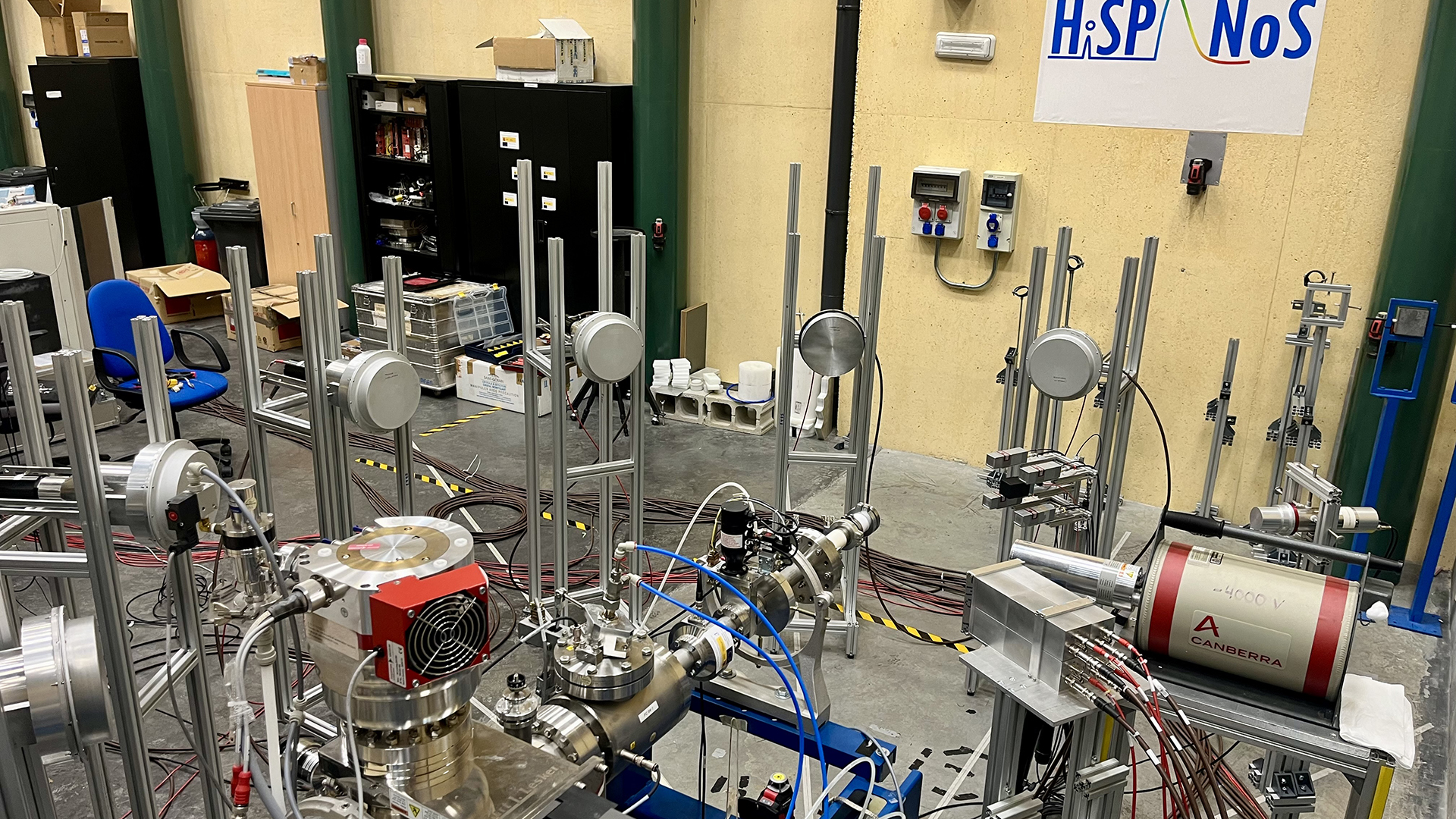
In a world of ever larger international facilities, a medium-sized neutron facility can have an impact on many research fields and applications.
Neutrons are nowadays involved in many industrial applications and fields of research. They are indeed very particular; their lack of charge makes them very penetrating radiation for which the electron cloud of the atoms is transparent, thus interacting only with the nucleus. Naturally unstable, they are created by, and also drive, nuclear reactions. Neutrons appear as a result of both fission and fusion reactions, being thus essential in the electricity production in current and future nuclear reactors. This is indeed a trending topic, given the recent advances in Small Modular Reactors (SMR) and the excellent prospects for fusion, with a series of recent records broken in plasma confinement. Besides energy production, the list of research fields and applications requiring neutrons is very extensive and varied. Their absorption by nuclei inside the stars gives birth to the elements of our Universe heavier than iron, and when they induce fission in nuclear reactors they produce the 99Mo that serves as generator of the 99mTc that is used in over 85% of the 30 million nuclear medicine diagnostic scans performed worldwide. In the context of materials science, the ESS and IFMIF-DONES projects represent worldwide efforts to build, respectively, the most intense slow and fast neutron beam facilities that have ever existed.
Consequently, neutron facilities are gaining attention, and the user demand keeps growing. Reactors and international facilities are, however, expensive, limited in access, and usually very specialised for a particular use. As a result, modest local or national facilities can and should contribute to making neutron applications more accessible and widespread.
A plethora of neutron beams
The Centro Nacional de Aceleradores (CNA) is located in Sevilla, where it hosts four accelerators devoted mostly to basic science, mass spectroscopy for actinides and carbon dating, medical applications, and industrial applications. Among these, the 3 MV Pelletron tandem accelerator drives the HiSPANoS neutron beam facility.

A modest particle accelerator such as this will never achieve the record neutron intensities and energies of large international facilities, but the inherent variety of particle beams and energies attainable is very well suited for the production of neutron beams tailored to each specific application:
The moderated beam of thermal neutrons enables conventional nuclear reactor applications such as Neutron Activation Analysis, the production of radioactive isotopes, or neutron imaging.
The flux of epithermal neutrons resulting from the ⁷Li(p,n) reaction at 1912 keV is renowned for its resemblance to the spectrum of the neutrons responsible for the nucleosynthesis in stars through the s-process.
Last, the fast neutron beams up to 20 MeV cover the established range of interest for fission and fusion applications.
All these beams can be delivered in continuous and pulsed mode. The latter is achieved through the combination of a conventional electrostatic chopper and a unique 3-species (¹H, ²H, and ⁴He) compact buncher module designed ad hoc by NEC. This capability enables the time-of-flight technique for measurements requiring neutron spectroscopy, which are many indeed.
Nuclear data as core application
Being uncharged, the interaction of neutrons with matter is through nuclear reactions, which are behind all and each of the applications and research fields mentioned. In short, the study of these reactions aims at quantifying their probability of occurrence, their outcome, and the dependence of these with the neutron energy. These quantities fall under the umbrella of what is known as Nuclear Data (ND). Surprisingly, nearly 100 years have passed since the discovery of the neutron, and still, there is plenty of room not only for improvement in neutron-related nuclear data but also for an internationally recognised need to improve our knowledge for a wide range of neutron-induced reactions. Naturally, this has become one of the objectives of neutron beam facilities, including HiSPANoS.
While all neutron-induced reactions are important in one or another field, there are two that are transversal to many and thus most studied: neutron capture and fission. At HiSPANoS, both are studied within a research programme partly complementary to that of the n_TOF Collaboration at CERN. At CNA, the neutron capture reactions are mostly measured by neutron activation under irradiation with neutrons with a 30 keV Maxwell-Boltzmann distribution. This energy range is essential for nuclear astrophysics, but it has recently also been recognised as key for nuclear technologies since it is a region in which cross sections are considerably reduced compared to the eV range, and resonances start to overlap, making time-of-flight measurements quite difficult because of low signal and a dominant neutron scattering background. At HiSPANoS, the neutron activation technique of Ratynski and Käppeler has been applied to the study of (n, gamma) reactions on 50Cr, 107Ag, 146Nd, 159Tb, 181Ta, or 197Au, with 59Co, 109Ag, 186W, and 232Th in the pipeline due to their expected impact on the International Reactor Dosimetry and Fusion File IRDFF-II. In addition, a new system has been designed and already validated in the context of a CNA-IFIC-CIEMAT-UPC-CERN collaboration funded through the NextGenerationEU programme for measurements in which the radioactive activation product is short-lived, requiring cyclic activation and decay measurements based on a fast linear stager and adequate shielding of the radiation detectors. Regarding fission, an ambitious programme has been launched using Micromegas technology as a choice for detecting fission fragments from fast neutron-induced reactions. This initiative is supported by the EC EUROLABS project, and the first differential cross sections based on time-of-flight measurements up to 10 MeV are expected within 2026.
On a less studied topic, nuclear data involving neutrons as a result and not as an inducer of the reaction have emerged as a field of interest in the case of (alpha,n) reactions, which are now recognised as significant sources of background in underground rare-event experiments for dark-matter searches, now that all other background sources have been largely suppressed. A national effort in Spain aims at assessing these reactions in the context of the recently established Measurements of Alpha Neutron Yields MANY Collaboration. In particular, a state-of-the-art neutron counter (the miniBELEN detector of UPC/IFIC) and spectrometer (the MONSTER array of CIEMAT) have been tested successfully at both CNA HiSPANoS and the CMAM accelerator in Madrid. The research programme has already started, including the study of reactions on isotopes of interest for the mentioned rare-event experiments, but also for nuclear technology and astrophysics, for instance 9Be, 13C, 14N, 19F, 27Al, 30Si, or 40Ar.
Industrial applications
Neutrons are a highly penetrating radiation and, as such, they serve to unravel the interior of voluminous objects. While charged particles such as protons or alphas of a few MeV stop after traveling tens to hundreds of micrometers into an object, both thermal and fast neutrons can traverse objects of tens of centimeters, in a way that depends strongly on the elemental composition of such objects. Neutron imaging exploits such a feature to produce 2D (radiography) and 3D (tomography) of either voluminous or metallic objects, something that is mostly done at fission nuclear reactors. However, at CNA HiSPANoS we have developed the technique for both 2D and 3D, with both thermal and fast neutrons (the latter more unique, as it cannot be achieved easily in reactors) and have even combined it with complementary gamma-imaging using CNA RadLAB’s 400 TBq 60Co source. The technique has been applied to cultural heritage (realistic Roman amphoras and gold jewelry phantoms) and, in collaboration with Neutron Insights S.L, to additive manufacturing of metallurgical parts.
As neutrons travel through an object and undergo a nuclear reaction, they might be absorbed by a nucleus that is then transmuted into a new isotope that is often radioactive. This enables the elemental study of an object by the so-called (prompt/delayed) Neutron Activation Analysis NNA, a technique that is usually performed at reactors and has also been established at HiSPANoS. The outcome is quite similar to standard techniques such as X-ray fluorescence, but while this tells a story only about the surface of an object due to the short penetration of X-rays, neutrons relate the story of the whole object. This is currently being applied to Roman coins at HiSPANoS, using slow neutrons from the newly designed moderator.
One last but less well-known application of neutrons is related to the fact that, as they travel through an object, they ionise the medium and deposit energy, often damaging cells of biological tissues. This is harmful in any radiation environment, for instance, in the context of radiotherapy. However, it represents a unique tool to induce mutagenesis in seeds or buds of crops that may result in new varieties that improve the harvest in many ways. Neutron-induced mutagenesis has been known and applied for decades in reactors with thermal neutrons, but lately, fast neutrons are being considered, and at HiSPANoS, a collaboration with ANECOOP S. Coop. is already leading to promising results.
Internationalisation through EC transnational access programmes
In an international context, the HiSPANoS neutron facility is medium or even small in terms of beam intensity, associated instrumentation, and human resources. Nevertheless, it has pursued and achieved a remarkable level of internationalisation given its size. This has been possible only through proactive participation in several Transnational Access projects, which receive proposals from foreign users and, upon their approval by an international Project Advisory Committee (PAC), grant the funds necessary for travel and accommodation to the participants and for Access Cost to the facility. This way, researchers from Portugal, Switzerland, Argentina, Iran, Greece, Italy, and Germany have performed nuclear physics experiments at HiSPANoS with funding from the European Commission EURATOM projects ARIEL, EURO-LABS, APRENDE, and the SNETP Platform project OFFERR.
Training the next generation of nuclear physics researchers
High-level training is crucial in the Research and Development environment, and especially in a complex field such as the use of particle accelerators. Particle accelerators are widely known for their role in understanding the universe’s origins at CERN, but they play a vital role in society by advancing scientific research, medicine, and industrial technology. They are essential for cancer therapy (radiotherapy), manufacturing, materials analysis, and environmental protection, with over 30,000 in use worldwide. But these high-tech machines are not easily accessible, not even to graduates and young researchers, and the CNA management has decided to have an impact on the matter.

A programme of international schools has been up and running since 2022, when the 1st edition of the HiSPANoS Hands-On School on Production, Detection and Use of Neutron Beams (funded through EC ARIEL) was held. That was followed by the Basic Training School on Accelerator Applications in Nuclear Physics, funded by EC EURO-LABS, and 2026 will see the second edition of the HiSPANoS School. The new edition, funded by EC APRENDE, offers the opportunity to 24 young researchers to spend one week in Seville, receiving lectures and carrying-out four experiments on epithermal neutron activation for astrophysics, neutron time-of-flight for fast neutrons spectroscopy, neutron and gamma imaging, and, last, design and validation of neutron moderation and shielding set-ups.
A bright future ahead
At present, one of the limitations of HiSPANoS is related to the accelerator beam intensity, especially in the case of the ⁴He beam for (alpha,n) measurements. This is about to change with the installation of the NEC TORVIS ion source, which will not only provide more brightness and intensity but also features a very stable operation, which is particularly interesting for long experiment campaigns. Last, HiSPANoS is missing a very particular type of neutrons that are not found anywhere else in Spain but are essential for fusion and other industrial applications: the 14 MeV neutrons resulting from DT fusion reactions. For this reason, CNA is determined to complement HiSPANoS with a commercial but intense DT neutron generator within this decade.

This project has received funding from the European Union’s Horizon Euratom Research and Training Programme under grant agreement No 101164596 (APRENDE), as well as from the Spanish AEI projects PID2021-123879OB-C21 and PID2024-155965OB-I00.
Please Note: This is a Commercial Profile
Please note, this article will also appear in the 26th edition of our quarterly publication.
Source link

