
Solar activity can predict when space debris will fall to Earth
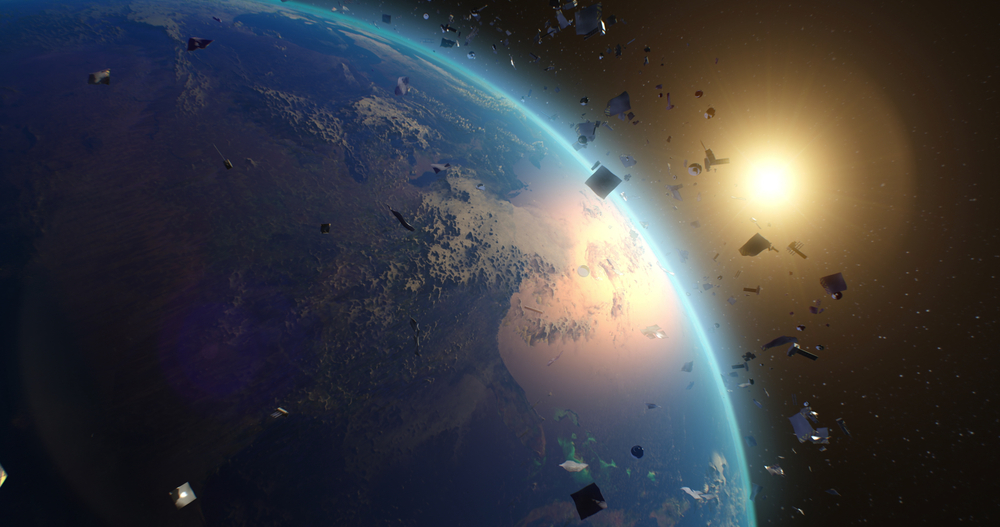
A new study has found that space debris around Earth loses altitude faster when the sun is more active, a finding that could help plan future space operations.
Fragments of old satellites and rocket parts litter the atmosphere. With more than 140 million objects orbiting Earth at an average speed 10 times faster than a bullet, space junk poses a significant risk to new satellites, communications constellations, and even new space launches like the recent Artemis II mission. The problem will only get worse over time, as collisions can cause significant damage and generate more debris.
A variety of solutions have been proposed to reduce the amount of space junk, from robots capturing debris to using ion beams to transport the junk to Earth’s lower atmosphere, where it burns up on descent.
But planning these missions requires navigating through debris to avoid collisions, which has so far proven difficult to predict.
Brighter, hotter, faster, heavier
A new study published in Frontiers in Astronomy and Space Sciences examined 36 years of space junk data and compared it to records of solar activity and observed that peaks in the Sun’s activity correlated with declines in its orbit.
The Sun emits ultraviolet light and charged particles such as helium nuclei and heavy ions over an 11-year cycle of active and quiet periods that correlate with the number of sunspots. When solar radiation peaks, most recently in late 2024, the heat reaches Earth’s thermosphere (located at a distance of about 100 to 1,000 km and has temperatures of 500 to 2,500 °C), increasing the density of the atmosphere and increasing drag on objects in orbit. This increased resistance slows down the space debris, making it fall faster to Earth.
The research team tracked the historical trajectories of 17 LEO space junk objects over 36 years starting in the 1960s, between the 22nd and 24th solar cycles, and cross-referenced their data with long-term data from the German Geoscience Research Center in Potsdam.
“Now we show that space debris around the Earth loses altitude faster when the sun becomes more active,” said author Aisha M. Ashruv, a scientist and engineer at the Institute of Astrophysics at the Vikram Sarabhai Space Center in Thiruvananthapuram, India.
The boundary for determining when space debris is more likely to fall is when the number of sunspots exceeds two-thirds of its maximum value, which the paper calls the “transition boundary.”
“This threshold does not seem to be related to a fixed value of solar radiation, but rather to how close the Sun is to the peak of its activity. Around this point, the Sun produces more intense EUV radiation, which may be caused by changes in solar processes that become stronger near the peak,” concluded Aisha Ashraf.
Space weather is important for predicting the movement of space debris
Space debris clearly lacks the ability to course-correct and maneuver like a satellite, so being able to harness data on density fluctuations in the thermosphere could be essential for planning collision-free trajectories for future space missions.
“Our results suggest that when solar activity exceeds a certain level, satellites, like space debris, lose altitude faster and require more orbital corrections. This directly affects how long satellites stay in orbit and how much fuel they need, especially for missions launched near the solar maximum,” explained Aisha Asrouf.
“What’s most interesting is that all this information comes from objects launched in the 1960s. They are still contributing to science and serving as valuable tools for studying the long-term effects of solar activity on the thermosphere.”
Source link

