



Analysts recently confirmed what identity security teams have been quietly worrying about. That means AI agents are being deployed faster than companies can manage. Gartner states in its first Market Guide for Guardian Agents that “enterprise adoption of AI agents is accelerating and outpacing the maturity of governance policy management.” Business leaders can request access to the Gartner Market Guide for Guardian Agents, available free of charge from Orchid Security.

The challenge is not just a tool issue. This is a structural gap in how identities are managed over the past few decades. Traditional identity and access management was designed to allow human users to log in and out of systems. AI agents behave differently. It runs continuously, spans multiple applications, obtains permissions agilely, and generates activity at machine speed. The result is yet another form of what Orchid Security calls “identity dark matter.” This is an invisible and unmanaged layer of identity activity that operates under the radar of traditional IAM platforms.
According to Orchid analysis, approximately half of enterprise identity activity already occurs outside of centralized IAM visibility. why? This is because as many identities and controls reside in the application itself as many identities reside in a central directory and controls are available in a central IAM tool. This is an identity and access management (IAM) challenge. How can we manage what we cannot see?
However, good news. One answer is, “Ask Orchid.” Here are some examples:
3 questions identity teams are asking now
Ask Orchid is an AI agent built into Orchid’s platform to do just that. It applies identity observability at the source (internal to the application, binary and configuration layers) and answers natural language questions about the complete identity asset. Here are three questions security and compliance leaders are asking right now.
Question 1: “What AI agents are running in our environment?”
This is a question that most companies still cannot answer, and it may be the most important question to ask. AI agents are spun up across business units, built into SaaS platforms, integrated via APIs, and built in-house by development teams. Governance processes have not kept up. Many organizations do not have a central inventory of the agents running in their environment, much less visibility into what they are doing, what data they are accessing, and what identities they are using.
“Ask Orchid directly addresses this problem by applying identity observability across all applications, examining user accounts, authentication flows, authorization privileges, and runtime activity at the source for the question, “What AI agents are running in my environment?” The platform does more than just flag active agents during the monitoring period. Provides the following features:
Automated discovery of AI agents, including their expected purpose and risk profile Identification of the complete picture of areas where AI agents are not seen being used Recommended actions to help establish appropriate oversight
For governance, risk, and compliance leaders, this capability represents the difference between managing an AI deployment and being managed by AI.
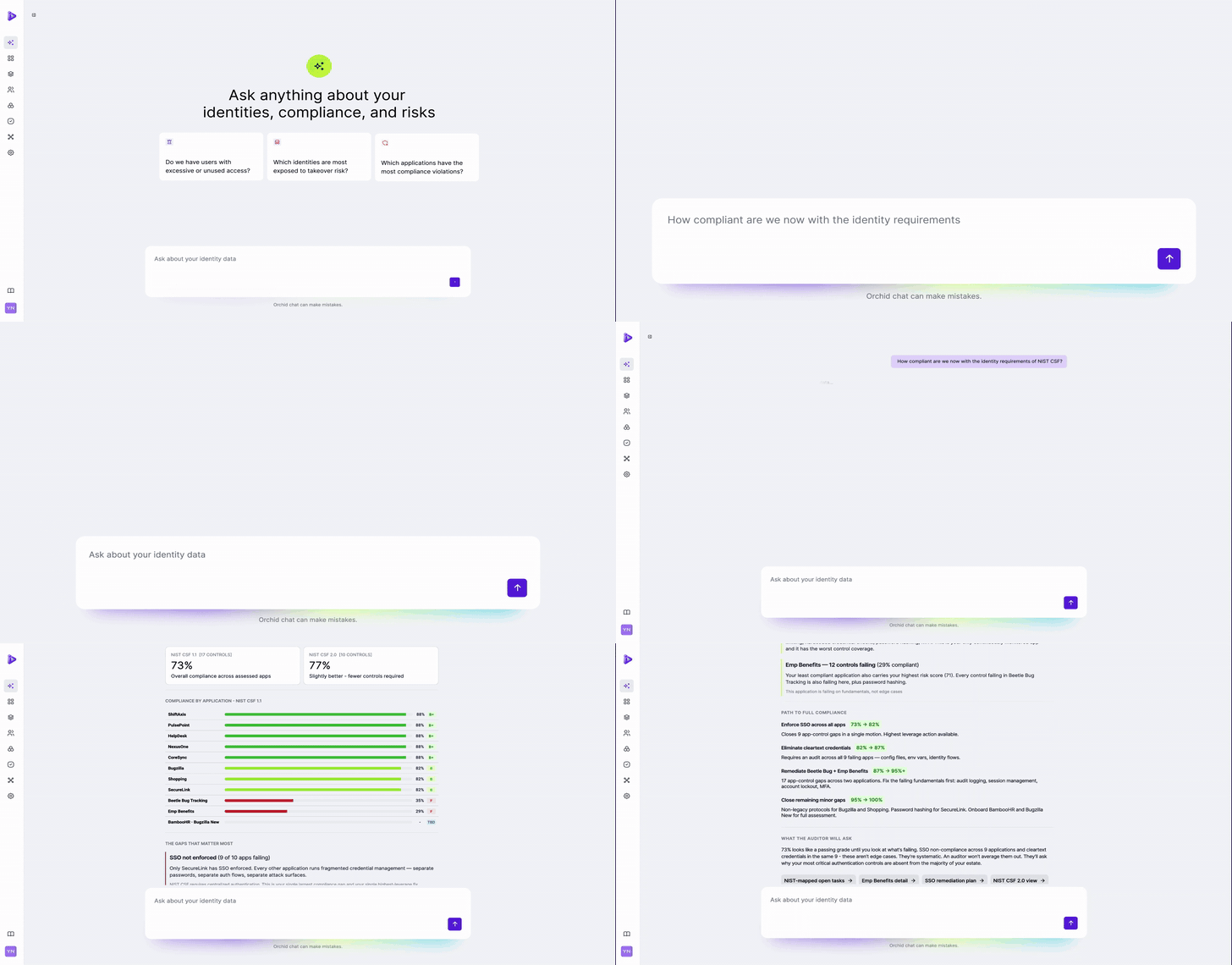
Question 2: “To what extent are you currently compliant with NIST’s identity requirements?”
For corporate CISOs, regulatory compliance is a dual imperative of both legal requirements and security baselines. However, application assets are constantly evolving, and knowing the actual state of NIST compliance, for example, has always required external third-party auditing.
“Ask Orchid” changes that equation. By directly asking, “How well do you currently comply with the NIST CSF identity requirements?”—validates how identity controls are implemented within each application at the binary level where they are ultimately defined. We then compare what is actually coded versus what NIST requires, covering both the established 1.1 framework and the updated 2.0 version. The output is not a typical scorecard. It includes:
A clear view of which controls are properly implemented and where gaps exist Application-level details, not just platform-level or tool-specific summaries A prioritized remediation roadmap with actionable next steps
CISOs can now assess and address compliance posture on demand, before an audit, rather than waiting for auditors to uncover vulnerabilities after the fact.
Question 3: “Are there any static credentials that need to be rotated immediately?”
Static credentials are one of the oldest and most persistent problems in identity security. Service accounts, API access, machine-to-machine tokens, and “glass-breaking” credentials accumulate in every enterprise, often issued for a good reason and then forgotten. Left unmanaged, it becomes one of the most valuable targets for attackers and one of the most common footholds for AI agents exploiting identity dark matter by design.
When asked, “Do you have static credentials that need to be rotated now?”, Ask Orchid examines credentials across all applications, including those connected to central identity providers as well as credentials in cloud, on-premises, and local accounts. The response includes:
A complete inventory of static credentials across your environment Where they exist and why they should be rotated Risk-tiered prioritization, identifying the credentials most immediately at risk
Deliver previously invisible authentication intelligence in minutes.
Deeper problem: identity dark matter is accelerating
The three scenarios above are not special cases. These represent the core challenges facing enterprise security teams today. Identity assets have grown far beyond what traditional IAM platforms were designed to recognize. The application authenticates users locally. Service accounts are provisioned and forgotten. AI agents will be given new identities with broader privileges. The sum of this uncontrolled activity (and more), identity dark matter, is growing at a pace that matches, and often exceeds, the rate of AI adoption itself.
What makes this particularly difficult is the structural nature of the gap. This is more than just adding a connector to your existing IAM platform. The problem is that most identity tools stop on the login event. It does not monitor what happens within the application after authentication.
How Orchid Security bridges the gap
Orchid Security was built for exactly this environment. It works at the source of identity activity inside your application, rather than at the boundaries of a centralized IAM system. Through binary analysis and dynamic instrumentation, Orchid inspects native authentication and authorization logic directly within applications without requiring API, source code changes, or lengthy integrations. This gives you visibility into half of your enterprise identity activities that are outside of traditional IAM visibility, including all AI agents operating across your assets.
Recognized as a representative vendor in Gartner’s first Market Guide for Guardian Agents, Orchid is described as a vendor that “manages AI agent identity/access with zero trust policies and governance,” offering so-called full-spectrum identity privileges across all human and non-human identities, from observability to orchestration.
Specifically for agent AI, the approach is based on five principles that govern the deployment of secure AI agents.
Human-to-agent attribution: All AI agent actions are associated with a responsible human owner, ensuring accountability for machine-driven activities. Comprehensive activity audit: Complete management chain is recorded (Agent → Tool/API → Action → Target). Enables compliance reporting and incident response. Dynamic, context-aware guardrails: Access decisions are continuously evaluated based on real-time context, sensitivity of the target resource, and human owner privileges, replacing broad privileges with purpose-specific authorizations. Least Privilege: Just-in-time elevation replaces persistent “god mode” access across AI agents and machine identities. Automatic remediation: When unsafe behavior occurs, automatic responses such as credential rotation and session termination are triggered without the need for manual intervention.
For more information, check out Orchid’s autonomous identity guardrails platform.
final thoughts
For security teams asking if there are unmanaged AI agents in the environment, unrotated credentials in forgotten applications, or compliance gaps missed in the last audit, Orchid provides answers and remediation paths without waiting for a breach to make them visible.
Enterprise leaders responsible for cybersecurity, identity and access management, and AI agent governance can request access to the Gartner Market Guide for Guardian Agents, which complements Orchid Security.
Gartner does not endorse any vendors, products or services depicted in its publications. Gartner publications reflect the opinions of Gartner’s research organization and should not be construed as statements of fact.