



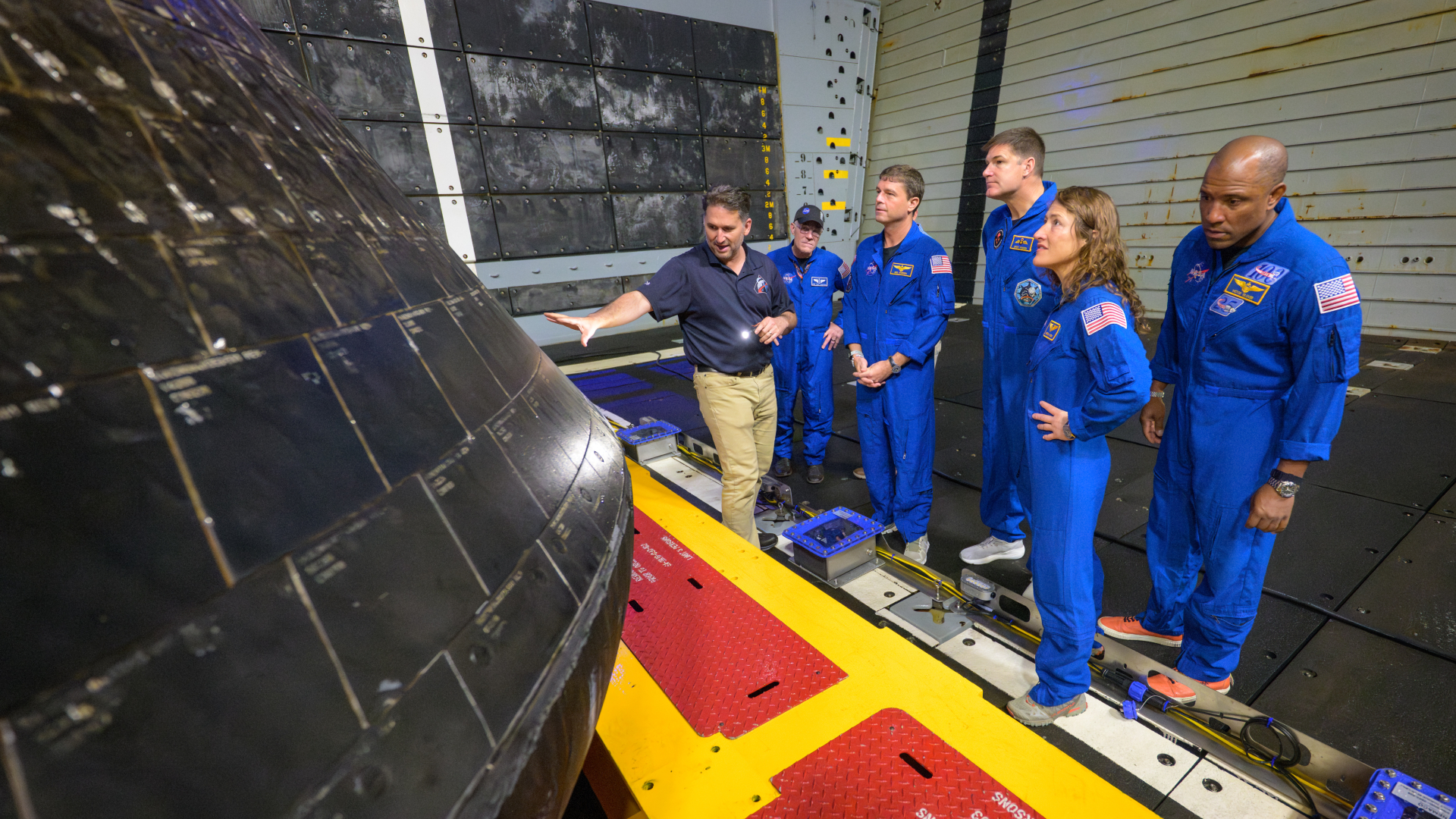
Artemis II made a successful test reentry despite some concerns that the Orion spacecraft’s heat shield would not be able to withstand it, a ghostly photo of the spacecraft’s underside taken shortly after splashdown revealed.
NASA’s preliminary post-splashdown investigation showed that charring losses in Orion’s heat shield were minimal, the ceramic tiles were not cracked, reflective thermal tape was still in place in many places, and the capsule’s four-member crew remained safe during its violent plunge through Earth’s atmosphere.
“Initial testing of the system revealed no abnormal conditions and found it to be operating as expected,” NASA officials said in a statement on Monday, April 20. “The first diver images of the spacecraft’s heat shield taken after splashdown, and further inspection on the recovery vessel, show that the char disappearance behavior observed on Artemis I has been significantly reduced, both in terms of quantity and size.”
you may like
The Artemis II heat shield is an ablative coating of silica fibers inside a polymer resin and was designed to protect the mission’s crew from a 24,664 mph (39,693 km/h) reentry. This incredible speed turned the surrounding air into a plasma inferno with a temperature half that of the sun’s surface.
But experts are concerned, as they doubt whether the shield is suitable for the final leg of the journey. Notably, Charles Camarda, a former NASA astronaut and thermal barrier research engineer who flew on the first space shuttle after the Columbia disaster, slammed the decision as “playing Russian roulette” with the lives of the crew.
That’s because the Artemis II mission’s heat shield was the same one used on Artemis I, and that shield cracked and scorched during reentry.
For the unmanned mission Artemis 1, NASA performed a “skip” reentry. In this re-entry, Orion bounces off Earth’s upper atmosphere like a stone on a lake and re-enters. NASA says this maneuver will extend Orion’s flight distance from re-entry into the atmosphere to splashdown in the Pacific Ocean, which will improve landing precision and provide a smoother ride for astronauts.
However, NASA engineers were alarmed when a subsequent inspection of the heat shield revealed that the shield’s Avcoat material was burnt and cracked, and some bolts were missing. Ground tests at NASA’s ArcJet facility recreated the conditions of atmospheric reentry, and it was found that the skip return caused gas to accumulate inside and destroy the shield.
For this reason, NASA chose a lofted atmospheric entry profile for Artemis II (the same type of reentry used in the Apollo program), sacrificing accuracy and astronaut comfort to send the mission’s “Integrity” spacecraft on a more direct path through the atmosphere. Early analysis appears to show that the authorities’ gamble paid off.
Meanwhile, NASA said the mission’s Space Launch System rocket, previously notorious for numerous leaks and launch failures, also performed well. The agency also had its numbers right, achieving the landing with pinpoint precision similar to the Apollo program.
“Orion dropped a precise drop in just 4.7 miles.” [4.7 kilometers] “There was inbound flight from the target landing site,” NASA representatives said in a statement. “Initial evaluations indicate an entry surface velocity of less than 1 mph.” [1.6 km/h] of prediction. ”
NASA is using early evaluations to signal that future Artemis missions are “on track,” but questions remain. Artemis III is scheduled to launch in 2027 for an Earth orbit docking test with the Lunar Module module, after which Artemis IV and V will aim for back-to-back moon landings in 2028. It remains to be seen whether these landers, along with other mission-critical hardware such as lunar spacesuits, will arrive on schedule or if the program will be further delayed.
Are you a NASA geek? See how much you scored on the Artemis quiz!