
Europe accelerates AI ambitions with six new AI factories

The European Commission has announced the next stage of Europe’s artificial intelligence strategy, with the launch of six new AI factories across the continent.
This latest expansion brings the entire network to 19 AI factories across 16 EU member states, strengthening Europe’s position as a global leader in digital innovation and AI sovereignty.
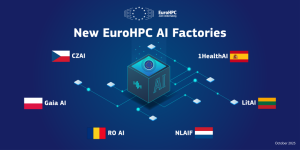
Located in the Czech Republic, Lithuania, the Netherlands, Romania, Spain, and Poland, the new facilities will serve as a powerful engine for AI research, innovation, and industrial adoption.
The initiative, backed by a €500 million co-investment from the EU and national governments, will give start-ups, SMEs and researchers direct access to AI-optimized supercomputers, training and technical expertise.
Together, these investments represent a broader commitment of €2.6 billion to the AI Factory and Antenna Initiative, which is part of the European Commission’s commitment to building a digitally sovereign “AI continent”.
Building the backbone of Europe’s AI infrastructure
Each AI Factory serves as a national one-stop shop for companies and researchers developing advanced AI models.
We provide access to high performance computing (HPC) resources optimized for AI workloads, along with data storage, accelerator technology, and hands-on innovation support.
As well as providing computing power, the AI Factory is designed to bridge the gap between research and application, enabling European companies to design, test and deploy AI solutions in critical sectors such as healthcare, cybersecurity, green energy, smart industry and agriculture.
This effort also complements the upcoming AI Factory Antenna, which will enable national AI communities to access these world-class supercomputing systems remotely. Together, these networks will create a fully interconnected European AI infrastructure.
Czech CZAI: Connecting research and real-world AI
In the Czech Republic, the Czech AI Factory (CZAI) plays a central role in promoting applied AI research. Built on EuroHPC Karolina supercomputer infrastructure, the upgraded KarolAIna system is specifically designed for AI workloads.
Operated by the IT4Innovations National Supercomputing Center, CZAI will focus on practical applications, industry collaboration and AI skills development, ensuring that the Czech Republic remains deeply integrated into the European AI ecosystem.
Lithuania’s LitAI Factory: Driving Sovereign AI Innovation
Lithuania’s LitAI Factory aims to transform the country’s computing infrastructure into a fully AI-optimized ecosystem.
Led by Vilnius University and hosted in the LRTC VDC3 data center, it will provide end-to-end AI support, from supercomputing and storage to data acceleration and innovation advisory services.
LitAI will prioritize areas such as cybersecurity, green energy, smart industry and digital health, and will also work closely with Polish and wider EU initiatives to ensure that Lithuania can actively contribute to Europe’s AI-driven growth.
NLAIF in the Netherlands: turning research into scalable solutions
The Netherlands AI Factory (NLAIF) will bridge the gap between groundbreaking AI research and real-world deployments.
With a new AI-optimized supercomputer at its core, NLAIF delivers customized AI computing power on a secure and scalable infrastructure that is compliant with EU data regulations.
This factory will specifically focus on sensitive data applications such as healthcare, intellectual property, and public safety.
NLAIF aims to accelerate the responsible and open adoption of AI technologies across Europe by supporting sectors such as healthcare, agriculture and security.
Gaia AI Factory in Poland: Building skills and scale
In Poland, the Gaia AI Factory will serve as a hub for developing cutting-edge AI technology and strengthening the country’s expertise.
Based on the PLGrid framework and operated by Cyfronet AGH, Gaia will expand its infrastructure, improve access to large data repositories, and provide comprehensive training programs for entrepreneurs, researchers, and students.
Targeting sectors such as healthcare, space technology and large-scale language models (LLM), the Polish factory will develop the next generation of AI talent and foster cross-border collaboration within the European network.
Romania’s RO AI Factory: Helping SMEs innovate with AI
Romania’s RO AI Factory focuses on transforming small and medium-sized enterprises (SMEs) from technology adopters to AI innovators.
The new AI-optimized supercomputer provides a suite of services including HPC access, model development support, data hosting, and a library of trusted AI algorithms.
RO AI Factory aims to help businesses and public institutions leverage AI responsibly and effectively through a combination of infrastructure and capacity-building programs.
1HealthAI in Spain: European leader in One-Health research
The 1HealthAI factory in Spain is making Europe a world leader in One-Health AI, which integrates human, animal and environmental health.
With an experimental platform for testing and developing AI models, 1HealthAI enables researchers and industry to build trusted AI solutions that improve health outcomes and sustainability across Europe.
Milestones in Europe’s AI continental vision
The European Commission’s latest expansion marks an important step towards establishing the AI Factory as the foundation of Europe’s digital future.
By connecting 19 AI hubs in 16 countries, Europe is creating an integrated ecosystem that combines technological sovereignty, innovation capacity, and ethical AI development.
These AI factories will not only strengthen Europe’s high-performance computing capabilities, but also ensure that AI solutions are devised, tested and scaled within a secure and sovereign European framework, accelerating the continent’s journey to becoming the world’s leading AI powerhouse.
Source link

