
First non-EU country joins European countries to replace Starlink
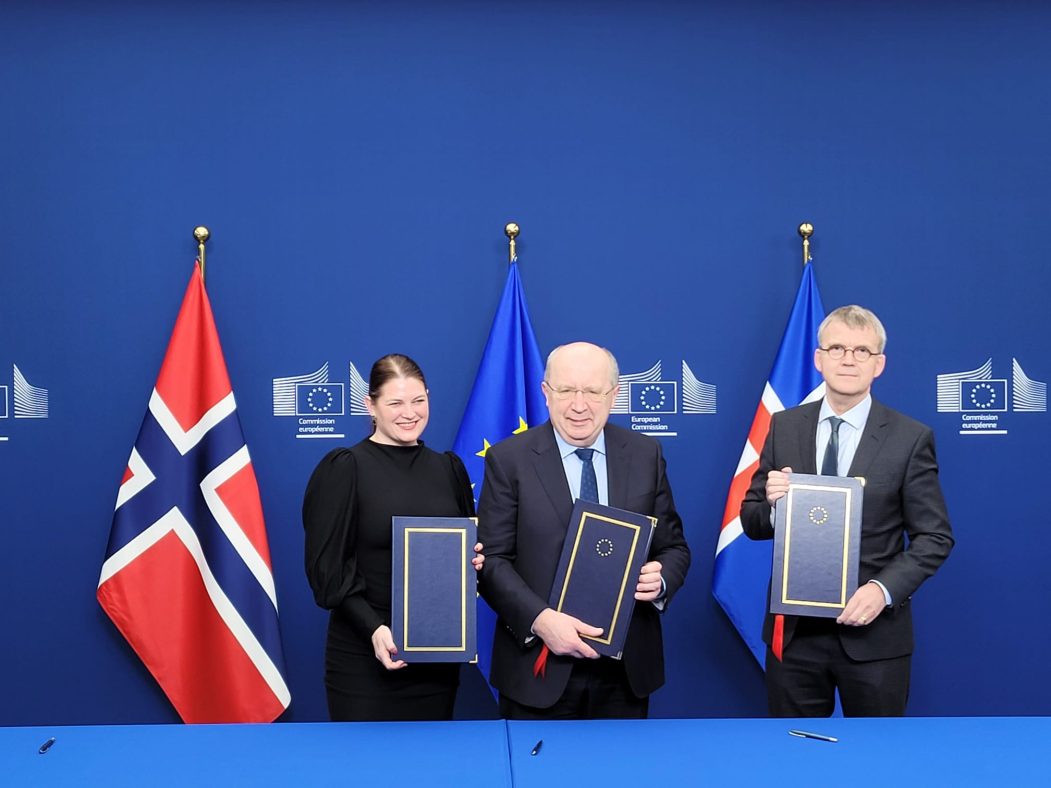
Iceland and Norway have joined IRIS2, the EU’s space-based secure communications initiative that seeks to provide an alternative to Elon Musk’s Starlink.
Norway and Iceland both signed participation agreements with EU Space Commissioner Andrius Kubilius in Brussels.
Norway and Iceland are expected to contribute approximately €40 million and €3 million respectively to IRIS2 in 2026-2027, with future amounts to be negotiated after the EU’s 2028-2034 budget is finalized.
Covering connection dead zones in Europe and Africa
The IRIS2 (Satellite Infrastructure for Resilience, Interconnectivity, and Security) constellation will use a variety of low-earth (LEO), geostationary (GEO), and medium-orbit (MEO) satellites to power communications services for European citizens, private industry, and government authorities, competing with American companies such as Starlink, which dominate the market.
The network utilizes more than 250 satellites and activates a connectivity dead zone spanning both Europe and Africa via north-south orbits.
IRIS2 not only enhances services for the public, but also strengthens European satellite communications across a variety of indicators.
For governments, improved communication supports:
Surveillance Crisis management (e.g. humanitarian aid) Secure communication of key infrastructure
For industry and business:
Improved mobile and fixed broadband satellite access Satellite trunking for B2B services Satellite access for transportation networks Enhanced support for cloud-based services
Cybersecurity is ensured through infrastructure through the European Quantum Communications Infrastructure (EuroQCI) and a secure-by-design approach to quantum cryptography.
There are open questions about how IRIS2 interacts with the sovereign constellation
Iceland completed negotiations with the EU in July 2025, but had to wait for Norway to complete its own negotiations before proceeding.
Stefan Johannesson, Iceland’s ambassador to the EU, said IRIS² is “very important” as it will be a backup for the three undersea internet cables that Iceland currently relies on for connectivity.
EU Space Commissioner Andrius Kubilius also indicated last summer that he was in favor of Ukraine’s participation in the initiative.
The EU’s goal is for IRIS2 to be fully operational by 2030, but there is some uncertainty after it was announced that the German military is building a nationwide constellation at a cost of 10 billion euros.
“Of course, we need to consider how to integrate new developments in the sovereign constellation,” Kubilius said at a press conference after the signing.
Source link

