
How electric vehicles will change emergency response
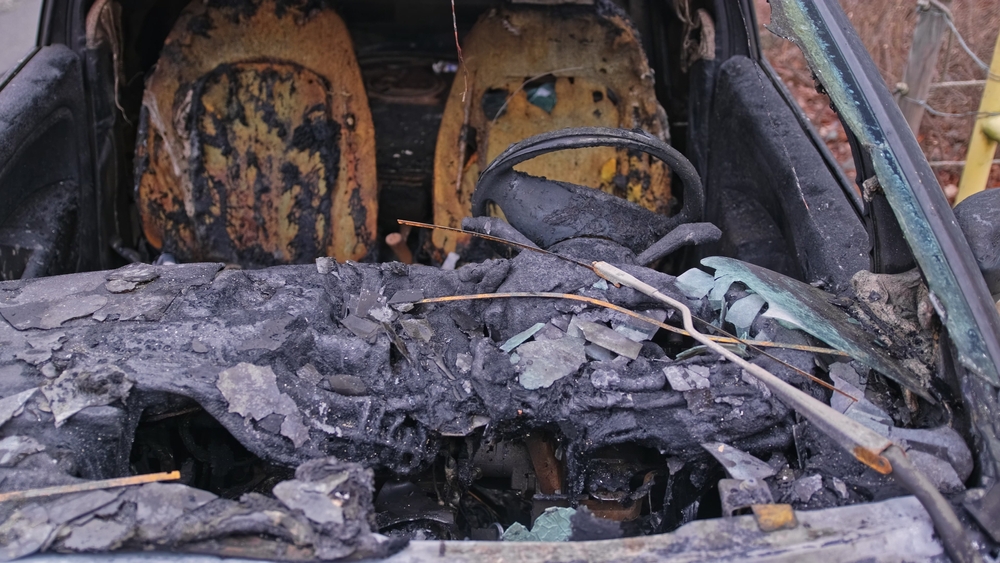
As electric vehicle adoption increases, crews must adapt in real time to new types of incidents: fires that burn hotter, last longer, and require more water to extinguish.
When a car catches fire, the reaction used to be predictable. Crews arrive, deploy hoses, extinguish the flames, and bring the incident under control within a relatively short amount of time. The risks are well understood and the strategies are well known.
Electric cars are starting to change that.
Fires involving lithium-ion batteries behave differently, running hotter, lasting longer, and being less responsive to traditional firefighting tactics. For fire agencies, this is not a theoretical concern, but an operational change that is already underway.
Fire that doesn’t behave like fire
At the heart of the challenge is the battery pack. Unlike a fuel tank, which burns until it’s empty, a lithium-ion battery can sustain its own reaction.
This process, known as thermal runaway, occurs when a cell overheats and causes a cascading failure of neighboring cells. Heat, gas, and pressure are generated inside, and once a reaction begins, it may continue even after the visible flame has extinguished.
This poses a fundamental problem for responders. What appears to be a controlled fire may still be active within the battery. Reignitions are not uncommon and can sometimes occur minutes to hours later.
For firefighters, that uncertainty changes the nature of their work. It’s no longer just about putting out what you can see.
Why water still matters – but it’s getting even more important
Water remains the primary tool for fighting EV fires, but its use is changing.
For traditional vehicles, the goal is simple: put out the flames. In the case of electric cars, the objective shifts to cooling the battery itself. If the temperature inside the pack is not lowered sufficiently, thermal runaway may continue.
In practice, this often means prolonged water use, far beyond what would be expected in a gasoline or diesel car fire. Workers may have to remain on site for long periods of time, continuously applying water to stabilize the battery.
The scale may be large. A single incident can require far more water than a typical vehicle fire, placing additional demands on local resources and planning.
time changes everything
One of the characteristics of EV fires is their duration.
Traditional vehicle fires are typically intense but short-lived. EV fires can last for hours, not because the flames are always visible, but because the battery remains unstable. Even after the outbreak has been suppressed, the risk has not completely disappeared.
This extended timeline impacts how incidents are managed. Firefighters monitor the vehicle thoroughly after initial response and may return to check for signs of reignition. In some cases, vehicles may be isolated for long periods of time to ensure safety.
Risk exposure also changes. Crews may be working around a damaged battery for much longer than in a normal fire, requiring careful management of safety distances and protective measures.
Not only fire suppression but also containment
EV fires cannot always be “put out” in the traditional sense, so firefighting strategies are moving towards containment.
Crews often focus on controlling the environment around the vehicle, preventing the spread of the fire and stabilizing the battery, rather than forcing a rapid extinguishment. This includes cooling from a distance, protecting nearby structures, managing spills, and more.
New technologies are emerging that support this approach. Some fire departments use special blankets to contain the heat and flames. Some companies deploy flood tanks and place damaged vehicles in water to cool down over time.
Thermal imaging has also become an important tool, allowing crews to monitor internal temperatures and identify hot spots that are not visible from the outside.
The overall approach is more careful and, in some cases, more time-consuming than traditional firefighting.
Training in high voltage environments
Electric vehicles pose risks beyond the fire itself. High voltage systems require careful handling, especially in crash scenarios where cables and components may be exposed.
Fire officials are updating their training to reflect this. Crews are learning how to identify battery involvement, recognize warning signs of thermal runaway, and safely isolate electrical systems when possible.

Operational awareness is critical. The structure of EVs is different from traditional vehicles, and responders need to understand where key components are located and how they behave under stress.
Attention is also focused on what will happen after the incident. Damaged vehicles can remain unstable during recovery and transportation, requiring coordination between fire services, recovery companies, and storage facilities.
Fire in a closed space
EV fires are more complex in confined environments such as underground parking garages, tunnels, and transportation decks.
In these situations, the prolonged heat associated with a battery fire can place additional stress on the structure. Smoke management becomes more difficult and access to fire suppression equipment may be restricted.
If these incidents continue for a long time, the problem becomes even more complex. A fire that may be extinguished quickly outdoors can become a longer, more resource-intensive operation in an enclosed space.
Therefore, as EV penetration increases, a broader reassessment of how such environments are designed and managed is required.
Engineering is part of the solution
Vehicle design plays an important role in preventing and reducing the occurrence of EV fires.
Modern battery systems are equipped with management software that monitors temperature and performance, with the goal of detecting failures before they become serious. Physical design features such as compartmentalization within battery packs are intended to slow or limit the spread of thermal runaway.
Although these measures reduce the likelihood of failure, they also affect behavior in the event of a fire. In some cases, it slows down the release of heat and occurs more slowly, but can last longer.
For fire services, this means understanding vehicle design is becoming part of their operational knowledge.
changing strategy
Firefighting has always evolved with technology. The rise of electric vehicles is another step in that progress.
What is changing is not just the equipment used, but the thinking behind the response. Incidents are becoming less about putting out flames and more about managing systems. Patience, monitoring and containment are becoming more important.
This change is already visible in training programs, operational guidelines, and field experience. Crews adjust and refine their approach as incidents occur.
The transition is still underway, but the direction is clear.
Electric vehicles do not rewrite the basics of firefighting. They are expanding it. And for those on the front lines, adapting to that reality is now part of the job.
Source link

