

Nanize’s patented technology creates a durable, functional, PFAS-free coating that fully crosslinks and covalently bonds to the substrate within one minute at temperatures below 70°C.
Nanize has developed a patented coating and curing technology that hydrolyzes polysilazane containing functional nanoadditives to create a glass-like, fully cross-linked and covalently bonded surface. Our versatile PFAS-free solutions offer unparalleled durability, ultra-low friction, and cure in less than 1 minute at temperatures below 70°C without catalysts.
Uncompromising coatings proven by testing
Over 20,000 individual tests resulted in extensive laboratory validation of the nanized coating, including FTIR (Fourier Transform Infrared Spectroscopy), to verify polymer crosslinking, hard curing, durability, and performance.

The test results confirm the following:
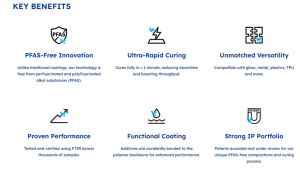
Fully cured in less than 1 minute at temperatures below 70°C No catalyst required – minimizes process complexity Dense cross-linked network confirmed by FTIR Proven covalent substrate bonding across a wide range of metals, plastics and glasses
Nanize’s ultra-fast-curing polysilazane coatings are proven to produce a hard, durable, glass-like, dense 3-dimensional Si-O-Si-dominated crosslinked structure that is covalently bonded to the substrate.
Nanize: Coating issue resolved
Nanize recognized that the superior potential of polysilazane coatings is limited by the ability to achieve high crosslinking densities upon curing. Hydrolysis of polysilazane, which typically occurs during curing, requires either long periods of time over several days at room temperature or short periods of time using catalysts at temperatures above 250°C. Using FTIR analysis, it is easy to identify that polysilazane has limited curing and reduced durability under these conditions. Additionally, curing at temperatures above 250°C limits the choice of substrate materials, excluding things like plastics and electronic components.
The patented technology developed by Nanize hydrolyzes polysilazane in less than 1 minute at temperatures below 70°C, resulting in near-perfect crosslinking and covalent bonding to the substrate.
Full cure within 30 seconds at 70°C is demonstrated by FTIR spectroscopy of Nanize polysilazane coatings applied to stainless steel and aluminum by ultrasonic spray.
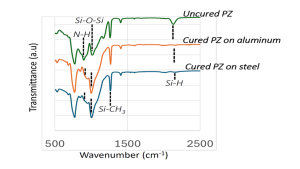
Note the absence of Si-H and NH in the cured sample and the corresponding strong Si-O-Si.
A key feature of polysilazane, which distinguishes it from other similar polymers, is the ability to covalently bond nanoadditives to the polymer backbone, which, when cured, confers specific coating performance properties such as superhydrophobicity, operation at temperatures above 1000°C, antimicrobial properties, and corrosion resistance.
Nanize has created and continues to develop a series of polysilazane formulations containing nano-additives that can cure ultra-fast in less than 1 minute at temperatures below 70°C. It features certain enhanced coating performance characteristics.
Nanize. One technique. Multiple industries.
Nanize coatings transform surface protection across multiple areas, enabling cleaner, safer and more efficient performance wherever advanced coatings are required.
Cookware and bakeware
Manufacturers can benefit from a simplified, lower-cost manufacturing process thanks to Nanize’s ultra-fast curing.

The problem: PFAS and other fluorine-containing compounds used in cookware and bakeware are prohibited because they do not retain non-stick properties and are susceptible to peeling off surfaces.
Solution: Nanize’s FDA-compliant coatings are free of PFAS and fluorine. These are covalently bonded to the substrate and maintain excellent non-stick performance.
The result: Manufacturers of cookware and bakeware can continue to meet customer expectations by offering PFAS-free, high-performance, durable non-stick products coated and ultra-rapidly cured using Nanize polysilazane formulations and technology. Additionally, manufacturers benefit from a simplified, lower-cost manufacturing process thanks to Nanize’s ultra-fast curing, which does not require long periods of time at high temperatures.
commercial and home use
Create smart surfaces for demanding environments.

Problem: Protective and decorative surfaces (TPU, paint, trim) are susceptible to chemical deterioration, markings/graffiti, or abrasion.
Solution: Nanize polysilazane formulations can be customized to create coatings that meet specific end-user requirements and expectations. Nanize cures extremely quickly below 70°C, allowing durable polysilazane formulations and coatings to be applied to a variety of substrates, including plastics such as TPU films.
Results: The coating is cost-effective and easy to mass-produce, exhibits excellent non-marking, anti-graffiti, and cleanliness properties, improves appearance, is easy to maintain, and is durable.
renewable energy
Reduces dirt on solar panels and turbine blades, increases power output and reduces cleaning costs.
Problem: As dirt builds up over time, it reduces energy production in solar modules and reduces wind turbine performance due to increased drag.
Solution: Nanize coatings have a high degree of hydrophobicity and a very low coefficient of friction, which significantly reduces dirt buildup and adhesion to the surfaces on which they are applied.
Results: The use of Nanize polysilazane formulations and ultra-rapid curing processes can improve the renewable energy generation performance of solar modules and wind turbines, with a corresponding reduction in the need for cleaning downtime. The durability and longevity of Nanize coatings is achieved through excellent cross-linking during the curing process and covalent bonding to the substrate that prevents peeling and peeling during use.
car
A non-marking, self-cleaning coating protects exteriors, TPU wraps, and sensitive surfaces from abrasion, graffiti, and UV rays.

The problem: From covering headlamps to protecting sensors like LIDAR and cameras, exterior plastics used in the automotive sector suffer from deterioration due to wear, scratches, and water and dirt buildup.
The solution: Nanize’s hydrophobic coatings are hard, durable, and scratch-resistant, so they’re easy to apply using standard industry processes and completely cure ultra-fast in less than 1 minute at less than 70°C without compromising the performance of the plastic substrate.
Results: The performance and durability of complex molded exterior plastic parts used in the automotive sector are significantly improved by the combination of Nanize polysilazane coating formulations and Nanize’s ultra-rapid curing technology. Production processes that apply and cure coatings can be easily implemented in high-volume production environments due to their low temperatures and fast process speeds.
electronics and displays
Curing heat-sensitive substrates below 100°C provides stain-resistant, antistatic, and easy-to-clean surfaces.
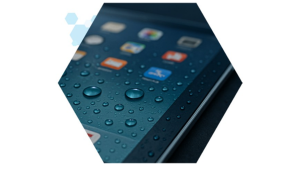
Problem: Touch screens and displays are prone to fingerprints and dust, making them difficult to use. Also, like other electronic devices such as OLEDs, they cannot withstand the high temperatures during manufacturing.
The solution: Nanize functional coatings can be applied quickly and effectively and fully cure ultra-rapidly at temperatures below 70°C, creating a durable, low-friction, stain-resistant protective surface with excellent dielectric properties.
Results: The application of ultra-fast-curing Nanize polysilazane formulation coatings significantly improved the performance of touch screens and displays, eliminating the need for frequent cleaning with chemical wipes. Electronic components such as OLEDs are sensitive to both high temperatures above 100°C and moisture intrusion. Nanize coatings are easily applied using standard high-volume industrial processes, cure quickly below temperatures where damage can occur, and protect sensitive devices from the environment.
The dielectric properties of Nanize coatings make them particularly suitable for use in batteries and other electronic assemblies.
construction and architecture
Anti-graffiti and anti-fouling coatings reduce maintenance on facades, glass and public infrastructure.
Problem: Building envelopes, such as cladding and curtain walls, are exposed to seasonal weather extremes and must not only maintain their ability to protect the building envelope, but also avoid visibly deteriorating its appearance due to corrosion, dirt, graffiti, etc.
The Solution: By applying Nanize polysilazane formulation coatings to commonly used steel or aluminum building envelopes and then curing them ultra-rapidly in a high-throughput manufacturing process, a durable, corrosion-resistant surface is created that is hydrophobic, mark-free, graffiti-resistant, and stain-resistant.
Results: The benefits of creating a long-life building skin that retains both architectural appearance and functional performance and does not require frequent cleaning due to dirt accumulation or graffiti removal are both economic and aesthetic. The fact that such building materials are produced in large quantities on high-speed production lines is not compromised by the standard industrial processes for applying Nanize coatings, including spraying and ultra-fast curing in less than 1 minute at below 70°C.
industrial production
Problem: In highly automated, high-speed industrial manufacturing processes, downtime due to equipment surface wear is costly. The root cause of this problem is usually due to interfacial friction between mechanical components and the product being manufactured. This can often be resolved by using an oil-based lubricant, but the product may need to be cleaned to remove any residue before further processing or sale.
The Solution: Nanize’s ultra-rapid-cure polysilazane coatings are inherently very low-friction and can be applied to a variety of substrates, including production machine parts, products being manufactured, or both.
The result: By creating a coating that is slippery, has a low coefficient of friction, and is durable, equipment runs more efficiently, reduces energy costs, reduces downtime to replace worn parts, and reduces damage to the final product from surface-to-surface rubbing. The mass production of small, delicate bottles transported along conveyors with multiple contact points between bottles and equipment is an application where Nanize formulated ultra-fast curing polysilazane coatings can be applied to both bottles and production equipment to increase efficiency, reduce waste, and lower costs.
Learn more about how Nanize delivers coatings without compromise and solves your coating problems. Please contact Jerry Stokes, Chief Commercial Officer, at js@nanize.com.
This article will be published in an upcoming PFAS Special Focus Publication in January.
Source link
