
Promoting clothing recycling in Europe with AI-powered condition assessment
TexMat solutions automatically classify consumer clothing for resale through digital product passport data and AI-based imaging and data processing technology.
TEXMAT revolutionizes the profitability of reused clothing collections and businesses in Europe. This allows consumers to bring their clothes to the collection machine in an effortless process. Consumers no longer have to choose the appropriate resale channel for their used clothing based on its condition, outlook, and brand. You can bring all your clothing to one TexMat solution. When a product is sold, the proceeds are automatically credited to the consumer. TexMat solutions enable different types of used goods retailers to increase the profitability of their businesses by allowing them to receive products through the system their customers want based on brand, product category, size, color, etc. With the implementation of the TexMat solution, manual sorting by second-hand goods retailers for resale or recycling of clothing is minimized. TexMat represents the systemic innovation Europe needs by making textile distribution easier for consumers and commercially viable for businesses.

DPP provides key data for garments
A Digital Product Passport (DPP) is an essential data set for physical goods that provides information about the product’s origin, composition, usage, maintenance, repair, and recycling. DPP consists of four pillars: a unique garment identifier, a data carrier integrated into the garment, a digital connector and an IT architecture for data exchange. This enables DPP to enable traceability and data exchange throughout the garment lifecycle. DPP is therefore not only a regulatory requirement, but also a bridge between the physical garment and TexMat’s digital solution.
VTT is collaborating with Protex Balti As to research the most suitable DPP data carriers, focusing on how to integrate DPP data carriers into clothing and read them effectively without compromising ease of use and durability. Although DPP provides background information about a garment, the decision to reuse it also depends on its actual condition after use.
Automatic analysis of surface conditions
Discarded clothing exhibits varying levels of wear and tear. Some have been used for years, others were discarded due to damage or defects, and others were discarded prematurely due to the nature of fast fashion. This is a key factor in determining whether each garment is suitable for reuse or should be directed towards other R strategies. Currently, there are no commercial solutions that automatically analyze the surface condition of clothing. This is one of the key research questions in the TexMat project.
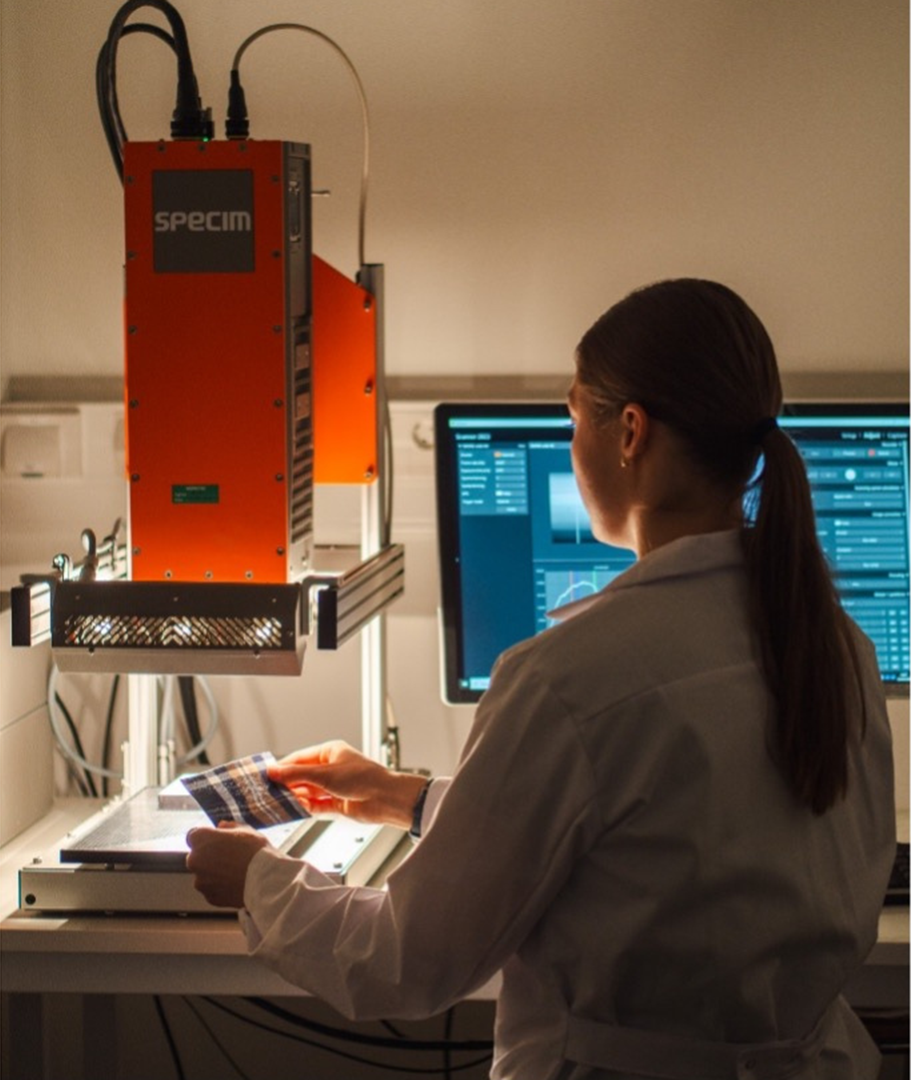
VTT, in collaboration with the TTK University of Applied Sciences, is applying its long experience in machine vision, particularly hyperspectral imaging and photography, to research optical modalities for analyzing the effects of “worn-in” clothing. The effects appear in various ways such as discoloration, pilling, and fluffing. Preliminary results show that these image analysis and computer vision methods are very promising for enabling automated analysis of textile surfaces.
By combining the rich data of clothing DPP with surface condition evaluation, it becomes possible to combine multiple criteria for classification. This complicating factor is used in a specific way by each used fiber management facility, allowing them to customize their separation procedures. Furthermore, providing accurate fabric type in DPP enables fabric-specific surface evaluation, improving predictive accuracy. This feedback enables dynamic evaluation of R-strategies at the end of a garment’s useful life, improving the circularity of textiles.
Pilot activities in Finland and Spain will test the system in real-world environments and help partners refine their innovations and consider how the system can be scaled across Europe.
partner

Disclaimer
Funded by the European Union. However, the views and opinions expressed are those of the authors alone and do not necessarily reflect those of the European Union or the European Research Executive Agency. Neither the European Union nor the licensing authorities can be held responsible for them.
Please note: This is a commercial profile
This article will also be published in the quarterly magazine issue 26.
Source link

