

Close Menu
  • Home
  • Identity
  • Inventions
  • Future
  • Science
  • Startups
  • Spanish
What's Hot

Relations between Anthropic and the Trump administration appear to be thawing.

Experimental drug doubles 1-year survival rate for pancreatic cancer

The App Store is booming again, and AI may be the reason

Facebook X (Twitter) Instagram
  • Home
  • About Us
  • Advertise with Us
  • Contact Us
  • DMCA
  • Privacy Policy
  • Terms & Conditions
  • User-Submitted Posts
Facebook X (Twitter) Instagram
Fyself News
  • Home
  • Identity
  • Inventions
  • Future
  • Science
  • Startups
  • Spanish
Fyself News
Home » Caergwrle Bowl: A gold-decorated bowl found in a Welsh bog — possibly left by Bronze Age sailors as an offering to the gods.
Science

Caergwrle Bowl: A gold-decorated bowl found in a Welsh bog — possibly left by Bronze Age sailors as an offering to the gods.

By November 17, 2025No Comments2 Mins Read
Share Facebook Twitter Pinterest Telegram LinkedIn Tumblr Email Copy Link
Follow Us
Google News Flipboard
Share
Facebook Twitter LinkedIn Pinterest Email Copy Link

simple facts

Name: Caergwrle bowl

What is it: shale bowl with gold and tin decoration

Birthplace: Caergwrle Castle, Wales

Created: From around 1300 BC to around 1150 BC

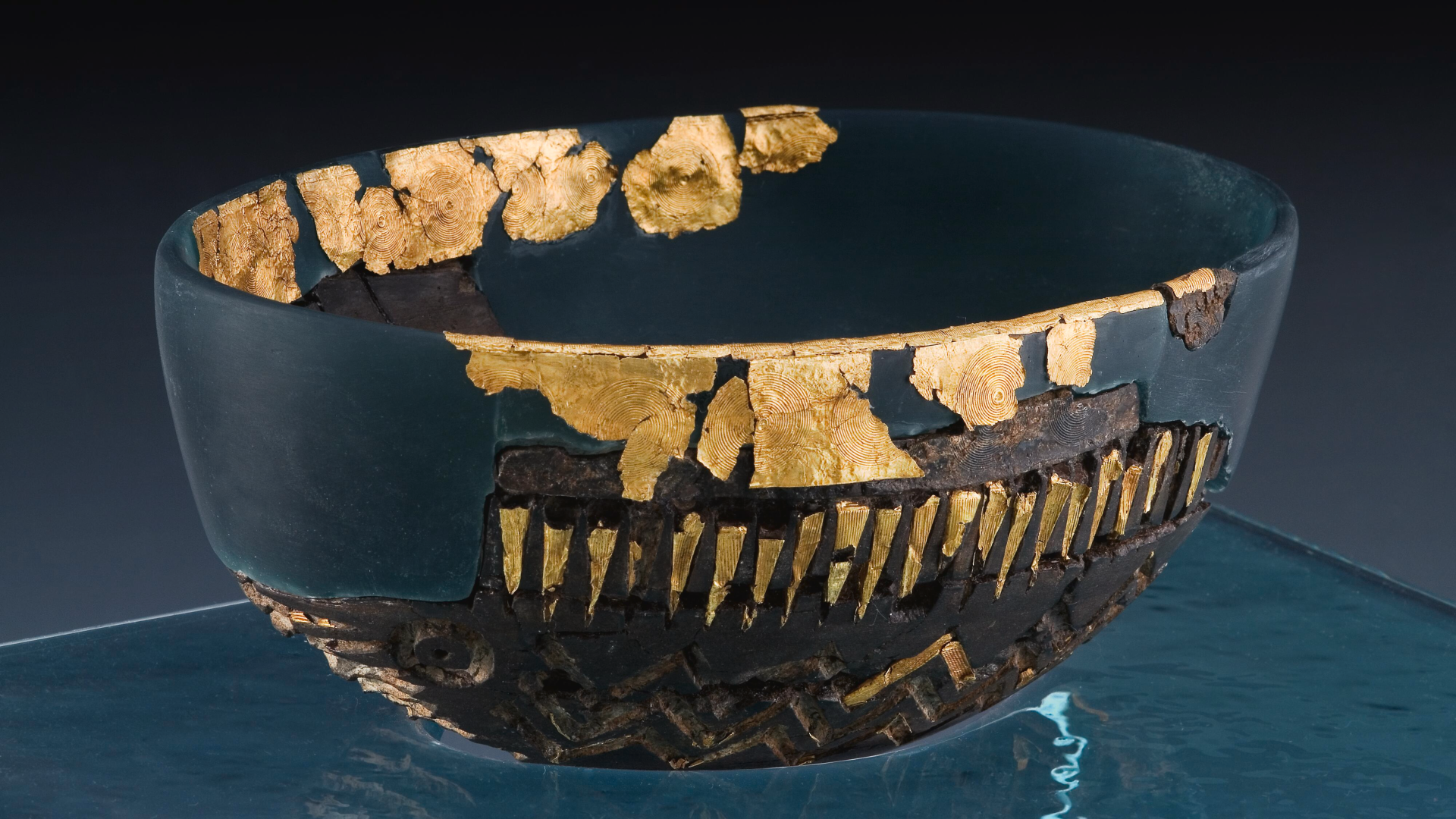
About 200 years ago, while excavating in a Welsh swamp, a worker struck an unusual ancient bowl in the shape of a ship. Named after a nearby castle, Caergwrle Bowl demonstrates the importance of seafaring travel in Britain’s Middle Bronze Age (ca. 1500-1000 BC).

According to the Museum of Wales, which owns the artifact, Cargulle Bowl was made from shale and tin from a county in southwestern England. and gold from Ireland or Wales. Today, about half of the original artifact remains, and when completed, the oval bowl was approximately 7.2 inches (18.2 centimeters) long and 3.1 inches (7.8 centimeters) deep.

The inside of the vessel is undecorated, but the outside and rim are decorated with various shapes of tin covered with gold leaf.

you may like

“We believe the zigzags around the base are waves and the long triangles are oars,” a Wales Museum representative wrote. “The symbol of the eye protected the sailors. The circle is the shield of the heroic voyager.”

However, in a study of this bowl in 1980, a slightly different interpretation was put forward by marine archaeologists.

Rather than seeing the gold-rimmed concentric circles as a shield, the researchers argued that the closest parallels could be seen to Bronze Age solar symbols. For example, Nebula’s Sky Disk, which also depicts a ship, and the Nordic “Chariot of the Sun”. And instead of a zigzag line representing a wave, that line could depict the wooden frame of the boat visible through the skin stretched over it.

More amazing artifacts

Regardless of the exact meaning of Cargulle Bowl’s design, its discovery in a bog near the River Arran, which flows into the Irish Sea, strongly suggests it was created as a representation of a boat, according to the Museum of Wales. And given that many Bronze Age solar artefacts have been found in bogs as offerings to the gods, it is likely that Cargurre Bowl was intended to be an ancient votive offering by sailors seeking safe passage.

Get the world’s most fascinating discoveries delivered straight to your inbox.

For more amazing archaeological discoveries, check out our Astonishing Artifacts archive.


Source link

#Biotechnology #ClimateScience #Health #Science #ScientificAdvances #ScientificResearch
Follow on Google News Follow on Flipboard
Share. Facebook Twitter Pinterest LinkedIn Tumblr Email Copy Link
Previous ArticleTurning submarine cables into environmental monitoring systems
Next Article Dragon Breath uses RONINGLOADER to disable security tools and introduces Gh0st RAT

Related Posts

Experimental drug doubles 1-year survival rate for pancreatic cancer

April 18, 2026

This week in science news: Physicists see pinpricks of darkness faster than light, humans are still evolving and some polar bears are fatter than ever

April 18, 2026

History of Science: Doctors dissect the brain of a man who could not speak, revealing the locus of spoken language – April 18, 1861

April 18, 2026
Add A Comment
Leave A Reply Cancel Reply

Latest Posts

Relations between Anthropic and the Trump administration appear to be thawing.

Experimental drug doubles 1-year survival rate for pancreatic cancer

The App Store is booming again, and AI may be the reason

This week in science news: Physicists see pinpricks of darkness faster than light, humans are still evolving and some polar bears are fatter than ever

Trending Posts

Subscribe to News

Subscribe to our newsletter and never miss our latest news

Please enable JavaScript in your browser to complete this form.
Loading

Welcome to Fyself News, your go-to platform for the latest in tech, startups, inventions, sustainability, and fintech! We are a passionate team of enthusiasts committed to bringing you timely, insightful, and accurate information on the most pressing developments across these industries. Whether you’re an entrepreneur, investor, or just someone curious about the future of technology and innovation, Fyself News has something for you.

Castilla-La Mancha Ignites Innovation: fiveclmsummit Redefines Tech Future

Local Power, Health Innovation: Alcolea de Calatrava Boosts FiveCLM PoC with Community Engagement

The Future of Digital Twins in Healthcare: From Virtual Replicas to Personalized Medical Models

Human Digital Twins: The Next Tech Frontier Set to Transform Healthcare and Beyond

Facebook X (Twitter) Instagram Pinterest YouTube
  • Home
  • About Us
  • Advertise with Us
  • Contact Us
  • DMCA
  • Privacy Policy
  • Terms & Conditions
  • User-Submitted Posts
© 2026 news.fyself. Designed by by fyself.

Type above and press Enter to search. Press Esc to cancel.