
MAST Upgrade begins new fusion energy experiment in UK
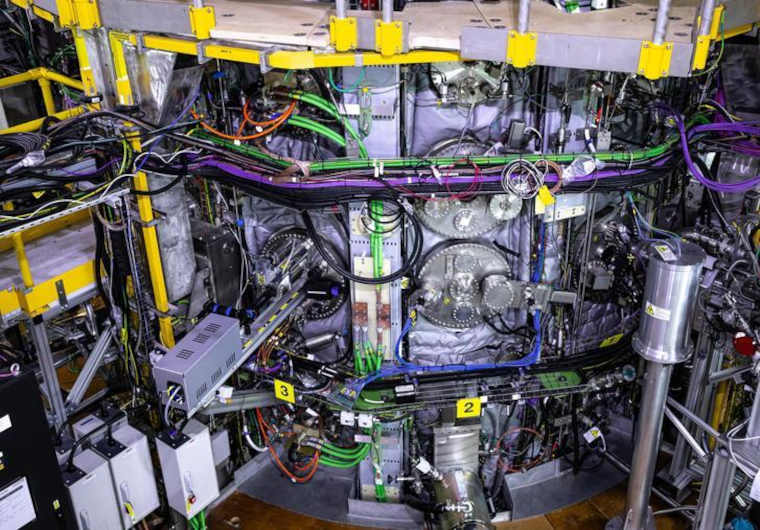
The UK Atomic Energy Agency (UKAEA) has launched a major new phase in fusion research as its flagship MegaAmp Spherical Tokamak (MAST Upgrade) enters its fifth scientific campaign.
This six-month program marks a significant step towards the delivery of the UK’s first fusion power plant prototype and strengthens the UK’s position at the forefront of global fusion innovation.
The campaign, involving more than 200 scientists from more than 40 international organizations, will deliver around 950 carefully controlled plasma pulses.
Each pulse represents a short period of time during which the superheated plasma is confined within the machine, providing valuable data about how fusion plasma behaves under extreme conditions.
James Harrison, Director of MAST Upgrade Science, explains:
“We are seeing great interest globally in our MAST upgrade experiments, demonstrating great collaboration in fusion research. In the coming months, we hope to further push the boundaries of what is possible with spherical tokamak science.”
Why is fusion energy so important?
Fusion energy is the process produced when lighter atomic nuclei combine to form heavier atomic nuclei, releasing vast amounts of energy and powering the sun.
Unlike fossil fuels, fusion emits no carbon during operation, produces minimal long-lived radioactive waste, and relies on abundant fuel sources such as hydrogen isotopes.
If successfully used on a large scale, fusion could provide an almost unlimited supply of clean, reliable energy, complementing renewable energy and supporting global net-zero goals.
Programs like MAST Upgrade are essential because they transform theoretical promise into engineering reality and address the scientific and technological challenges that stand between today’s experiments and tomorrow’s power plants.
What the MAST Upgrade Campaign Accomplishes
The latest MAST upgrade campaign is designed to push the boundaries of spherical tokamak performance while directly informing the design of future power plants, particularly the UK’s STEP Fusion programme.
Spherical tokamaks are a more compact variant of traditional fusion machines and have the potential to enable smaller and more economical fusion reactors.
This campaign builds on previous breakthroughs by expanding the scope of experimentation and testing new ideas on a scale never before possible.
The large number of planned pulses allows researchers to explore a wide range of plasma conditions, accelerating learning and improving the reliability of predictive models.
Key research priorities driving MAST upgrades
The fifth campaign focuses on four priority areas essential to transforming fusion from a scientific challenge to a practical energy source.
First, scientists will study high-pressure fusion plasma to refine predictions of future reactor performance. By testing theoretical models against real experimental data, researchers can reduce uncertainty about how plasmas behave in power plant-related conditions.
Second, this campaign explores improvements in plasma stability and control of energy flow. For the first time, instability control technology is combined with advanced exhaust technology, such as the Super-X diverter, to achieve more efficient and stable plasma operation.
Third, the researchers will work on optimizing the divertor design. The divertor handles excess heat and particles escaping from the plasma, and by improving its shape and magnetic configuration, it has the potential to reduce component size and cost, making fusion plants more commercially viable.
Finally, advanced computer modeling tools are tested against the experimental results. These tools aim to predict plasma behavior related to heating, stability, and evacuation, supporting the design and operation of future machines such as STEP and ITER.
Based on the world’s first results
This new phase of research follows a highly successful fourth campaign in which the MAST Upgrade achieved several world-first milestones.
Scientists demonstrated suppression of plasma instability within a spherical tokamak, reaching a record 3.8 megawatts of injection heating power and achieving independent control of plasma exhaust in both the upper and lower diverters.
The strong international response to these results is reflected in more than 100 research proposals, highlighting the global importance of the MAST upgrade facility.
Significant upgrades strengthen the program
Significant enhancements planned over the next few years will further expand the capabilities of MAST Upgrade.
In 2026, an electronic Bernstein wave heating system will be installed using the same technology planned for STEP Fusion. This will allow researchers to pre-test STEP-related plasma heating techniques.
An additional neutral beam injector will be added in 2026-2027, doubling the machine’s heating output. Importantly, the MAST upgrade will be the first spherical tokamak to operate both electron Bernstein waves and neutral beam heating simultaneously, unlocking new experimental possibilities.
An important step towards fusion power generation
As the MAST upgrade campaign progresses, the insights gained will directly shape future reactor designs at STEP Fusion and around the world.
Through a combination of international collaboration, cutting-edge upgrades, and ambitious experiments, the MAST upgrade will continue to play a central role in transforming fusion energy from a long-held ambition to a practical solution for clean power generation.
Source link

