
Northumbria University secures £4 million to decipher Earth’s radiation belts
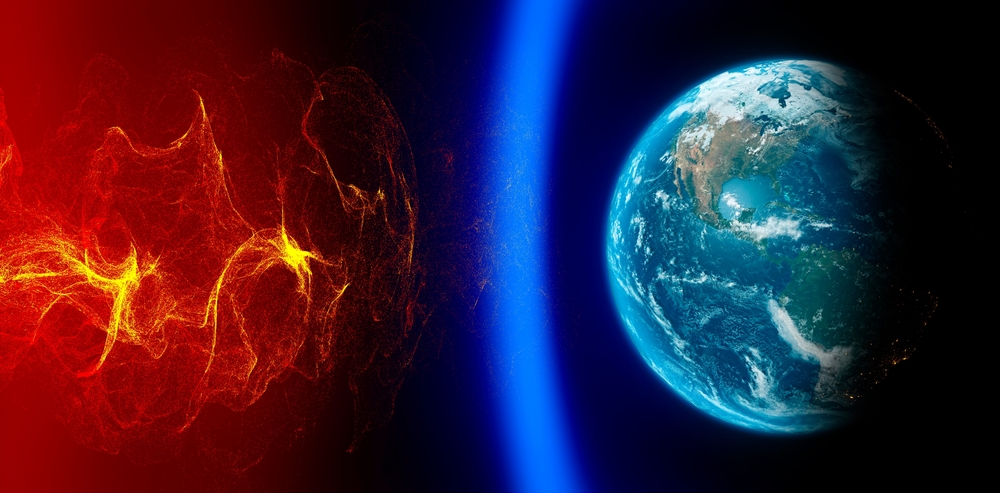
Researchers at Northumbria University have been awarded £4 million to investigate one of space science’s most enduring mysteries: why Earth’s radiation belts behave so erratically.
The five-year project aims to improve space weather predictions and strengthen the protection of the satellites that support modern life.
Project leader Claire Watt, professor of astrophysics, explained the significance:
“This project will help us understand whether it’s because we don’t fully understand the physics involved, or whether it’s because parts of the system are inherently chaotic and sensitive to small changes in state.”
Understanding the radiation belts
Radiation belts are zones surrounding the Earth where charged particles are trapped by the planet’s magnetic field. Within these regions, particles can accelerate to speeds close to the speed of light, creating a harsh environment for spacecraft.
For satellite system operators, the stakes are high. Fluctuations in the radiation belts can damage electronic equipment, degrade solar panels, and disrupt services such as GPS navigation, communications, and weather monitoring.
However, despite decades of research, predicting how these belts will evolve remains a major scientific challenge.
unstable and poorly understood systems
One of the characteristics of radiation belts is their variability. Their strength and size can change dramatically over hours or days, often in response to solar activity, such as bursts of charged particles from the sun.
What remains unclear is how these changes will unfold. Scientists still don’t have a reliable model to determine whether the belt strengthens or weakens, expands or contracts after a solar disturbance.
This unpredictability limits the ability to predict risks to satellite infrastructure.
A major UK-led research effort
Claire Watt’s team will combine data from international spacecraft missions with advanced computational models to better understand how energy flows through Earth’s magnetosphere and into the radiation belts.
This research is supported by the Science and Technology Facilities Council (STFC) as part of the Major Awards Programme, which supports ambitious and high-impact scientific research.
Collaborators include Professor Jonny Rae and Dr Sarah Bentley from Northumbria, Dr Oliver Alanson from the University of Birmingham and Dr Ravindra Desai from the University of Warwick.
Two key questions driving research
At the heart of the project are two fundamental questions. First, what determines the amount of energy that reaches Earth’s radiation belts from the solar wind? Second, can small changes in conditions cause large-scale changes in the system?
Answering these questions could reveal whether current limitations arise from gaps in scientific understanding or from the inherently chaotic nature of the system itself. Both results will have a significant impact on how scientists model space weather.
From theory to practical predictions
The central goal of this project is to translate scientific insights into actionable predictive tools. By improving models of radiation belts, the research team hopes to improve predictions of space weather phenomena and their potential impact on satellites.
The researchers plan to develop recommendations for integrating real-time data into forecasting systems and generating probabilistic forecasts using ensemble modeling techniques.
This approach provides satellite operators with a clearer risk assessment, rather than relying on single-point predictions.
UK’s extensive space weather commitment
Northumbria University already plays a leading role in space weather research.
The company’s Solar Astrophysics Group contributes to the UK’s national SWIMMR programme. The program is a £20m initiative aimed at strengthening the country’s space weather monitoring and forecasting capabilities.
The program will support the Met Office to develop operational capacity in this area.
A unique natural laboratory
Earth’s radiation belts offer scientists a unique opportunity. These locations are the only places where high-energy astrophysical processes of this type can be studied directly.
Insights gained here could extend beyond Earth and inform our understanding of similar phenomena across the universe.
A Northumbria-led project aims to fill a critical knowledge gap by tackling the unpredictability of the radiation belts.
If successful, it could revolutionize the way we predict space weather and protect the critical satellite systems on which modern society depends.
Source link

