
Close Menu
  • Home
  • Identity
  • Inventions
  • Future
  • Science
  • Startups
  • Spanish
What's Hot

Google Gemini Prompt Injection Flaw Exposes Private Calendar Data via Malicious Invites

Rogue agents and shadow AI: Why VCs are betting big on AI security

Now, the Metaverse begins!

Facebook X (Twitter) Instagram
  • Home
  • About Us
  • Advertise with Us
  • Contact Us
  • DMCA
  • Privacy Policy
  • Terms & Conditions
  • User-Submitted Posts
Facebook X (Twitter) Instagram
Fyself News
  • Home
  • Identity
  • Inventions
  • Future
  • Science
  • Startups
  • Spanish
Fyself News
Home » Rings around M dwarf provide new clues about planetary habitability
Inventions

Rings around M dwarf provide new clues about planetary habitability
userBy userJanuary 8, 2026No Comments3 Mins Read
Share Facebook Twitter Pinterest Telegram LinkedIn Tumblr Email Copy Link
Follow Us
Google News Flipboard
Share
Facebook Twitter LinkedIn Pinterest Email Copy Link

A study at the Carnegie Institution for Science considers the use of naturally occurring space weather observatories orbiting the early orbits of at least 10% of M dwarfs.

We know that most M dwarf stars (smaller, cooler, and fainter than the Sun) host at least one rocky Earth-sized planet. Most of them are inhospitable, too hot to contain liquid water or atmosphere, or frequently hit by stellar flares and strong radiation.

But stars can still provide interesting laboratories for understanding how they shape the environments in which their planets reside.

Luke Buuma, who led the study, explained, “Stars influence planets through light, both through optical observations, which we are good at, and through space weather, such as solar wind and magnetic storms, which is more difficult to study at long distances.”

Tracking the complex movements of M dwarf stars

Bouma, in collaboration with Moira Jardine from the University of St Andrews, focused on a strange type of M dwarf called a complex periodic.

These are young stars, rapidly rotating, and observations have shown that their brightness repeatedly decreases. Astronomers weren’t sure whether these dips in brightness were caused by star spots or by material orbiting the star.

“For a long time, no one knew what to make of this strange little change in darkness,” Buuma said. “But we were able to demonstrate that they can tell us something about the environment just above the star’s surface.”

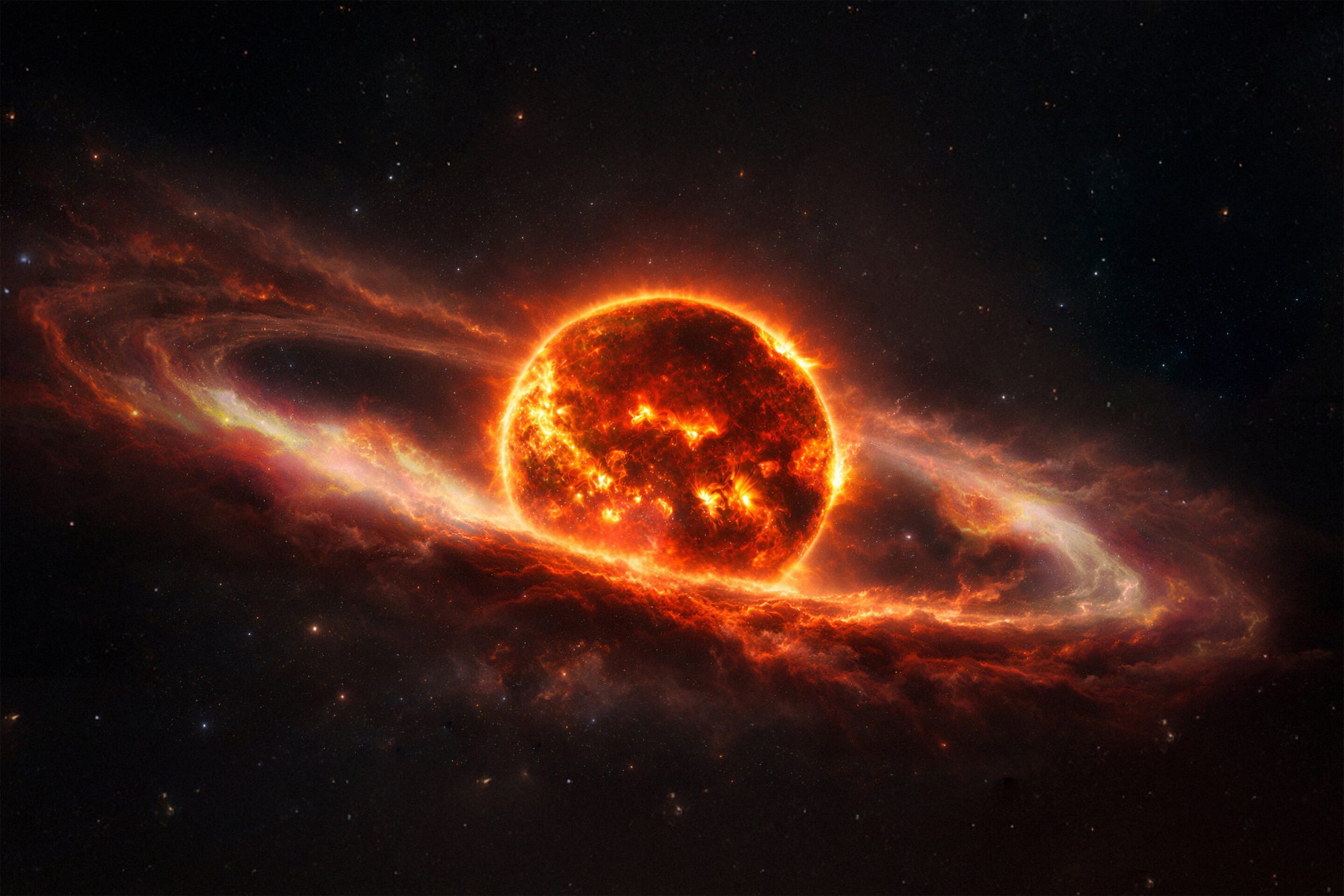
Bouma and Jardine answered that question by creating a “spectroscopic movie” of one of these complex periodic variable stars. They demonstrated that they are large clumps of cold plasma trapped in the star’s magnetosphere, forming a donut-shaped torus.

How DIP becomes a space weather observatory

Bouma explained: “Once you understand this, the dimming phenomenon ceases to be a strange little mystery and becomes a space weather observatory.

“The plasma torus gives us a way to see what’s concentrated in the material near an M dwarf, how it’s moving, and how strongly it’s influenced by the star’s magnetic field.”

Bouma and Jardine estimate that at least 10% of type M dwarfs may have such plasma features early in life. Therefore, these space weather observatories could help astronomers learn a lot about how particles from stars contribute to planetary conditions.

Next steps in torus research

Next, Buma hopes to find out where the material in the torus comes from: the star itself, or an external source.

Bouma concluded as follows: “This is a great example of a serendipitous discovery, something we never expected to find, but one that gives us a new window into understanding the relationships between planets and stars.

“We don’t yet know whether planets orbiting M dwarfs can support life, but we are confident that space weather will be an important part of answering that question.”


Source link

#CreativeSolutions #DigitalTransformation. #DisruptiveTechnology #Innovation #Patents #SocialInnovation
Follow on Google News Follow on Flipboard
Share. Facebook Twitter Pinterest LinkedIn Tumblr Email Copy Link
Previous ArticleResearchers discover NodeCordRAT hidden in npm Bitcoin-themed packages
Next Article Cisco patches ISE security vulnerability after releasing public PoC exploit
user
  • Website

Related Posts

Astroscale wins £350,000 contract to transform in-orbit services

January 19, 2026

The High Seas Treaty heralds a new era in maritime governance

January 19, 2026

Promoting Jess’s life-saving rules at all GP surgeries

January 19, 2026
Add A Comment
Leave A Reply Cancel Reply

Latest Posts

Google Gemini Prompt Injection Flaw Exposes Private Calendar Data via Malicious Invites

Rogue agents and shadow AI: Why VCs are betting big on AI security

Now, the Metaverse begins!

BioticsAI, winner of Disrupt’s Battlefield competition in 2023, receives FDA approval for its AI-powered fetal ultrasound product

Trending Posts

Subscribe to News

Subscribe to our newsletter and never miss our latest news

Please enable JavaScript in your browser to complete this form.
Loading

Welcome to Fyself News, your go-to platform for the latest in tech, startups, inventions, sustainability, and fintech! We are a passionate team of enthusiasts committed to bringing you timely, insightful, and accurate information on the most pressing developments across these industries. Whether you’re an entrepreneur, investor, or just someone curious about the future of technology and innovation, Fyself News has something for you.

Castilla-La Mancha Ignites Innovation: fiveclmsummit Redefines Tech Future

Local Power, Health Innovation: Alcolea de Calatrava Boosts FiveCLM PoC with Community Engagement

The Future of Digital Twins in Healthcare: From Virtual Replicas to Personalized Medical Models

Human Digital Twins: The Next Tech Frontier Set to Transform Healthcare and Beyond

Facebook X (Twitter) Instagram Pinterest YouTube
  • Home
  • About Us
  • Advertise with Us
  • Contact Us
  • DMCA
  • Privacy Policy
  • Terms & Conditions
  • User-Submitted Posts
© 2026 news.fyself. Designed by by fyself.

Type above and press Enter to search. Press Esc to cancel.